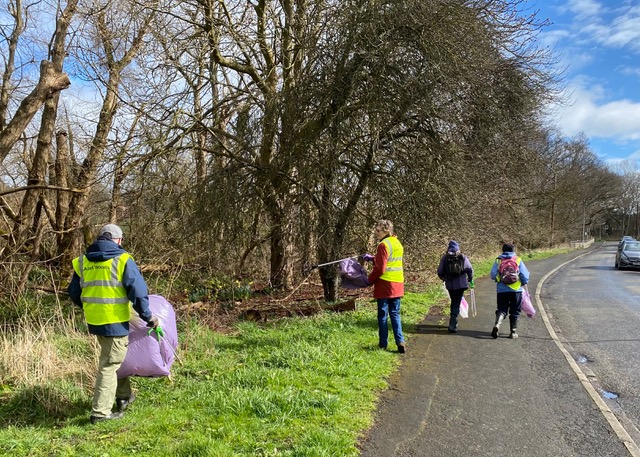
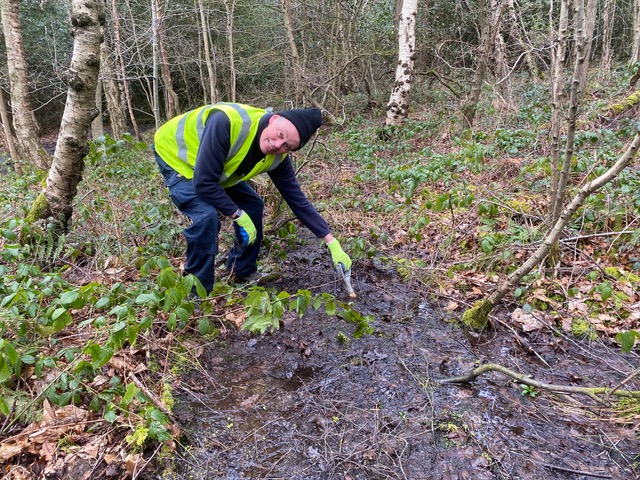
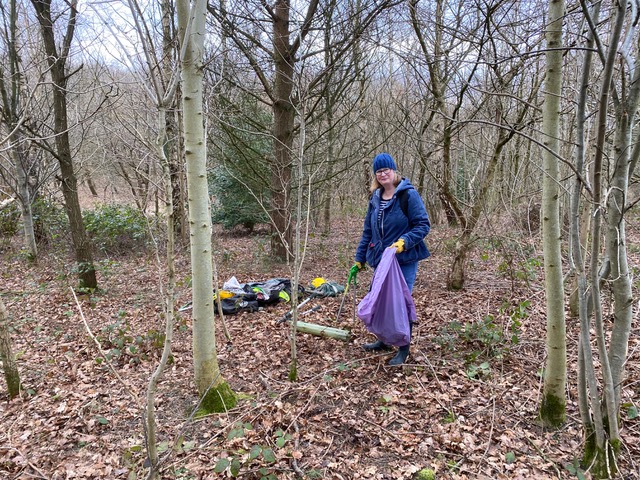
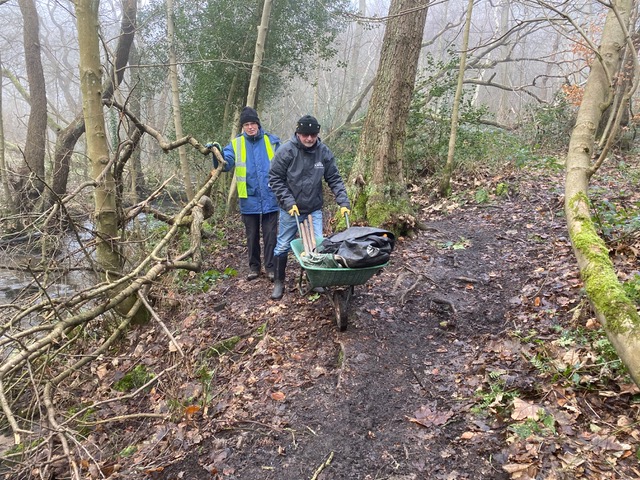
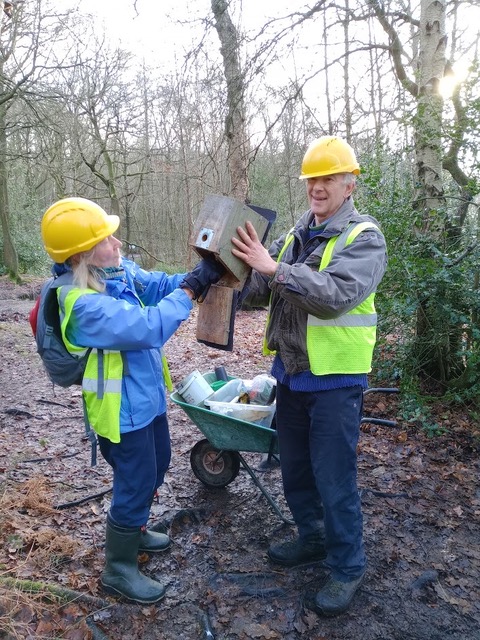
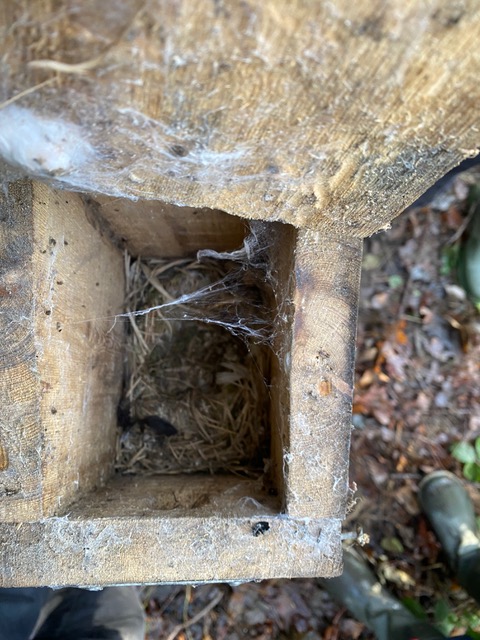
A beautiful weekend and six of us met this morning to pick up litter and clear paths.
We met in the Stairfoot Lane carpark at 10 am, and two of us chose to pick up litter and the rest of us to clear paths.
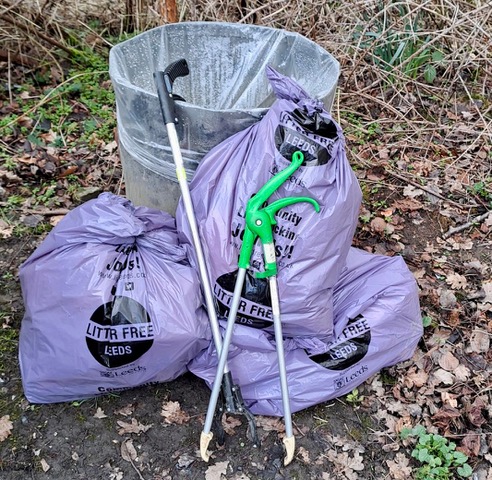
The litter pickers picked up litter on the main paths, the Village Green, around Adel (or, if you prefer Alwoodley) Crag – where there were a lot of small pieces of glass – and around the picnic tables. They also pulled up some bracken and Himalayan balsam. They found that there was much less litter than normal, and judging by the purple bags left by the bin on the Village Green, this was probably because another group had recently been out litterpicking.
Star of Bethlehem: Adel Woods – 21 May 2023
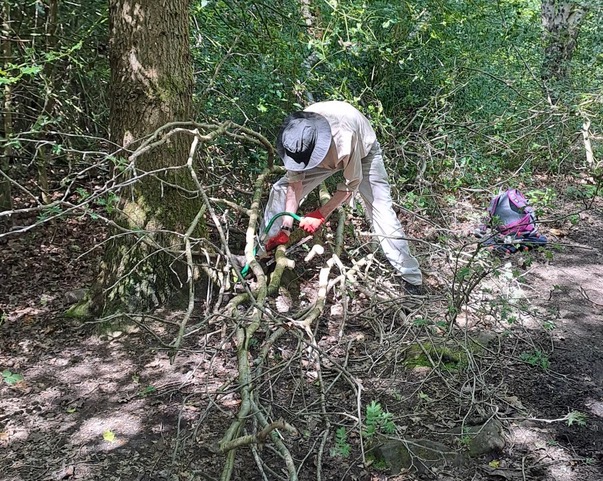
We path clearers made our way to the picnic area and cleared vegetation back from the left hand path which leads down from the picnic area to the Meanwood Valley Trail.
This field used to be regularly cut as a hay field, but since the practice stopped in the 1980’s, the brambles, nettles and bracken have dominated the grasses and regularly engulf the footpath.
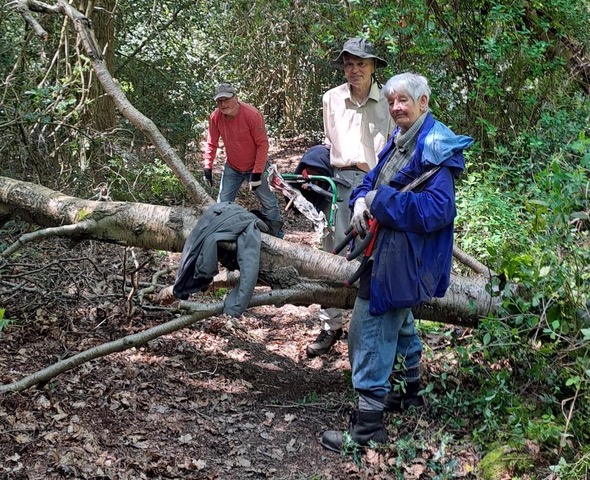
Having widened that path, we made our way back to the picnic area and set off down the path indicated by the fingerpost next to the picnic bench. Our objective was to widen the path, but part way down we found a tree had fallen across the path, obstructing the way. Unfortunately, the tree was too big for us to clear away but we cleared around it so that people could use the path.
After that three of us continued down the path and did further path clearing work.
Another enjoyable and successful morning in Adel Woods!
A gloriously misty morning for our annual birdsong walk with Steve Joul. Today, we saw or heard 19 species of bird – a full list is given at the end of this post.
We met at 6.55 am in Old Leo’s car park, and had a couple of good sightings straight away – a male greater spotted woodpecker and a blackcap. The blackcap was warbling merrily in a nearby tree and we had good views.
From the car park we made our way down to the cricket club. On the way we heard plenty of robins and wrens singing and were lucky enough to see a pair of woodpeckers entering and leaving a hole in a tree where they were clearly nesting. This was a first for our annual birdsong walks.
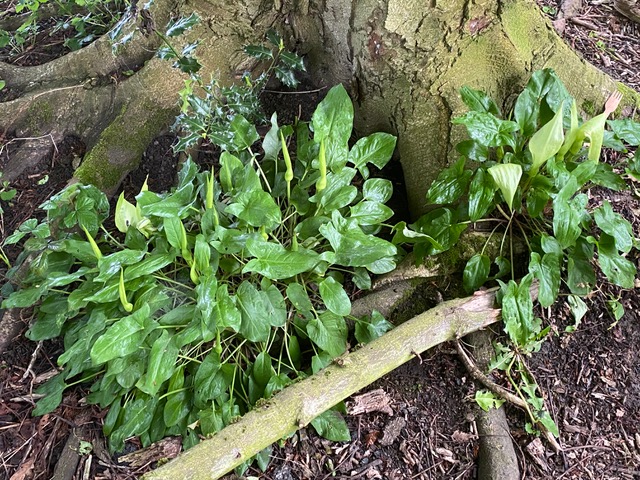
We also paused to look at various points of interest including Lords and Ladies in flower, wild garlic and the cobwebs on trees made very visible and beautiful by the mist.
Lords and Ladies or “cuckoo pint” in floweradjacent to the track down to the cricket club
We crossed the stream behind the cricket club and were excited to have clear views of a pair of jays on a nest at the top of a tree by the kissing gate. Another first for our birdsong walks.
We made our way down the path towards the Slabbering Baby on the right we had clear views of a wood pigeon sitting on its nest. Yet another first!
We then made our way up to Adel Moor. By now the day was beginning to warm up and the mist to burn off.
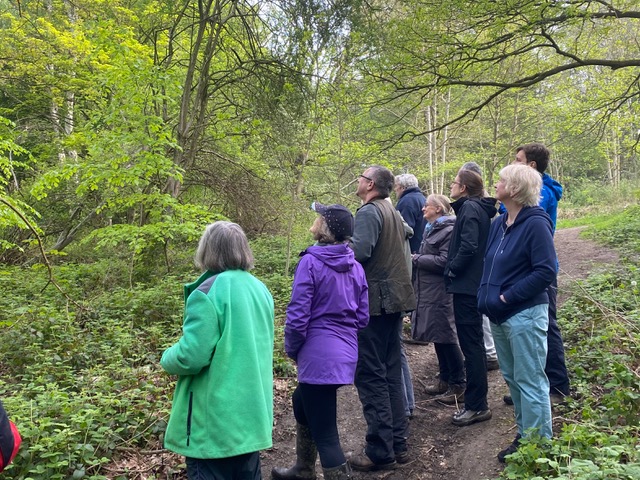
Steve Joul talks about some of the bird species seen on Adel Moor
The moor looked magnificent in the mist. The heather and bilberries were bedecked with spiders’ webs which were transformed into strings of pearls by the morning dew.
A spider’s web on Adel Moor, glistening with morning dew
From the moor we made our way to Copper’s Field (so named because a horse called Copper used to be kept on it).
Apple blossom on Copper’s field, Adel WoodsBird watching in Adel Woods. Where is that bird?
From Copper’s Field we made our way past the Buck Stone (after which the Buckstone estate is named) and then walked down to the Seven Arches.
A view upstream from the Seven Arches, Adel Woods, Leeds
On a previous birdsong walk we have seen a dipper in the vicinity of the Seven Arches. Steve has also seen a kingfisher here, but no such luck today.
From the Seven Arches we walked up the Meanwood Valley Trail towards the Slabbering Baby. On the way we saw a pair of blue tits or great tits entering and leaving one of our nest boxes.
From the Slabbering Baby we made a quick detour to have a look at Adel Pond, and then made our way back up to Old Leo’s.
Inspecting Adel Pond
As we approached Old Leo’s car park we saw a pair of treecreepers making their way into a hole in the rotten trunk of a silver birch where they were clearly nesting. Another first for our birdsong walks! This was also the fourth set of nesting birds we saw this morning (the others being the jays, the woodpigeon, and the blue or great tits).
All in all it was a great morning’s birdwatching.
List of all the species of bird we saw or heard this morning
Today we did a litterpick and cleared paths from 10 am to 12 noon. However, no-one took photos so cannot say a lot more. I have used an archive photo from 16th April 2022.
This morning, Steve Joul, a member of the committee of Friends of Adel Woods, and former senior ranger with Leeds Parks and Countryside, went for a walk around Adel Woods between 7 and 10 am. As you will see, there is a lot of “nature” to enjoy in Adel Woods. Highlights for Steve this morning were seeing a pair of tree creepers; a pair of mandarin ducks; a close view of a female great spotted woodpecker; and a peacock butterfly basking in the sun.
Below there is a list of some of the other flora and fauna he saw. NB I have included archive photographs showing activities of Friends of Adel Woods and other flora and fauna which can be found in Adel Woods, but which Steve did not see this morning.
Adel Woods truly are something to treasure! If you would like to join in the activities of Friends of Adel Woods, please get in touch through this website.
Birds: 23 species
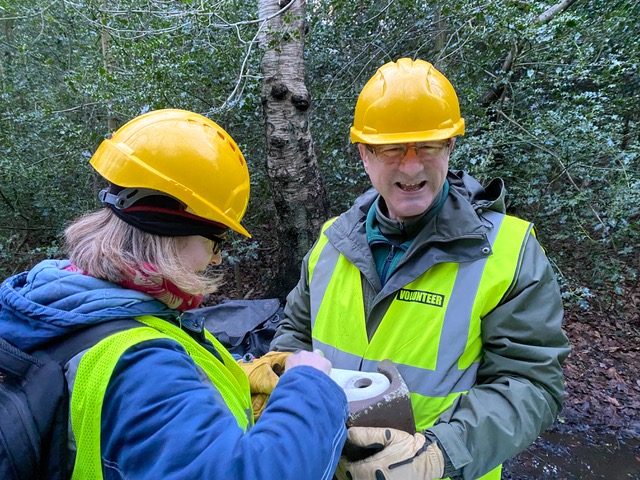
Surveying nest boxes in Adel Woods on 13th January 2023
Blackbird – over 20 seen
Blackcap – 3 males singing
Blue Tit – over 20 seen
Carrion Crow – 5 seen
Chiffchaff – over 10 males singing
Coal Tit – 3 males heard singing
Dunnock – 1 male singing
Goldcrest – 1 male singing
Great Spotted Woodpecker – female good views, another drumming
Great Tit – over 10 males seen
Jackdaw – 5 birds flying over woodland together
Jay – pair seen
Magpie – 5 birds seen
Mallard – a pair near the stream and a drake on the pond
Mandarin – a pair on the stream
Mistle Thrush – alarm heard
Nuthatch – over 10 birds calling or singing
Red Kite – single over woodland
Robin – over 20 seen
Song Thrush – 2 singing males seen, another heard
Treecreeper – pair near to Treecreeper nestbox but didn’t go in
Woodpigeon – over 20 seen
Wren – over 10 seen
Plants in flower
Bluebells in Adel Woods on 1st May 2023
American Skunk-cabbage – two patches on stream bank
Blackthorn
Dandelion
Flowering Currant
Garden Daffodil
Garden Yellow Archangel
Green Alkanet
Hybrid Bluebell – an early example
Lesser Celandine
Marsh Marigold
Meadow Foxtail – an early-flowering grass
Opposite-leaved Golden-saxifrage – stream banks
Ramsons – an early example
Red Currant
Wild Cherry
Wood Anemone
Wood Forget-me-not
Insects
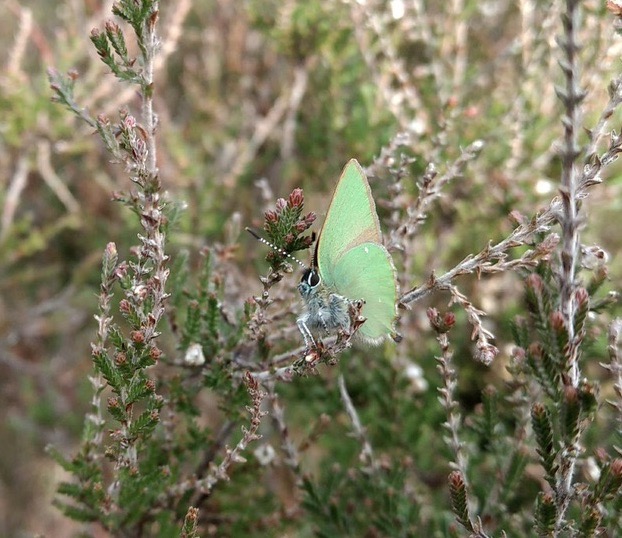
Green Hairstreak butterfly photographed on Adel Moor on 17th April 2022 (photo taken by Joseph Worrilow)
Buff-tailed Bumblebee
Common Carder Bee
Peacock Butterfly
Seven-spot Ladybird
Fungi
Alder Bracket
Birch Polypore
Blushing Bracket
Glistening Inkcap
Hoof Fungus
Willow Bracket
Witches Broom
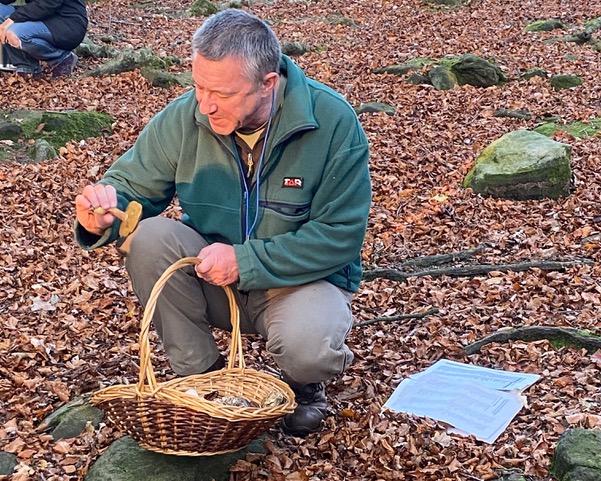
Steve Joul leading a fungal foray attended by about fifty people on 12th November 2022
Mammals
Grey squirrel – over 20 seen.
Friends of Adel Woods working on Adel Moor: 15th May 2022
A fine Spring morning and six Friends of Adel Woods met on Buckstone Road at 10 am to pick up litter and clear the ditches which feed water to Adel Pond (also known as Mill Fall Pond). Two more Friends joined us at the pond a little later.
As you can see, it was a fine Spring morning at 10.15 am as four of us set off up Buckstone Road to pick up litter on the path through the copse to Tescos, on the recreation ground, and along Crag Lane.
Our fantastic litter pickers
Two of us set off down to Adel Pond laden with spades, saws, loppers and mattocks. The pond was looking beautiful in the sunlight – but no frogspawn yet.
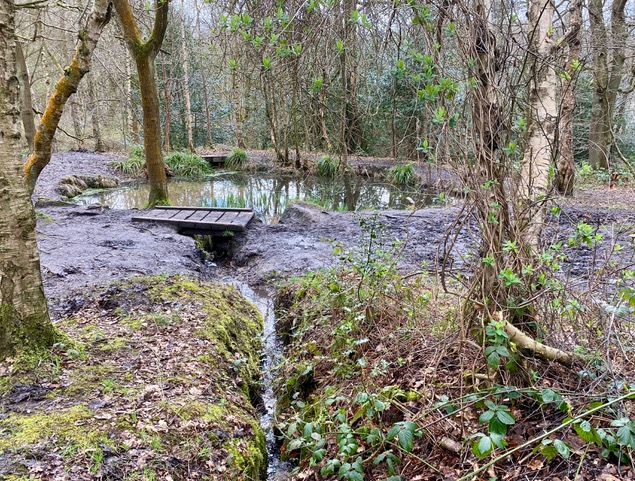
Having appraised the work we needed to do, we started off with a ditch about 10 metres to the north of the pond. As you can see in the photos below, a section of this ditch was completely filled in. Interestingly though, as soon as we started digging, we found that water was flowing swiftly under the surface. By the time we had finished, water was pouring very swiftly through the ditch.
We then started on the main ditch feeding the pond. This was relatively clear, but still full of mud, sticks and leaves. Fortunately, as we started on this ditch two more Friends joined us and together we were able to make a good job of clearing the stretch nearest the pond.
As we were working, one of our Friends, Sylvia, spotted a newt among the leaves we had just pulled out of the ditch. Geoff was despatched to relocate it to the pond. This was a task Geoff had to repeat another five times as we found more newts among the leaves!
A newt in Adel Woods
Towards the end of the morning one of our party decided to work on a stretch of ditch further away from the pond – and was surprised to find that his spade kept going down through the mud until only the handle could be seen. Fortunately, he had not stepped into that particular patch of mud!
A very deep boggy area in one of the ditches leading to Adel Pond
Towards 12 noon, Diana, another Friend of Adel Woods came to see usfor a chat and to offer encouragement.
Adel Pond on 25th March 2023
Yet another lovely morning of friendship, learning and achievement.
The original intention this morning was toclear the ditches feeding Adel Pond, and litterpick around the cricket club, and Crag Lane. However, yours truly and his better half have had covid this week, so plans had to be modified.
Judith, our ever resourceful treasurer, stepped into the breach and led a successful litterpicking team of five litter pickers, focusing on Stairfoot Lane carpark, Adel Crag and the area around the picnic tables.
They found plenty to keep them busy – mainly doggy doo doo bags and glass bottles.
So thank you to all who picked up litter today!
Since David Preston and his team of Meanwood Valley Volunteer Rangers cleared a lot of the scrub around Adel Crag, it is looking a lot better.
The entrance to the Hospices Woodland on Stairfoot Lane
Spring was definitely in the air this morning. On getting up, your correspondent drew the curtains to a glorious blue sky and sunrise. The temperature outside was 4 degrees centigrade, but by 10 am it was a lovely mild morning, perfect for working in Adel Woods!
The projects this morning were litterpicking and tidying up the Hospices Woodland, the latter being something we have been doing since March 2010.
We met in the Stairfoot Lane carpark and had a wonderful turn out of ten Friends (including two who joined us later in the Hospices Woodland).
Clearing brambles in the Hospices Woodland in Adel Woods; 19th February 2023
Three of us litterpicked while the rest of us spent the morning clearing brambles from the trees and paths in the Hospices Woodland.
The Hospices Woodland is on the South side of Stairfoot Lane, to the North East of the Stairfoot Lane carpark. It is called the Hospices Woodland because in about 2000 St Gemma’s and Wheatfields hospices had heard about a tree sponsorship scheme and were keen to contribute to tree planting in Leeds, and raise funds for their work. They approached the Parks and Countryside department of Leeds City Council and it was agreed that Parks and Countryside would provide the land adjacent to Stairfoot Lane and manage the trees, while the hospices would administer the scheme. People could sponsor a tree for £25 of which £15 went to the hospices, and £10 to Parks to pay for purchasing the tree and ensuring its establishment.
It was very successful in the first year and a hectare of new native woodland was planted. Sponsorship money continued to come in and so a second phase was planted in the following years. Money continued to come in so a further woodland was planted at Temple Newsam alongside one of the main roads into the estate.
A large stone monolith was installed at both sites sponsored by a local quarry.
Friends of Adel Woods: picking up litter in the Hospices Woodland: 19th February 2023
On our way back to the Stairfoot Lane carpark, we cleared from the path a substantial tree which had fallen across it.
Another successful and enjoyable morning.
Friends of Adel Woods are always keen to attract new volunteers, so if you would like to help maintain Adel Woods, make new friends, and get some fresh air and exercise, please get in touch!
A beautiful morning, but – By Gum – it was cold first thing! It took your correspondent 20 minutes to scrape the ice off the car windows – including inside! Nevertheless, eleven Friends turned out for this morning’s work party. Five of us litterpicking. and the rest of us path clearing. And it was a lovely day for working in the woods.
The litter pickers picked up about six bags of rubbish on Buckstone Road, the Village Green, Crag Lane, the Hospice Woodland and on the track down to the cricket pavilion.
For the path clearers the objective this morning was to improve the path running alongside Adel Beck. Historically, there has been a path by the beck on the Alwoodley side all the way from Stairfoot Lane bridge down to the Spring Hill bridge, just downhill from the Slabbering Baby. However, in recent years the path has become overgrown and muddy and its route unclear at the halfway point, in the region of Adel Bog. Our focus today was to work on the path from Spring Hill bridge up to the midway point.
Getting under way: the path by Adel Beck – Spring Hill bridge can just be seen to the right
Near Spring Hill bridge, the path had been eroded away by the beck, making it a bit hazardous, as can be seen in the photograph above. One of our first jobs was therefore to move the route of the path further away from the stream and remove brambles and a large sapling which was growing across the path.
Looking towards Spring Hill Bridge
The main things to tackle today were brambles and holly which were making the path very narrow – even before the growing season starts again.
Making our way home
In the space of two hours we were able to accomplish our aims, though there is still a lot to do – principally to improve the muddy sections of the path and to improve way marking.
BeforeAfterViews of Spring Hill Bridge before and after clearing brambles and saplings
The two photographs show the difference made in the vicinity of Spring Hill bridge. The tree on the left can just be seen in the “before” photograph though it is obscured by the brambles which we removed. You can also see to the right of the tree the stump of the large sapling which we removed because it was growing across the path.
Adel Beck path looking upstream from the vicinity of Spring Hill bridge – after clearing and widening the path
Another satisfying and successful morning for the Friends of Adel Woods!
Today was the second (and concluding) part of the Friends of Adel Woods annual nest box survey and Spring clean. Yesterday (in part 1) we started by surveying the nest boxes to the north of Crag Lane and spent the afternoon surveying the nest boxes on the Meanwood Valley Trail from the picnic area down to just short of Adel Pond.
This was another day which defied the weather forecast and turned out to be a lovely harbinger of the nesting season.
We met at 10 am in Old Leo’s car park. Five Friends turned out, including two who were taking part in the nest box survey and Spring clean for the first time!
Today, our first task was to put up “Tina’s nest box”, so named because Tina gave it to us! Situated on Crag Lane, near Old Leo’s car park, it is without doubt our best nest box, being made of woodcrete, a mixture of concrete and straw. It is spacious, dry, and designed to let the inhabitants nest well back from the entrance hole, away from the reach of predators. We cleaned it out yesterday, but found it too heavy to put back. Today with the use of a “stand off” to the ladder, we were able to put it back up.
From the car park, we made our way down to the pond with our wheelbarrow, ladders and equipment and started with box 42, just to the north of the pond. This contained a blue tit nest (we know because the entrance hole is 25 mm, so too small for birds like great tits) and the presence of droppings indicated that it had been used for roosting.
Cleaning out nest box 42
Incidentally, the reason we clean out the nest boxes each year, is that the species which use our nest boxes – like blue tit, great tit, sparrow and nuthatch – do not re-use nests from previous years. This was made clear by the lockdown in January 2021 which prevented us from cleaning our nest boxes that year. When we surveyed the boxes in January 2022, most nest boxes contained two nests, one on top of the other. It is also clear why the birds evolved to make new nests each year: when we clean out the boxes, the old nests are often full of lice and mites, droppings from roosting birds, and damp, rotted moss – not a great environment for young birds.
Nest box 38 – a sparrow nest?
Our next nest box was number 38, just by the bridge below the pond. This was unusual in that it seemed to contain a sparrow nest – which is made of straw – rather than a tit nest which is made of moss and fine grass. On several occasions, nuthatches have nested in this location, but not this year.
We then surveyed and cleaned out the nest boxes on the Meanwood Valley Trail from the Slabbering Baby down to Seven Arches, finishing at about 1.45 pm.
In all, we cleaned and surveyed seventeen nest boxes today. This is the overall summary:
twelve boxes contained tit nests;
one box contained an incomplete tit nest;
one appeared to contain a sparrow nest, but strangely it had a small amount of moss (which is typical of a tit nest) on the top;
two small nest boxes which we put up last year were not used, but one contained a small amount of moss;
one of the boxes containing a tit nest had clearly been used initially by nuthatches, but it looks as though they were driven out;
another box showed extensive work by nuthatches, but there was no nest.
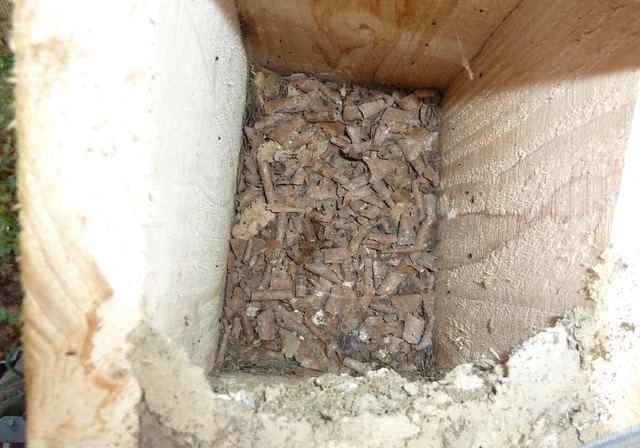
I mentioned above that there was some evidence of nuthatches in the nest boxes but no nuthatch nests. In some years we have found one or two nuthatch nests. They are very distinctive for two reasons. Firstly, nuthatches seal all possible gaps in the nest box with copious amounts of mud, both on the inside and outside – and sometimes make the entrance hole smaller. Secondly, the nest is not made with moss and grass but with bark chips, so the nest box looks rather as if someone has tipped some bran flakes into it.
Courtesy of RSPB websiteA nuthatch and a nuthatch nest: note the mud around the top of the box
Nuthatches are very sleek looking birds which are the only UK bird that can climb headfirst down a tree trunk!
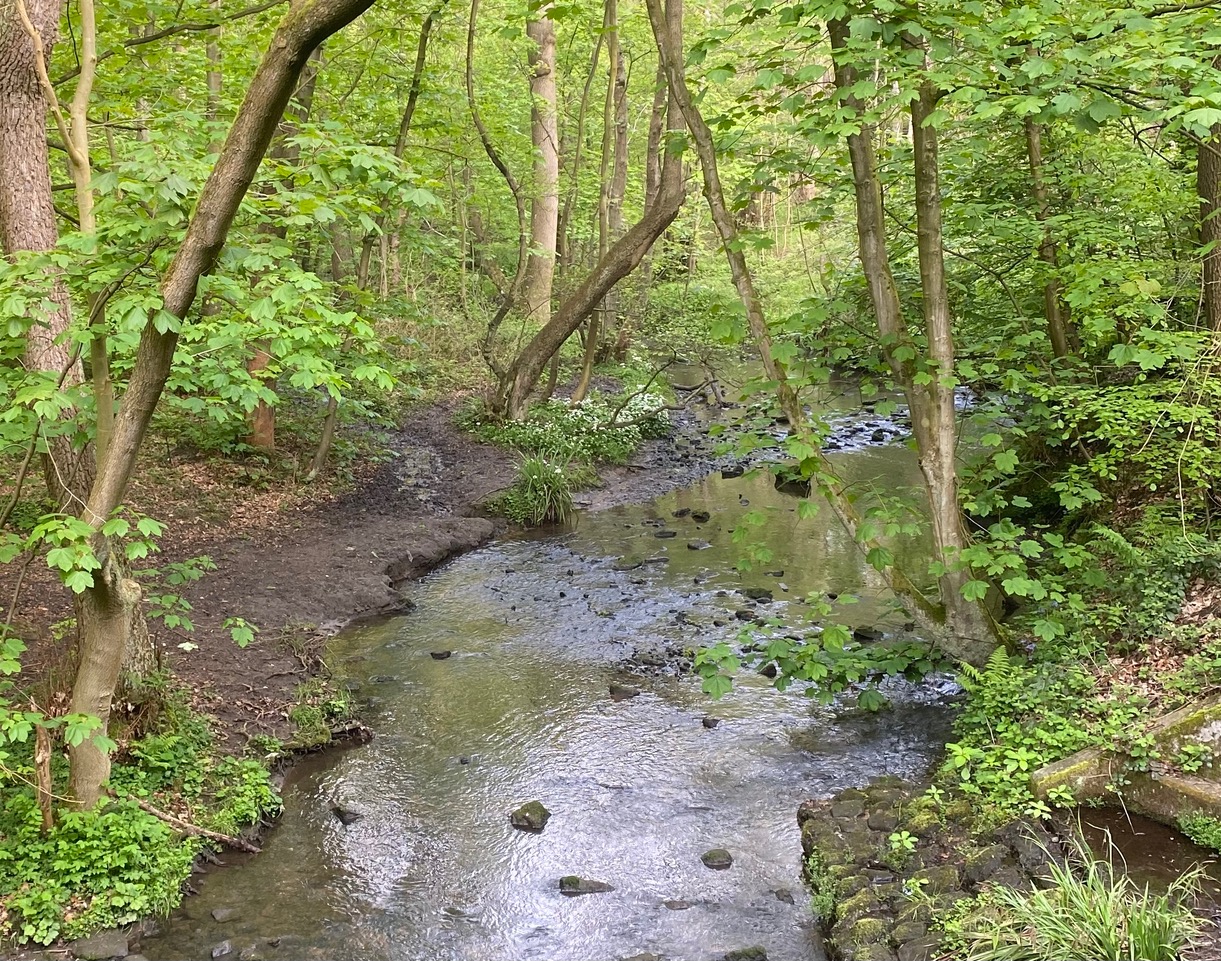
A view of Meanwood Beck through the trees in Adel Woods: 15th January 2023
Time again to get the ladders out, get out in the woods, and clean and survey the Friends of Adel Woods nest boxes! We have put up forty three since 2010 and surveying them is always an interesting and sociable activity.
Despite a dire weather forecast for today, the weather started off quite reasonably and got better and sunnier throughout the morning. Eight of us turned out for this morning’s start on the job, and five of us returned for the afternoon shift.
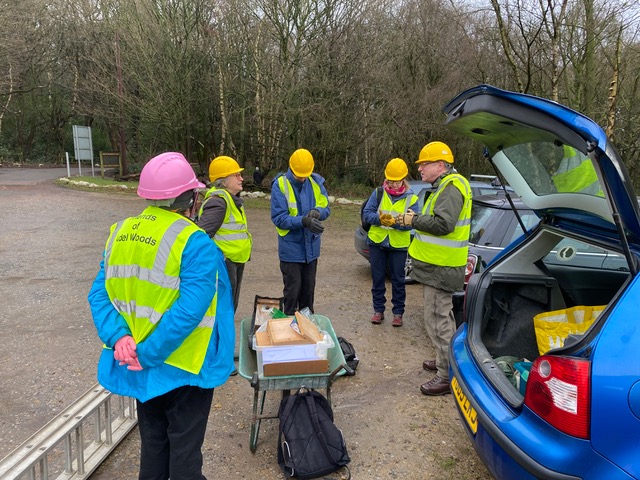
Meeting in Old Leo’s car park
We met in Old Leo’s car park at 10 am and, led by Steve Joul our wildlife adviser, we set off into Alwoodley plantation.
Our first job was to put up a new bat box which we had been given by two of our Friends.
We put up seven bat boxes in 2010 to provide shelter for bats to roost in over the Summer months, and hopefully hibernate in over the Winter.
We are not allowed to have a look inside the bat boxes, but one fell off the tree a couple of years ago and this was a good opportunity to replace it.
If you look at the photo, you will see that bat boxes are very different from tit boxes: there is no entrance hole on the front! Bats enter the box by landing on the wood protruding downwards beneath the box and then crawling up into the box through a slit in the bottom. So you can see that bats powers to negotiate the environment by echo-location are truly astonishing.
You can also see that there are bat boxes on the left and right hand side of the tree. This is because bats are sensitive to temperature, and we put the boxes on different sides of the tree so that they can choose the one that suits them best.
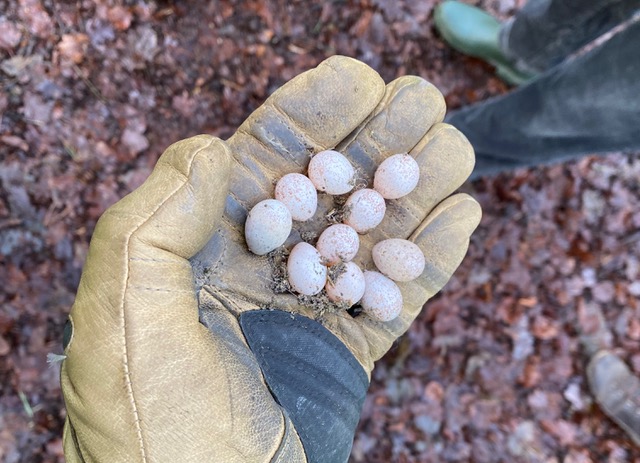
Ten unhatched eggs from nest box 5
Having put up the bat box we headed further into Alwoodley Plantation, our first stop being nest box 5 on a Scots pine near the Devil’s Rock. This contained a nest but there were ten unhatched eggs of various sizes. We measured them and came to the conclusion that they were probably great tit eggs. We’ll never know what happened, but presumably the parents were taken by predators. As you can see the eggs are very small, and it is a source of wonder that in a matter of weeks great tits (or blue tits) can develop into fully adult birds from such small beginnings.
Cleaning nest box 5The new bat boxTaking down “Tina’s” nest box near Old Leo’s
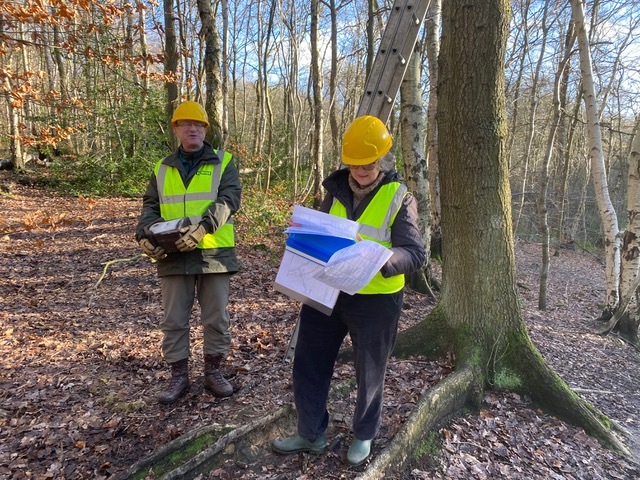
There is always plenty to do on the nest box surveys: Steve carries the ladder; one of us pushes the wheelbarrow loaded with all the tools which are needed to clean and, if necessary repair, the boxes; one of us (usually Steve or yours truly) climbs the ladder to bring the nest boxes down to the ground. We then take it in turns to open the box, and clean it before returning it to the tree. One of us makes a note of what we find, and one of us scouts around to find the next nest box: sometimes it can be very hard to find them and occasionally we don’t!
At about 12.50, having surveyed sixteen nest boxes, we decided it was time for a lunch break and we headed back to yours truly’s home to eat our sandwiches, and have a cup of tea and a piece of cake.
Duly replenished, we were back in the woods by 2.30, when we surveyed two nest boxes on Crag Lane, and then made our way down the Meanwood Valley trail from the picnic area down to Adel Pond – surveying another seven nest boxes until dusk arrived and it started to rain and hail!
In summary, today we surveyed twenty five nest boxes. Twenty one of these were tit boxes and four were robin boxes.
Of the twenty one tit boxes, all had been used for nesting except for one which had fallen off the tree. We cannot say that all of the nests were successful. Some clearly were as the nest looked used and was empty. Some had one or two eggs left in the nest and the assumption is that the other ten or so eggs hatched and the youngsters fledged. As reported above, the first nest box we surveyed contained ten unhatched eggs. Another nest box contained the macabre remains of eleven chicks. Presumably their parents were predated.
Turning to the robin boxes, the RSPB website says this about robin nesting habits:
“Most nests are located on or near the ground in hollows, nooks and crannies, climbing plants, hedgebanks, tree roots, piles of logs and any other situations which provide a fully concealed cavity.
“If a nestbox is provided to attract robins, it needs to be open-fronted, and placed in a hidden location in a climber or other such vegetation. Robins are famous for nesting in all kinds of unlikely locations, including sheds, kettles, boots, hanging baskets, coat pockets, under car bonnets, in farm machinery, even on boats in daily use.“
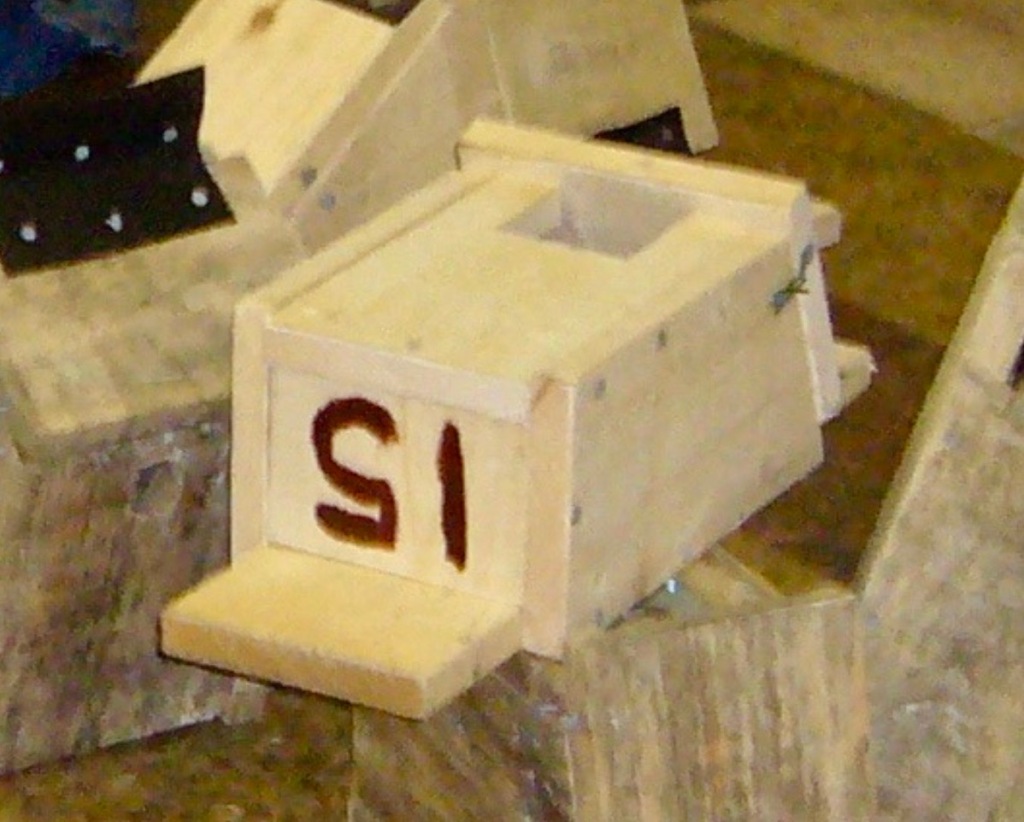
Robin nest boxes differ from tit boxes in that they have a large entrance – as shown in this photo taken when nest box 15 was made.
Clearly a nest box like this is very easy for a predator, such as a squirrel, to enter, so when we put them up in January 2010 we placed them on tree trunks a couple of feet off the ground in the middle of holly bushes. Two unintended consequences of this are (a) that they are very painful to reach to survey and (b) we have never been able to find one of the robin boxes which we put up!
None of the robin boxes have been used by robins for nesting. Occasionally, over the years they have been used by tits for nesting.
This year, two of the robin boxes contained a mass of oak leaves showing that they had been used by squirrels for roosting.
It was a very satisfying and enjoyable day, but yours truly was glad to get home and have a hot bath!
Views of Adel Woods on Saturday the 14th January 2023