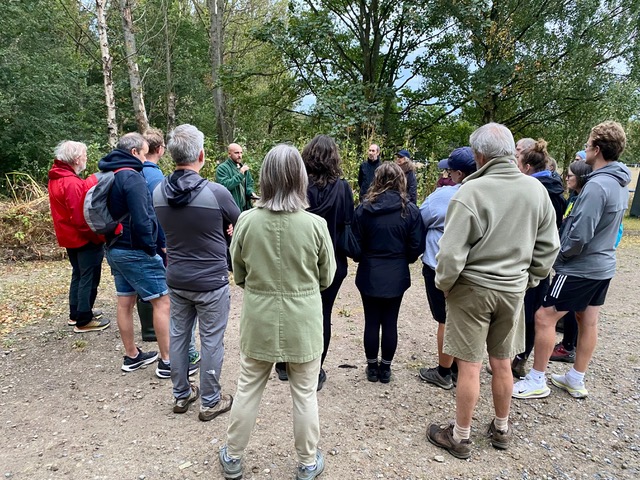
At 7.45 pm this evening, twenty three nature lovers gathered in Alwoodley Village Green car park for a bat walk led by Parks and Countryside rangers, Joe Craig-Jackson and Catherine Clarke.
After a brief introduction to Friends of Adel Woods by our Chair, and distribution of bat detectors, we set off to Old Leo’s car park, where Joe gave a talk about bats, and what we were likely to see this evening.
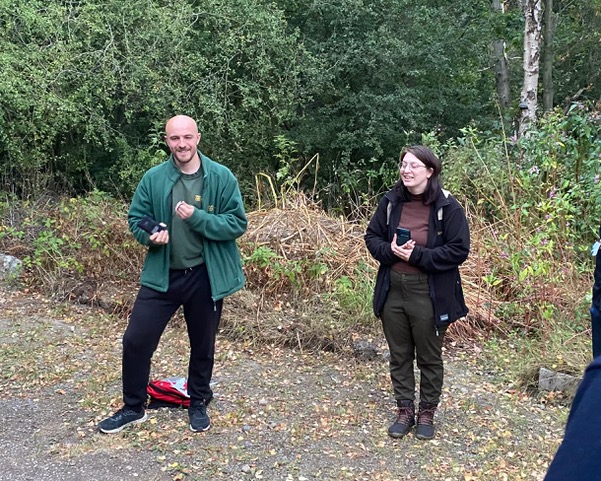
Joe explained that there are eighteen species of bat in the UK, though only seventeen breed in the UK. The eighteenth species is the greater mouse-eared bat. It is the largest species of bat in the UK but as far as we know there are only three individuals left in the UK.
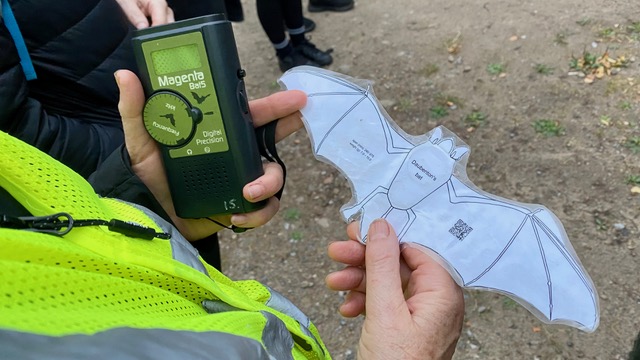
Of the seventeen species breeding in the UK, this evening we were likely to spot three: Common Pipistrelle, Soprano Pipistrelle and Noctule, though Joe was hopeful we might spot a Daubenton’s bat near the stream. To illustrate the relative size of the various species, Joe handed out life-sized cutouts of the species we were likely to see. The noctule is the largest of the four.
Bats fly very quickly at dusk and at night so that it is very difficult to identity their species by sight. We have to identify them by sound.
Joe explained that bats are not blind, but navigate and hunt at night using echo location, sending out shout like noises and using the echos to locate their insect prey. The shouts are far too high for adult humans to hear, though some children may be able to hear the lower sounds made by bats.
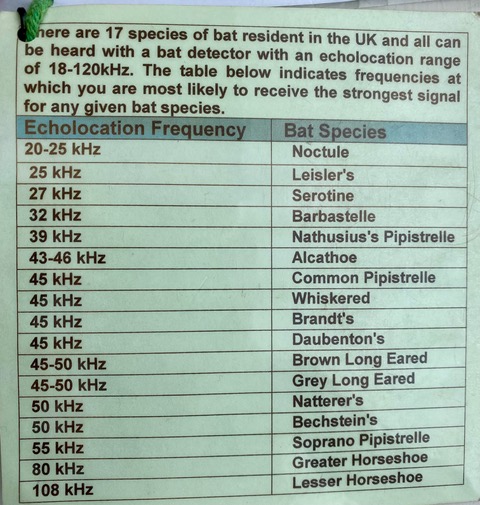
To hear bats we use bat detectors which pick up the sounds of any bats in the vicinity and convert them to a pitch within human hearing range. The converted sounds sound like a series of rapid clicks. And since each species of bat sends out calls of different frequencies, it is possible with the bat detectors to tell which species of bat we can hear.

The bat detectors we were using tonight were Magenta detectors which have a frequency dial which allow you to tune to a specific frequency, and discover which type of bat you can hear, and hopefully see. Joe handed out charts showing the pitch or frequency of the various bat calls:
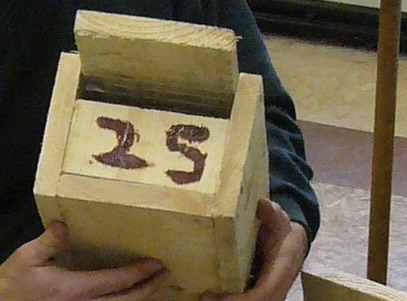
After Joe’s talk we set off to have a look at some bat boxes put up by Friends of Adel Woods, just to the north of Old Leo’s car park. In 2010 we placed four around one tree at a height of about 5 metres, each facing a different direction so that the bats could choose which was best for them, and similarly we placed three around a second tree.
At first sight they look like tit boxes. However, they differ from tit boxes in that they do not have a hole in the front of the box. Instead, there is a small slit in the bottom of the box, and bats land on a backboard below the bottom of the box and crawl up into it. Each of the boxes are capable of housing very many bats.
We are not allowed by law to have a look in the boxes, and so we do not know if they have ever been used by bats.
Having had a look at the bat boxes, we made our way along Crag Lane towards Adel Crag, and at the practice rugby field on the right, we had our first sighting of bats: always an exciting moment, particularly when accompanied by the staccato clicking of the bat detectors.
From the practice field we made our way to the picnic area, and then Adel Crag, and in both places we found lots of bat activity.
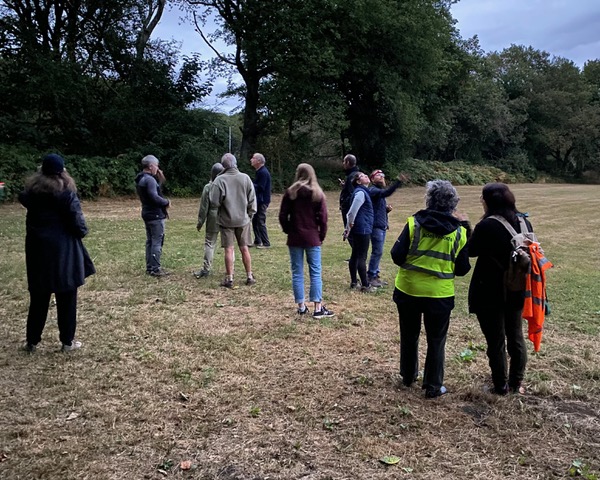
To conclude the evening’s walk we made our way back along Crag Lane and down to the cricket pavilion and the stream in the hope of finding a Daubenton’s bat.
Unfortunately we did not find any Daubenton’s bats, but during the evening we had many sightings of Common Pipistrelle, Soprano Pipistrelle, and Noctule bats.
We all learned a lot, so thank you to Joe and Catherine for leading the event, and to everyone who attended and made it a very enjoyable evening.
Join Friends of Adel Woods
Friends of Adel Woods were formed in 2009 to help maintain Adel Woods and encourage people to enjoy them. We meet one weekend morning a month to carry out various jobs or ”work parties”, and we also put on educational events such as bat walks, fungal forays and birdsong walks.
We are a very friendly group and welcome new members who want to help preserve our special woods, enjoy fresh air, exercise in the woods, and make new friends.
If you would like to take part in our activities, keep an eye on our Home Page. You don’t need to book to come along to one of our work “parties”: just come along!
If you would like to join our email mailing list, please get in touch by leaving a comment on this website – you should be able to see a comment box at the bottom of this page.

