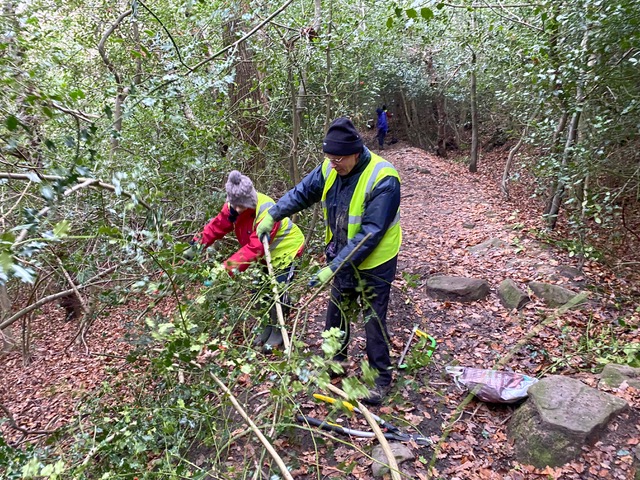
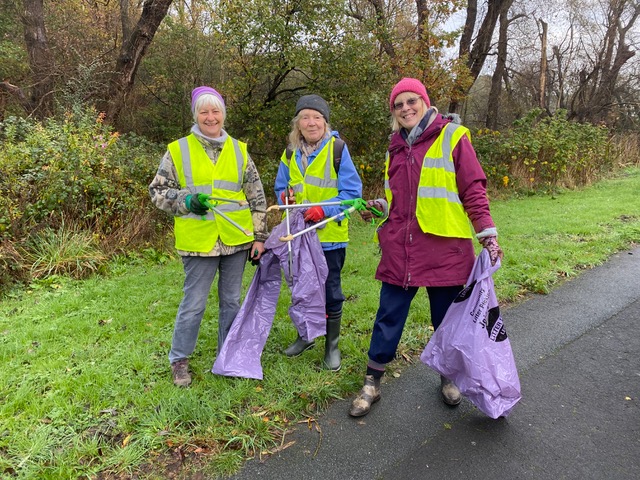
Today the plan was to help David Preston to carry out further work on Adel Bog. Unfortunately, due to a puncture to his van tyre, he was unable to join us, and so, while two of us did some litterpicking, six of us did some path clearing.
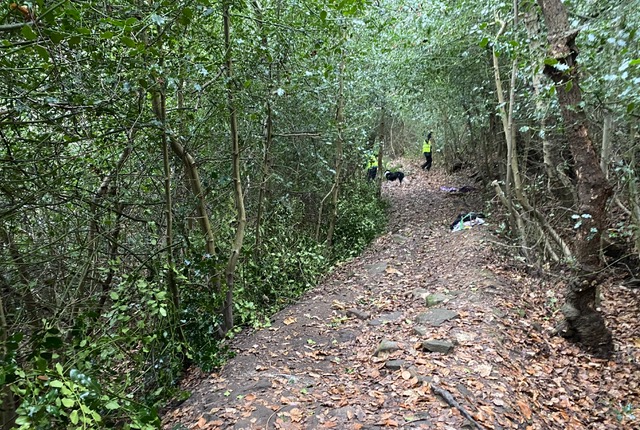
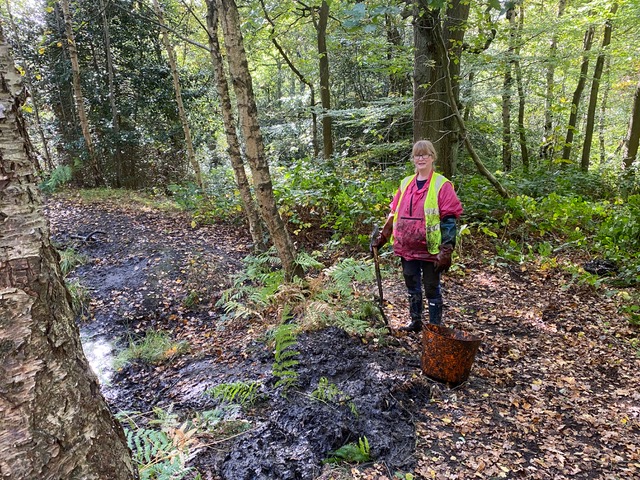
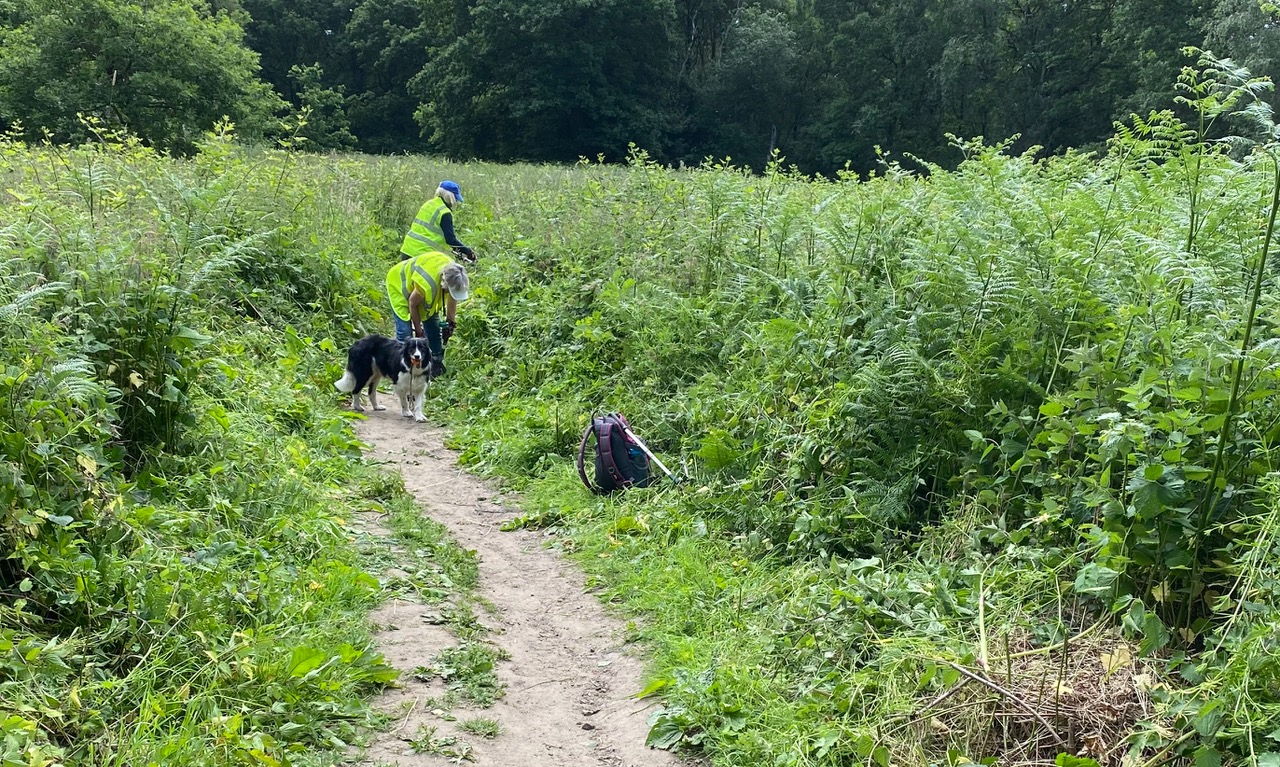
The path we chose was the raised path which runs from Adel Pond, along the north side of Adel Bog, towards Stairfoot Lane.
The trees on each side of this path are mainly holly which were creating a dark canopy over the path. We removed a great deal of holly from above the path.
We used the offcuts to create some dead-hedging between the path and Adel Bog.
Looking along the path in the direction of Stairfoot Lane: dead hedging on the left of the pathLooking back towards Adel Pond
Another successful and enjoyable morning in the woods.
On Friday, the Chair of FOAW (ie me) attended the inauguration ceremony for the creation of a new area of woodland off King Lane to the north of Alwoodley.
Leeds University has purchased 37 hectares of land (that is about 90 acres) from Clonmore Farm in order to create the new woodland. The precise location is shown below. The boundary is shown in red. To help you orient yourself, Five Lane Ends is the bottom centre of the map, and King Lane runs along the south west boundary.
It was a beautiful afternoon and the event was attended by about 40 people – including two Alwoodley parish councillors, representatives of the Forestry Commission and other interested parties.
The university’s intention in creating the woodland is to:
provide the opportunity for research and teaching
increase biodiversity
reduce carbon in the atmosphere
provide benefits to the university and the local community
The research and teaching opportunities will be across many departments of the university.
The university will be leaving in place the existing woodland adjacent to Eccup Whin (which is owned by Leeds City Council) and leaving some of the land as scrub to study how the land changes over time. Where they plant woodland, they will be planting appropriate broadleaf trees. They will also be planting trees of different ages to try to create the mix of ages to be found in a natural woodland. The existing buildings will be retained but only to provided shelter to lecturers and students. No new buildings are planned.
The long term intention is to allow public access to 20% of the woodland. 80% will be kept as private because the primary purpose of the woodland it to provide opportunities for research and walkers and dogs may well affect the outcome of the research. Public access to the 20% will be allowed in phases. Phase 1 is to provide an alternative route for Leeds Country Way and the Meanwood Valley Trail.
Roger Gair and Professor Simone Buitendijk, Vice-Chancellor of Leeds University, after planting the first tree in Gair Wood.
The woodland is named Gair Wood to honour Roger Gair who retired as secretary of Leeds University last year, and has had a long interest in conservation. He and Professor Simone Buitendijk, Vice-Chancellor of Leeds University, planted the first tree, an oak, and then the rest of us had the opportunity to plant cherry tree whips (ie very young trees which have not yet developed branches).
If you would like the opportunity to plant some trees in the new woodland, the university is organising some planting days and you can book your place by clicking on the following link which will take you to Eventbrite where you can choose a time and date to do your bit. You don’t need any previous experience and you will be shown what to do.
Today we had a team of three litter pickers, who picked up about six bags of rubbish between them, and a team of seven Friends working with David Preston, our local ranger, on Adel Bog.
When we reached Adel Bog, it looked beautiful as the morning sunlight broke through the trees.
Our task this morning was two-fold, to remove saplings and brambles from the bog and use them to strengthen the dead-hedging we started to build in September.
If you are wondering why we are doing this, the bog is a valuable habitat, and home to plants such as bog asphodel, heath spotted orchids, devil’s bit scabious, and cotton grass, and it is a lovely place to do some conservation work. A hundred and twenty years ago it was much more extensive, stretching a further 100 metres or so to Adel Pond, but it has gradually been taken over by trees. That process is continuing as saplings and brambles dry out the soil.
A further problem is that, as it has dried out in the recent dry summers, people have created paths across it, causing further damage. To try and protect the bog we have been creating a “dead hedge” as a natural barrier to deter people from walking across it. A dead hedge is simply a fence made with natural materials – stakes of wood, interwoven with brambles, branches, sprigs of holly and the like.
Hard at work!Another satisfying morning’s work for Friends of Adel Woods!
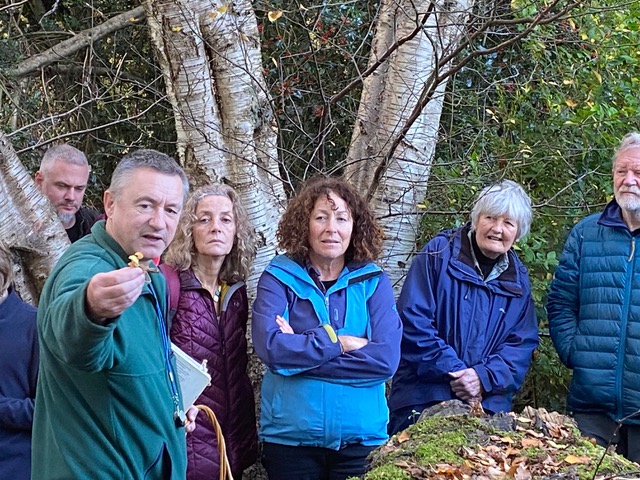
We never know how many people will turn up to a Friends of Adel Woods event, but today wonderful weather, and the chance to learn about fungi from the amazing Steve Joul brought out approximately forty five people including number of enthusiastic youngsters!
We met up in Alwoodley Village Green car park at 2.30 pm, and, after a short introduction, Steve led us into Adel Woods. Our first stop was a few yards along Crag Lane to inspect the remaining trunk of a mighty tree which fell about ten years ago, demolishing part of the garage next to it. This tree trunk always gives a display of numerous species of fungi, and today was no exception.
We then moved on to Alwoodley Plantation to the north of Crag Lane. Here many sharp-eyed fungi hunters brought Steve numerous specimens to identify. Steve astounded us all by his knowledge not only of their common names, but his amazing knowledge of their formal latin names.
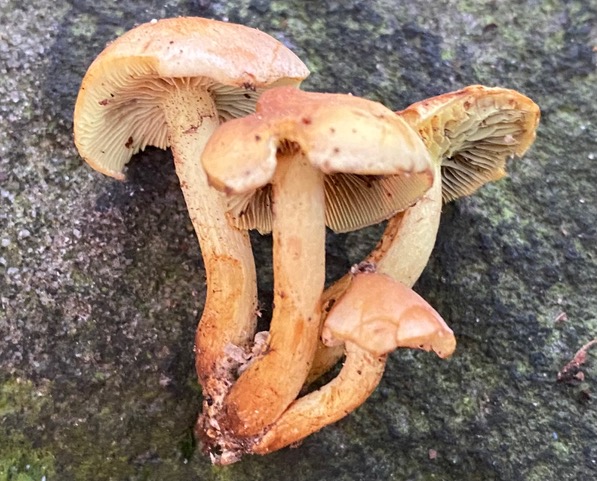
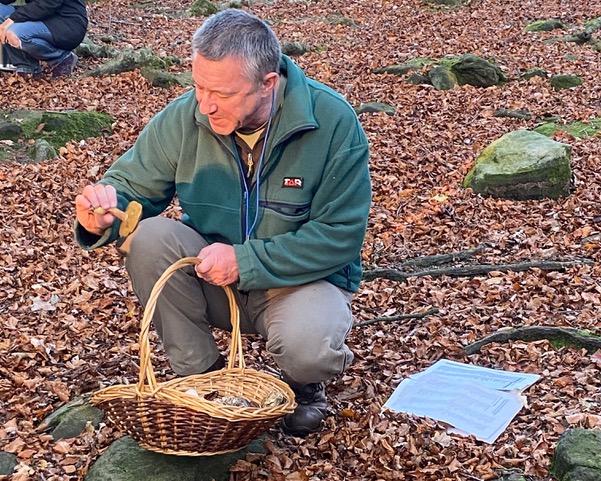
Steve collected the specimens in a wicker basket (an essential tool of the fungi enthusiast) and at the end of the walk paused to do a recap of what we had seen and found. In all we found about twenty five species of fungi and a complete list appears at the end of this report.
Candlesnuff Fungus
The event finished at about 4.30. It was a fabulous afternoon, and the trees looked beautiful in the evening sun. An added and unexpected bonus was the appearance of a handful of bats hunting for insects in the tree canopy (not visible in the photographs).
Alwoodley Plantation: Saturday, 12th November 2022
Here is a list of the species of fungi which we found this afternoon:
We woke this morning to a clear blue sky and a beautiful day. What better way to spend the morning than in Adel Woods?
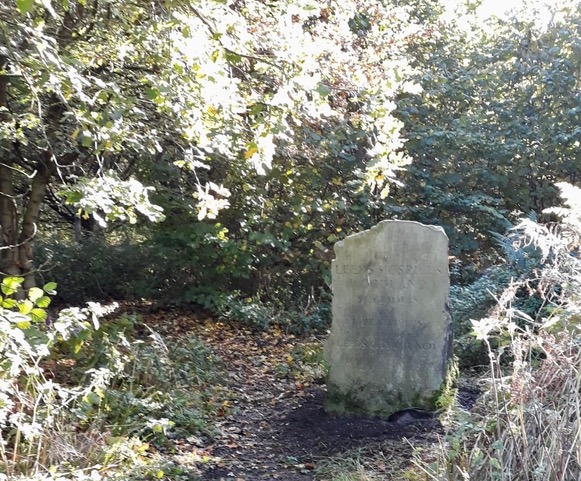
We had two activities planned for this morning – to work on Adel Pond and to litterpick. Our treasurer, Judith, added a third, namely to go and clear away grass and other vegetation growing around the stone monument marking the Hospice Woodland. And a great job she made of it, as shown by the photograph below. Unfortunately, she was unable to take a photograph showing its state before she began due to the angle of the sun.
The entrance to the Hospice Woodland, Stairfoot Lane, Adel Woods, Leeds.
Only one Friend, Sue, chose to litterpick today, and she picked up two bags of rubbish, mainly around the rugby club and Stairfoot Lane car parks. Thank you Sue!
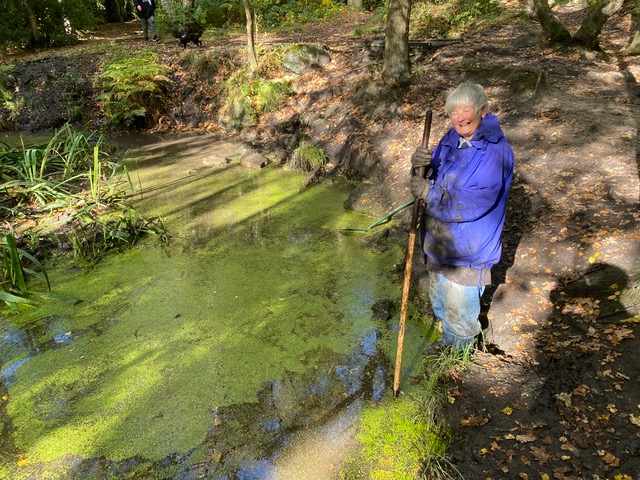
While Judith and Sue set off on their respective missions, the remaining nine of us made our way with David Preston, our local Parks and Countryside Ranger, to work on Adel Pond.
There were three aspects to our work on the pond. Firstly, to remove small trees and overhanging branches from around the edge of the pond, in order to let more light in and to reduce the number of leaves falling into the pond.
Sizing up small trees and overhanging branches for removal
Secondly, to remove silt from the pond. Thirdly, to clear mud and leaves from the ditches leading into the pond. This involved a lot of digging of mud from the pond and ditches, and removing it to somewhere it will not wash back into the pond.
Clearing silt from Adel Pond
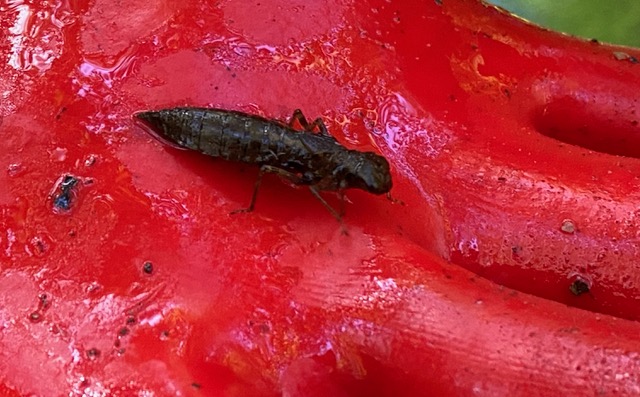
It was hard work, but of course there was time for a bit of nature watching!
Today was our third and final bracken pulling morning on Adel Moor.
Despite rain as we got up – and an unpromising weather forecast – it turned out yet again to be a lovely morning. Again we had a lovely group of seven enthusiastic and hardworking Friends.
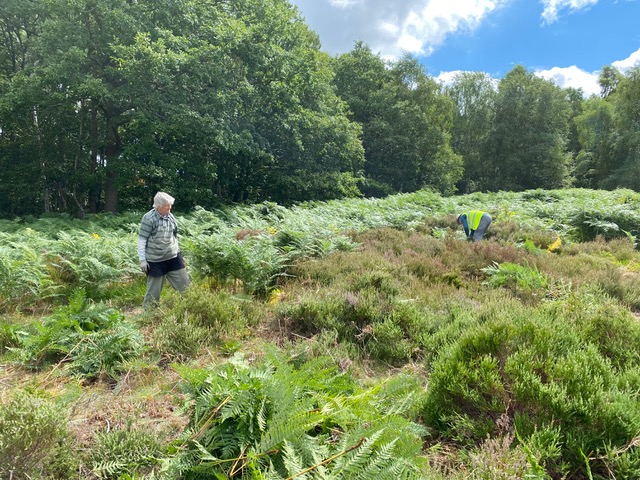
We set ourselves the target of clearing a triangular area of bracken adjacent to the area we cleared last Wednesday. And we more or less achieved our aim! The first photograph below shows the area at 10.11 am, and the second photograph shows the same area two hours later at 12.15 pm, after we had finished carrying all the pulled bracken to a compost heap in the woods.
Before pulling bracken……and after.
If you think that bracken looks good and are wondering why we pull it up , the brown patches in the photo above give an indication: where bracken has been established for a while, all other plants die off and we are left with a monoculture of bracken. Fortunately, quite a lot of heather and bilberries were hanging on under the bracken we pulled up. Bilberries and heather are both typical and desirable moorland plants. In the photo above, the bilberries are the green plants in the middle right.
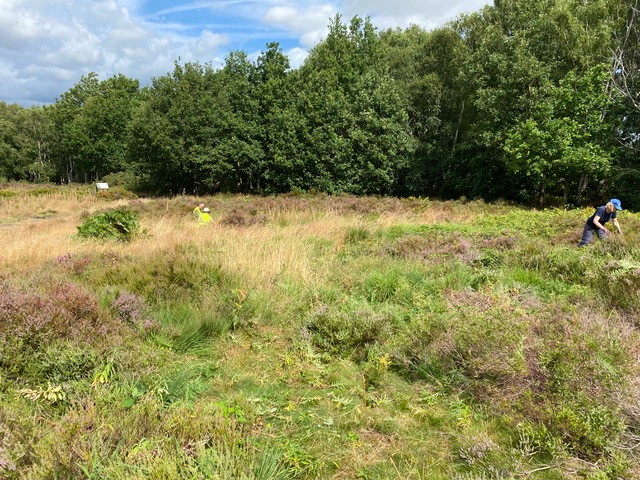
At this time of year the moor looks fantastic – as you can see from the next two photographs.
Heather on Adel Moor, 24th August 2022
The post and brown tube you can see in the foreground of the photograph above is used by mason bees and leaf cutter bees and is part of a study by Leeds University to understand more about bee biodiversity in urban areas.
Heather on Adel MoorThree tired but happy Friends of Adel Woods
For more information about bracken pulling on Adel Moor, see our blog posts for the 10th August and 17th August.
This was our second Wednesday “work party” during August in which we focused on pulling bracken on Adel Moor. Again we had a very good turn out of nine “Friends” and it was another lovely morning. We have one more bracken pulling session this year – next Wednesday, the 24th.
If you are wondering why we pull up bracken, it is because it eventually smothers all other plants and diminishes bio-diversity. This was very evident in some parts of the area we worked on today where there no other plants living under the bracken. However, in other parts, we found lots of heather and bilberries still managing to carry on – as can be seen in the “before and after” photographs below.
Before……and after!
Today we focused on a triangular area to the east of the main path crossing the moor from North to South. Again you can see from the photographs below that there was still a lot of heather growing under the bracken and it was very satisfying to bring it to light. In the area beyond and to the left of the area shown in the photographs, there was little growing as can be seen in the last photograph in this post.
Before...After
As we pulled the bracken, we had a lovely surprise when one of our party found a bird’s nest suspended in the top of some bracken fronds. There were empty egg shells in the nest which we identified as a robin’s nest. The fact that the egg shells were still in the nest is probably not a good sign as birds usually remove shells from the nest once the chicks have hatched.
A bird’s nest found in the bracken fronds on Adel MoorThreeFriends of Adel Woods on Adel Moor: 17th August 2022
Another lovely morning. In the foreground, you can see how bare the ground can be once the bracken has been removed. Hopefully, other plants will now have a chance to repopulate the moor.
Fortunately, you can also see lots of heather and gorse in the background.
Today was the first ever Friends of Adel Woods event to take place on a weekday.
It was Barbara’s idea to have three midweek events during August focusing solely on removing bracken from Adel Moor. We have two more coming up – on Wednesday the 17th and Wednesday the 24th.
For those of you reading this in a few weeks, months or years time, we are currently in the middle of a heatwave, the second in less than a month, and it was already very warm by the time we met at 9.55 am on Buckstone Road. Despite the heat, we had a fantastic turn out of ten Friends, including three new volunteers.
Bracken pulling on Adel Moor: Getting started
Friends of Adel Woods and the council have done a lot of work on the moor over the last thirteen years and it is looking fantastic. However, it is a constant battle to remove bracken, brambles and saplings. Bracken is particularly invasive and will eventually smother other plants which we wish to see on the moor.
Bracken pulling on Adel Moor: an hour and a half later!
In an hour and a half of diligent activity we were able to clear an area which I would estimate as similar in size to a 25 metre swimming pool – a fantastic achievement. You can see from the photo above, that where the bracken has overrun an area, there is very little other vegetation underneath it. However, heather and bilberries were still hanging on. [By the way, the two photographs above were taken from the same spot, but I didn’t point the camera in quite the right direction for the second].
Unfortunately, it takes a determined and regular effort to remove bracken from an area. However, we are hopeful that as bracken pulling work continues, the heather and bilberries will be renewed.
Adel Moor: looking towards the south.
Adel Moor has a population of viviparous lizards, though we did not see any today. In the last three years, green hairstreak butterflies have also been found here.
We are continuing the work of bracken pulling next Wednesday, the 17th August, and on Wednesday the 24th August. All are welcome – see our home page for more information.
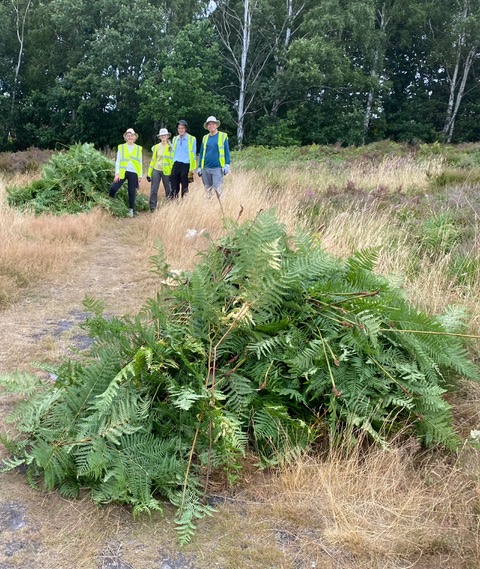
Our agenda today was litterpicking through the woods, and removing bracken, brambles and saplings from Adel Moor. As can be seen from the photos we were blessed with lovely weather.
Two of us chose to litterpick and gathered about three bags of rubbish during the morning.
Our intrepid litterpickers!
The rest of us, eight in all, spent a warm morning working on the moor, focusing mainly on pulling up bracken. If you are wondering why we do this, it is because bracken is extremely prolific and eventually smothers and kills off all other plants. In the photo below, you can clearly see, just beyond our Friends, the dividing line between the heather (which we are trying to encourage) and the lighter green bracken.
Adel Moor is special as the last remaining piece of heathland in Leeds and it is also host to a population of common lizards, though we didn’t see any today.
In the last three Springs, green hairstreak butterflies have been found on the moor. They are not a rare species nationally but until 2020 they were only found in the Leeds area on Otley Chevin.
Fortunately, bracken is usually pretty easy to pull up, though the main part of the root is left in the ground and it takes several years of “bracken bashing” to kill bracken off.
It was heartening to find plenty of heather still hanging on beneath the fronds of bracken.
Two piles of bracken and four of our bracken bashers.
At the end of the morning’s work, the bracken is carried into the surrounding woodland for composting
At the end of the morning’s work, the bracken is carried into the surrounding woodland for composting.Time for lunch!
It has been a beautiful week weatherwise, with soaring temperatures yesterday. Still a nice day today, but fortunately a lot cooler at 10 am this morning.
Twelve Friends today: four of us to pick up litter and eight of us clearing paths.
Having furnished the litter pickers with equipment and bags, the path clearers set off with the ultimate aim of widening the path that runs South across the meadow between the picnic area and the Meanwood Valley Trail.
First, though, we made our way to the path heading north off Crag Lane from the back of Old Leo’s clubhouse. The entrance to this path had become much narrower due to encroaching grass, nettles, brambles and other plants, and so we widened the entrance and trimmed back the more prominent holly further up the path. We also removed a large fallen branch from the path.
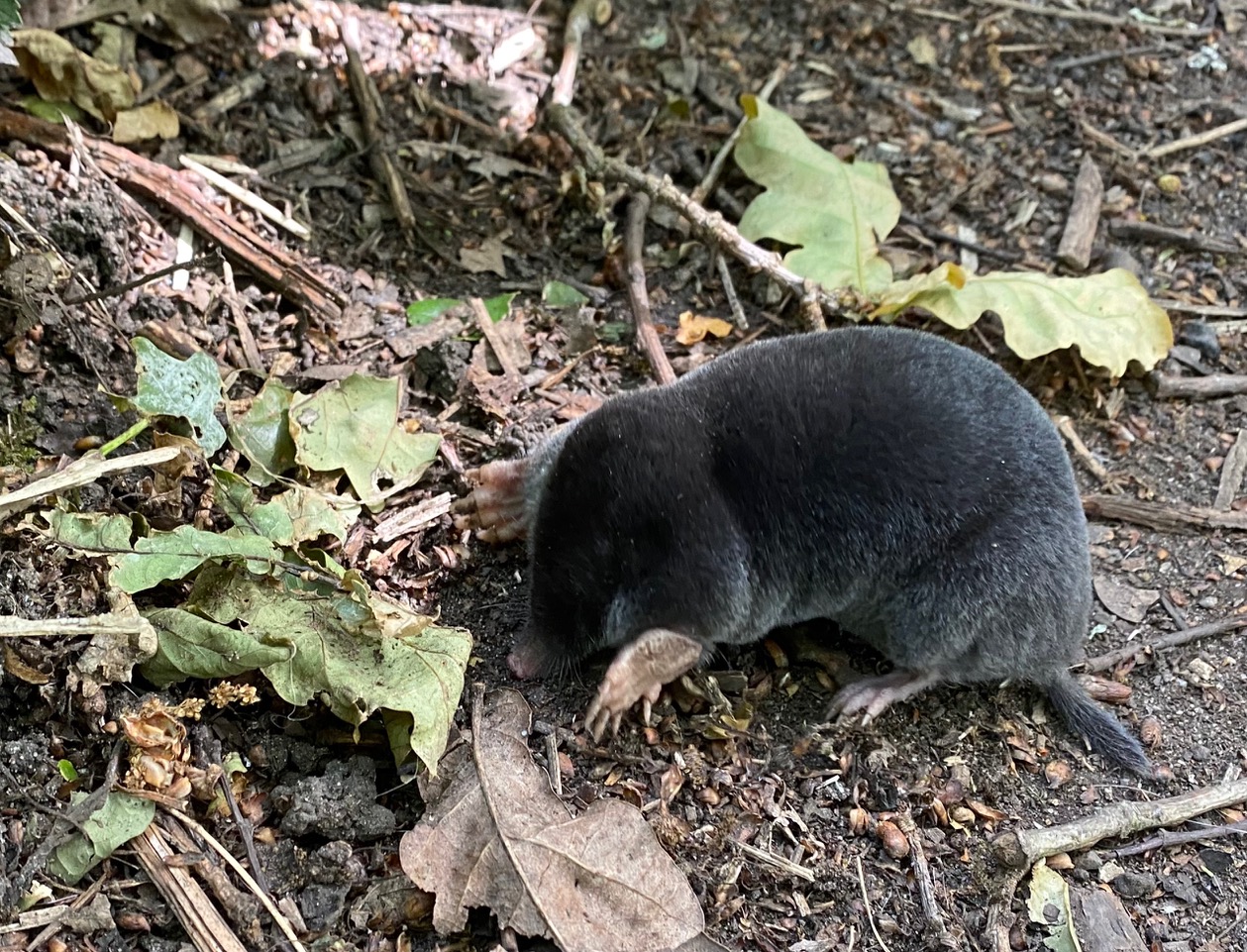
From there we made our way back to Crag Lane, heading in the direction of the picnic area. However, we had only gone a few yards when one of our Friends made the amazing discovery of a mole snuffling around in the foliage at the edge of the path.
A mole wandering about on Crag Lane
We all stopped work to have a look at him or her. It was the first time your correspondent had ever seen a mole – and probably the first time any of us had! We didn’t touch the mole but watched it wander around. It seemed completely unaware of our presence, but also seemed not to know where it was going. We speculated that it had lost its way and could not make its way back underground because the ground was so hard. One of us poured out some water for it and it immediately lapped it up. We were worried for its safety as we could hear dogs nearby, but fortunately it made its way into the undergrowth and we left it to its own devices. What an exciting start to the day!
As we made our way along Crag Lane, we cut back foliage which was encroaching most onto the path.
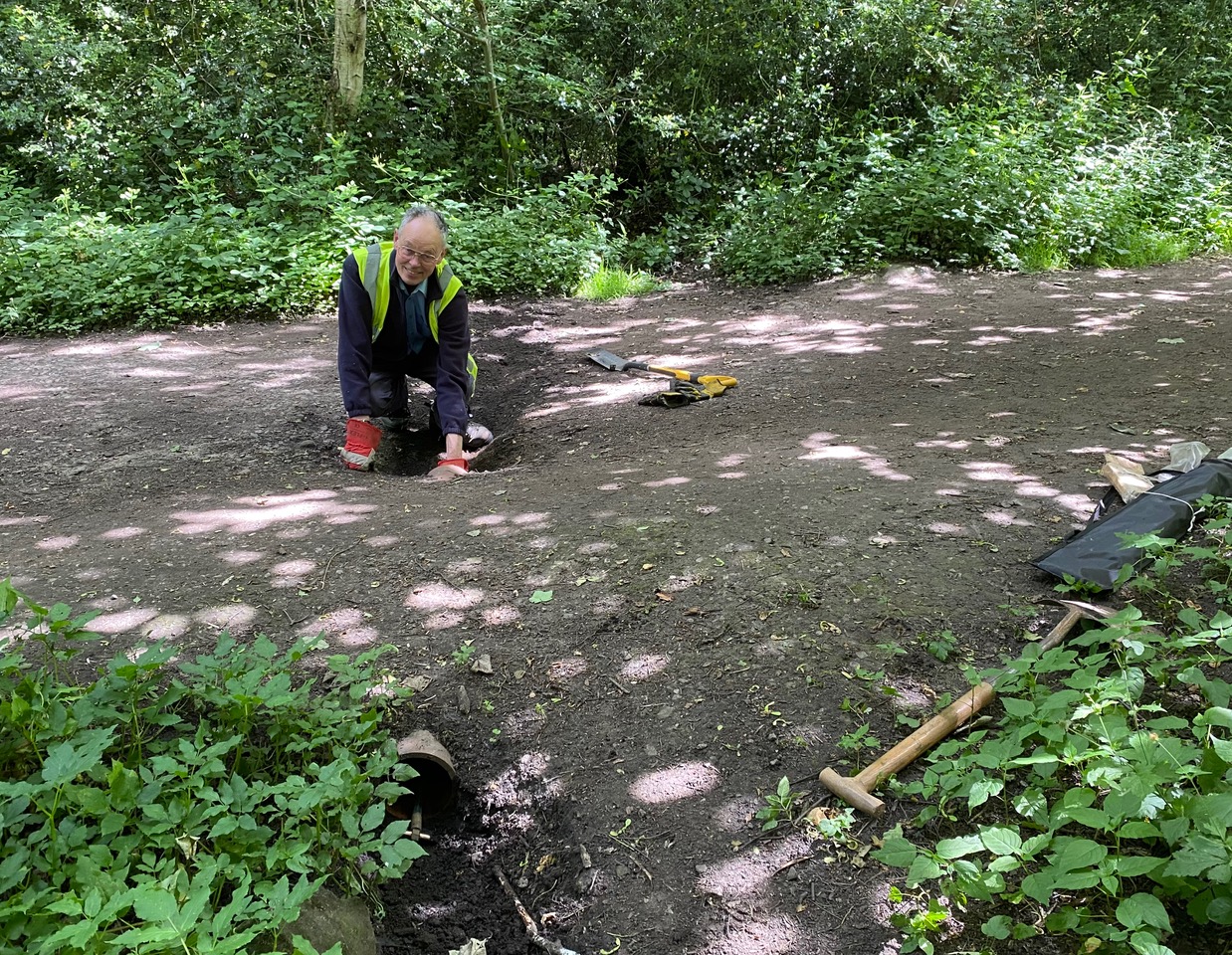
Once we reached the picnic area, we took the path down to the Meanwood Valley Trail which had become very narrow. But first, two of us made a detour to ensure that the drainage pipe under the path just beyond the picnic area was clear. We dug out the mud from the entrance and exit ditches, and cleared the mud from the pipe.
Clearing the drainage pipe near the picnic area
By now, the sun was out and it was hot work clearing the path. One or two of our Friends were extremely pink in the face! However, we made good progress before finishing at 12 noon.
Widening the path from the picnic area down to the Meanwood Valley Trail
Having finished work, some of us went to have a look at the orchids in the orchid meadow (otherwise known as the cricket meadow).
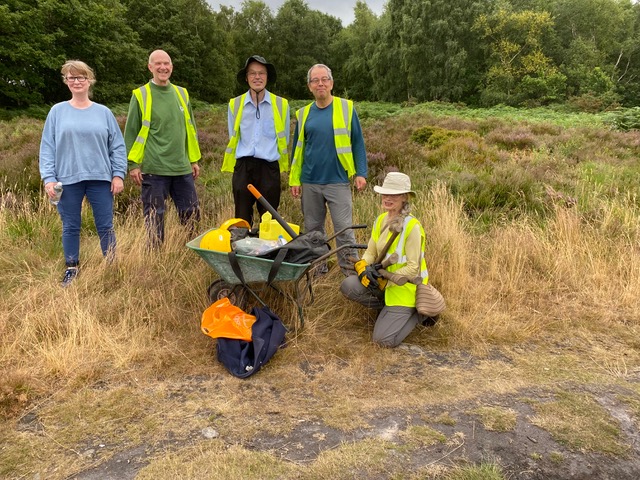
Friends of Adel Woods in full colour after a very enjoyable morning
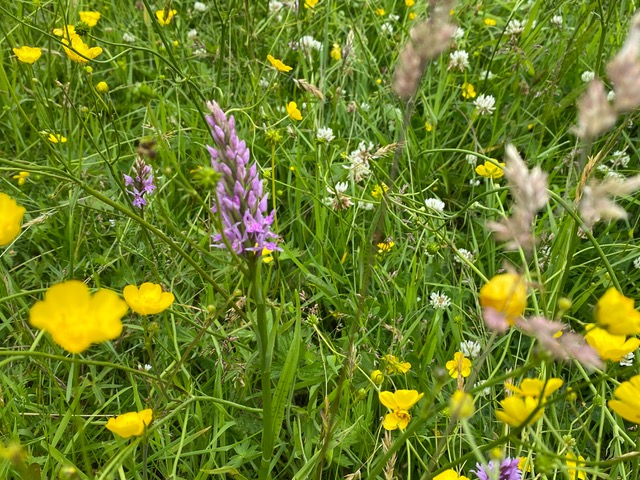
The meadow was an absolute picture, full of buttercups and orchids, clover and all sorts of grasses and other wild plants.
Common spotted orchids, buttercups and clover in the orchid meadow, Adel Woods
We first discovered this meadow in 2014. At that time it contained a large number of common spotted orchids but it was in a poor state: trees and Himalayan Balsam were beginning to take over. We began work on the meadow under the supervision of Steve Joul in 2016 and it has been transformed into a wonderful haven for wild flowers and insects. We have removed the trees and most of the Himalayan Balsam, and Steve has mown the meadow each Autumn for the last three years. Our new ranger, David Preston, is planning to mow the meadow again this Autumn.
You can see what the meadow looked like in 2016 here.
Thank you to all the Friends who joined us today. The litter pickers picked up about three bags of litter.
The orchid meadow, 18 June 2022. There are a lot more orchids than you might think!





















 Friends of Adel Woods