

Tonight David Preston, Parks and Countryside ranger with Leeds City Council, led an enthusiastic band of “bat detectorists” on a walk round Adel Woods: our mission to learn about bats. It was a clear, dry and mild evening so a good night for finding the object of our study.

We met at 7.15 in Old Leo’s car park where David (pictured in the orange hi-vis jacket) outlined the plan for the evening and gave an excellent introductory talk about bats, their importance ecologically and how to survey them, and shared some interesting facts about bats around the world. Perhaps one of the most surprising facts was that there are seventeen species of bat in the UK, several of which can be found in the suburbs of Leeds! David handed out paper “cut outs” showing the relative sizes of some of the UK species.
In preparation for this evening’s walk, yours truly (ie me!) had been out in the woods three evenings this week to find out when and where bats were likely to be found. The good news is that there were bats present in various locations – in Old Leo’s carpark; by the track leading down to the cricket pavilion; in the practice rugby pitch to the north of Crag Lane, and around the picnic area and Adel Crag. At this time of year they seemed to be appearing in flight at about 8.10 pm (sunset was at about 7.40 pm). At this time of year, bats are building up their fat supplies to prepare for their winter hibernation.

Whilst it is possible to see bats in flight at dusk, it is not possible – at least not for the non-specialist – to identify the particular species by sight. The way to detect the presence of bats, especially as it gets dark, and to identify which species is present, is by using a “bat detector”. And so David had brought twenty of so for us to use.
David explained that whilst bats have excellent eyesight, they find their way about and catch their insect prey using an echo-location system. As they fly, they send out high pitch sounds, and the echos from these sounds enable the bats to track and catch insect prey. The high pitch sounds are too high for human hearing and so the bat detector picks up the sounds and converts them into clicks which humans can hear. It also identifies the pitch of the sounds which helps you to know which species of bat is making them, and David handed out sheets which gave the frequency of the different bat clicks. For example, the noctule bat, the UK’s largest bat makes clicks at the frequency of 25kHz; the pipistrelle on the other hand, makes clicks at the frequency of 50kHz.
After a quick lesson on how to use the bat detectors, we made our way to have a look at some bat boxes which Friends of Adel Woods made and put up in the woods in January 2010 under the tutelage of Steve Joul, then a ranger with Leeds Parks and Countryside.

We put up eight bat boxes near Old Leo’s clubhouse, four on each of two trees. We put the boxes approximately twenty feet up, with the boxes on each tree facing roughly North, South, East and West so that the bats could choose the best for them. Bat boxes differ from tit nest boxes in that they don’t have a hole on the front of the box. Instead, the back of the box protrudes down below the box and bats land on this and then crawl into the box and come out again through a slot in the bottom.

Whilst Friends of Adel Woods put up the boxes, it would be illegal for us to take them down and have a look inside. This was therefore a good opportunity for David to use his specialist Echo Meter Touch Active Bat Detector which fits on a smart phone, to see if there were any sounds of bats in the vicinity of the boxes. Unfortunately, it detected no activity near either set of boxes.
However, when doing our annual survey of the FOAW tit boxes, two years running we were surprised to find a noctule bat hibernating in one of them! David also recounted that when surveying dormice in North Yorkshire (which he is licensed to do) he has found bats roosting in dormouse nesting boxes; and he has even found a tit box containing a tit nest and eggs, with a dormouse sharing the box!
From the bat boxes we made our way towards the moor, past the cricket pitch, looking out for bats and listening for any noises coming from our bat detectors. The first clear sounds and sightings of bats came as we crossed the stream behind the cricket pavilion. Our detectors told us that the bats in the area were noctule (25kHz), pipistrelle (50kHz) and soprano pipistrelle (55kHz) bats.

From there we made our way up to Adel Moor, which we thought could be a good place to see and detect bats. However, we just picked up the odd sign of bat activity. So yours truly took the opportunity to explain the importance of the moor as a habitat for common lizards and green hairstreak butterflies, and to talk about the work which Friends of Adel Woods and the Parks and Countryside rangers have done to maintain the moor.
From the moor we returned to Old Leo’s carpark via the cricket pavilion and made our way from there to the disused rugby pitch where there have been a number of bats earlier in the week. Again we detected bats but not as many as seen on earlier evenings – and the battery on David’s Echo Meter ran out!
However, when we were in the disused rugby pitch we heard tawny owls calling from opposite ends of the field.
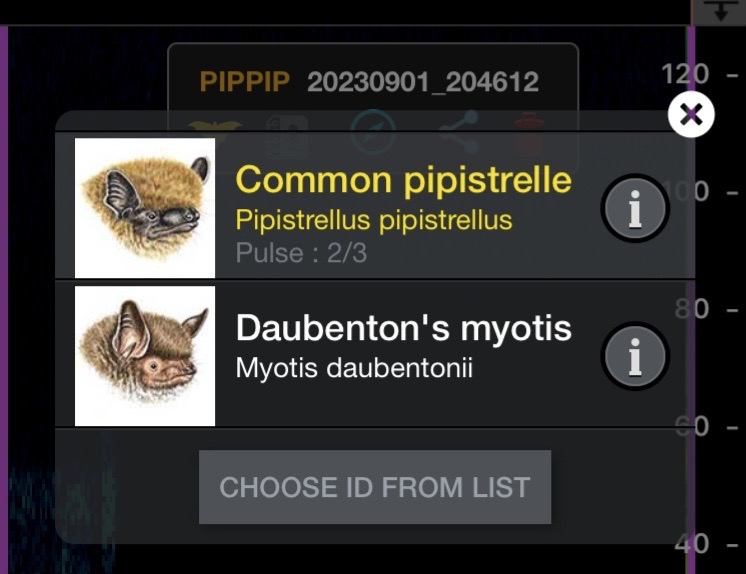
By now it was 9.15 pm and time to finish. The preliminary results from David’s Echo Meter bat detector, subject to proper analysis, were that we saw and detected four species of bat:
- noctule
- pipistrelle
- soprano pipistrelle
- natterers bat
This is a print out from David’s Echo Meter. As can be seen, most bat activity was detected in the area in front of the cricket pavilion.

Thank you to David Preston for leading an interesting and enjoyable walk, and thanks to everyone who attended. It was a great evening.
I hope that you have found this blog post interesting. The next “educational” event organised by Friends of Adel Woods will be on the afternoon of Sunday the 8th October 2023, when Steve Joul will be leading a Fungal Foray.
Friends of Adel Woods were formed in 2009 to protect, enhance and maintain Adel Woods and to work with Leeds City Council and other groups and organisations to that end. We meet one weekend morning a month to carry out a variety of tasks in the woods. If you would like to join us, have a look at our website for upcoming events: we welcome everyone who would like to help us to look after the beautiful woods on our doorstep.
 Friends of Adel Woods