
Himalayan Balsam 19 July 2015
Himalayan Balsam was introduced (impatiens glandulifera) was introduced to the UK in 1839. As its latin name suggests, it is a relative of the Busy Lizzie. It is an annual plant which can grow up to 10 feet in height. Between June and October it produces clusters of pink helmet-shaped flowers which are followed by seed pods that can open explosively, dispersing up to 800 seeds up to 7m when ripe!
If you are not familiar with the plant – sometimes known as the Pink Peril – you will have seen it in Adel Woods – for example at the side of Nanny Beck on Buck Stone Road.
Unfortunately, it has become a problem in the UK in that it tolerates low light levels and shades out other vegetation, so gradually impoverishing habitats by killing off other plants. This reduces bio-diversity, and is also a problem along river banks – where Himalayan Balsam thrives – as it has very shallow roots which permit soil erosion to occur. The plant has no natural enemies in the UK and so it is gradually progressing unchecked through the countryside.

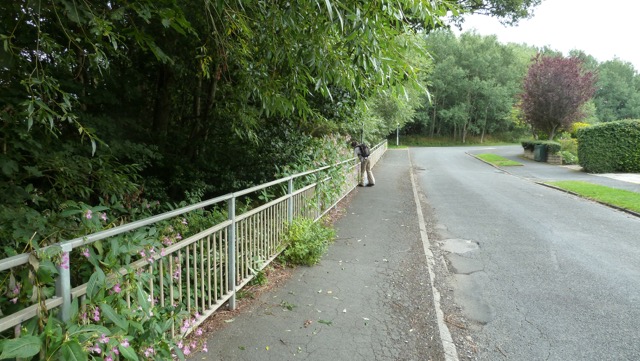
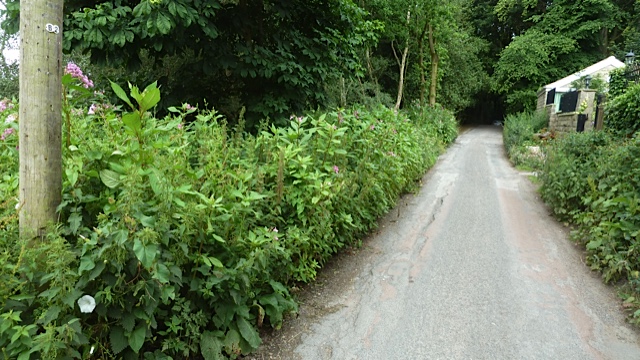
Crag Lane – Himalayan Balsam visible to the left
On a walk through the woods, FOAW’s chair noted that there was a clump of Himalayan Balsam at the entrance to Crag Lane by King Lane carpark – and that it seemed to be isolated and therefore a suitable candidate for eradication. Unchecked, there is little doubt that the plant will spread along Crag Lane which is mercifully reasonably clear of it at the moment.
June and July are the ideal time to clear Himalayan Balsam, before the seed pods form, because clearing the plants when the seeds are ripe can cause the pods to explode scattering the seeds yet further.
We therefore had an hour long session this morning clearing the plant from this small plot.
This was your correspondent’s first experience of HB clearing and it was a rewarding and illuminating experience.
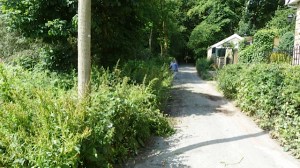
Same scene less Himalayan Balsam
Because Himalayan Balsam has very shallow roots – the root spread of a 10 foot plant might only be the size of a man’s hand – the plants are very easy to pull up. However, they grow to a density of probably fifty plants per square foot, which means that, if you are clearing an area thirty feet by thirty, there are very many plants to remove.
Having uprooted the plants, the question is what to do with them. Apparently, if left in contact with the soil, the plants will re-root and so the video’s on youtube show a variety different ways of disposing of them. The National Trust hang the uprooted plants on trees. Others favour slashing the uprooted plants with a machete and crushing the stems. Our team tried a selection of disposal methods: hanging them on a tree; pulling off the roots and crushing the stalks; and laying them on the track so that the many cars passing along Crag Lane to a strongest man competition at Old Leo’s could crush them.
We pulled up many of the plants including some a good 8 feet tall, but time unfortunately ran out and we probably only managed to clear 90% of the plants. However, it is now a much more manageable task to complete the job.
An optimistic sign was that the native UK flora like nettles were continuing to persist in the middle of the HB

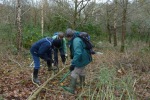 A pleasant morning and eleven of us turned out to help Steve Joul thin out the trees in the hospice woodland.
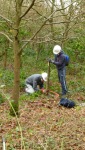 If you are wondering why this is necessary, it is because they have been planted too close together. Mature trees need to have up to ten metres of space on either side. Many of the trees in the hospice woodland are planted no more than two metres from their neighbours and are growing into each other. Left unmanaged, the trees will not prosper.
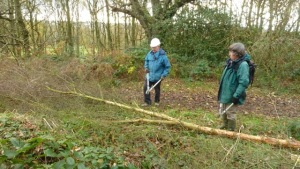 Steve demonstrated how to safely fell a tree using a bow saw (the bird’s beak method) and then we set to in teams – felling trees which Steve had marked, and then cutting the fallen timber up into smaller pieces which will rot down, providing habitat for beetles and insects.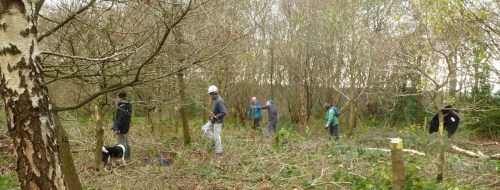
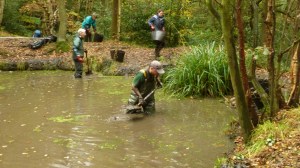 Travellers along the Meanwood Valley Trail may notice as they pass through Adel Woods, a circular pond, surrounded by trees. It is not large – perhaps only twenty five feet across – but it is the only pond in Adel Woods and, in your correspondent’s view, it is a beautiful adornment to the woods. Quite apart from its natural beauty, it is home to a thriving population of palmate newts.
 If you do not know where it is, follow the Meanwood Valley Trail in either direction and you will surely come to the pond. Otherwise, enter the woods by the entrance on Buckstone Road, follow the path down through the kissing gate and at the bottom you will see a stream on your right, with a bridge leading to some steps heading upwards into the woods. Adel Pond lies in placid beauty at the top of the steps.
 Today we had a good team of about a dozen, two or three litter picking around the woods, but the rest of us enjoying wet and muddy fun in the pond. This was also the opportunity for FOAW to try out our four pairs of pond gloves for the first time.
 A good turn out of about thirty five people, including many children, for a “tree walk” led by Steve Joul, senior countryside ranger with Leeds City Council.






 Friends of Adel Woods