
 Steve Joul led a group of enthusiastic birdwatchers this morning. Here is a report, written by the man himself – plus at the end a few additional miscellaneous sightings. In all we spotted 27 species of bird – not bad for a morning’s birdwatching in a woodland on the edge of the city.
Adel Wood – Birdsong Walk 07.05.16
This Friends of Adel Woods walk was led by myself, Steve Joul, Leeds City Council Countryside Ranger. 15 people met in the car park at 7am when much of the talk from regulars was of how much better the weather was today compared to 12 months ago when we undertook our walk during heavy rain!
Although it was cool at first the sun gradually forced its way through the haze as a hot and sunny day developed.
After introductions, we watched a Great Spotted Woodpecker and listed to Chiffchaff before walking down the track towards the Cricket Club. Along the way were Wren, Robin, Song Thrush and Blackcap.
At the cricket ground a male Mistle Thrush fed on the pitch before flying up and singing from a Poplar tree, freshly clothed in shiny green leaves.
We then crossed Adel Moor where a Willow Warbler was singing and made our way to the Buckstone a sandstone feature that gives its name to the nearby housing estate. This had been recently tidied by the Friends of Adel Woods.
Next, we made our way to the Seven Arches Aqueduct which brought from Eccup Reservoir Leeds’ first alternative water supply to the River Aire. Here, we spotted a Nuthatch calling and searching upside down on a branch for food.
Further along the Meanwood Valley Trail we watched another Mistle Thrush carrying a large quantity of mud in her beak. She returned several times to build her nest in the fork of a Birch tree.
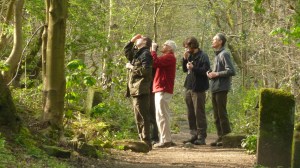 Arriving at the Slabbering Baby Spring, which marks the former location of Verity’s Tea Rooms, those who had important business to attend to returned to the car park. However, it was developing into such a lovely morning tht the remainder of the group decided to continue past Mill Fall Pond (the newt pond) and along Adel Beck to the Stairfoot Steps.
Along the way we enjoyed the colourful streamside flora which included Golden Saxifrage, Hard Fern and a superb bank of Marsh Marigold. Those at the front of the party also saw a Red Fox.
Up the steps we climbed, then past Adel Crag to the Hospice Wood where we were delighted by a trio of neat and colourful Bullfinches.
27 Bird species seen or heard
Blackbird: too many to count
Blackcap: 4 males singing: good views of 1 perched. 2 males chasing 1 female close by.
Blue tit: too many to count
Bullfinch: 2 males chasing with female close by
Carrion crow: 2 including 1 mobbing a red kite
Chiff Chaff: 6 calling males including 1 bathing in a puddle
Dunnock: 1 pair seen, not calling
Goldfinch [noted by Sylvia]
Great spotted woodpecker: 1 female called observed in a tall tree
Great tit: 7 males singing
Grey heron: 1 flew over
Jay [noted by Roger]
Jackdaw: 1 flew over
Long tailed tit: 3 pairs seen foraging; 1 pair flew to nest
Magpie [noted by Roger]
Mallard: 3 flew over
Mistle thrush: 1 male singing in tree; 1 female carrying mud to nest
Nuthatch: 3 calling
Red kite: 1 pair, mobbed by carrion crow
Robin: too many to count
Skylark: 1 flying over neighbouring farmland
Song thrush:
Starling:
Stock dove: 1 pair occupying owl box
Swallow: 1 male singing on the wing
Wood pigeon: too many to count
Wren: too many to count.
Miscellaneous Sightings
In addition to the above, the group also saw: 3 blackbird eggs (hatched or destroyed by a predator); 8 campers and a tent; speckled wood butterfly; dog violet; ivy leaved speedwell; greater stitchwort; seven spotted ladybird; peacock butterfly; small tortoiseshell butterfly; orange tip butterfly (thanks for Sylvia for this information).
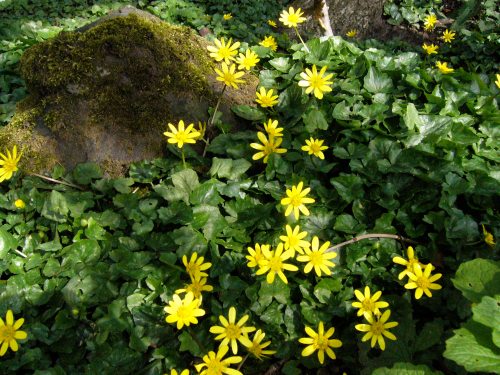
Lesser Celandine: Adel Woods, May 2010
 The Friends of Adel Woods have worked on the area around the Buck Stone in recent years to ensure that it is remains an impressive feature of the woods and is not overgrown by trees, bracken and brambles.
 When we first worked on the Buck Stone, we created a woodpile with the tree branches which we had cut – not only does it look neat, but it also creates a habitat for beetles, other insects and small animals. When we arrived today, your correspondent was dismayed to see that all that was left of our log pile were a few charred logs. It seems that last week someone set fire to it and the fire brigade had to be called.
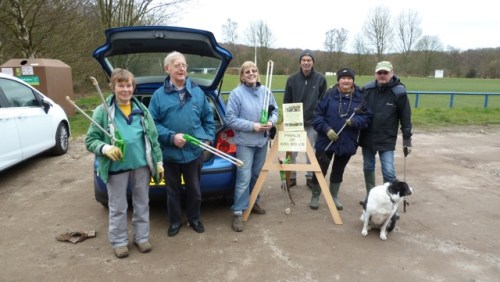


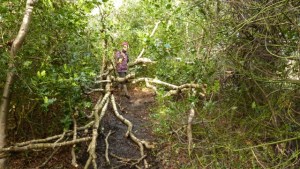


 Six Friends turned out at 9.30 am to complete our nest box survey with Steve Joul.
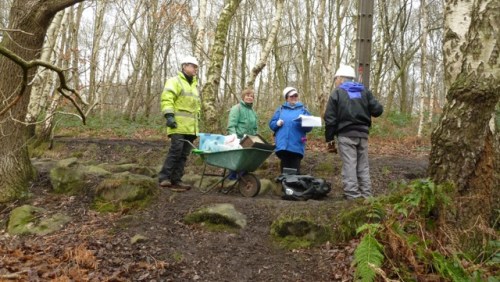
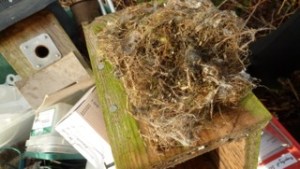 Taking an hour for lunch, we managed to survey all the tit boxes north of Old Leo’s and down the Meanwood Valley Trail to the Slabbering Baby, and all of the robin boxes before the light began to fail at 4pm. We cleaned them out, gave them a spray of disinfectant (harmless to wildlife), and reinstated them. We replaced a couple of damaged ones.
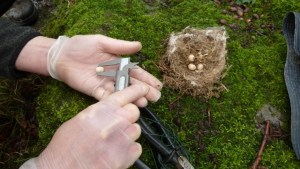 The tit boxes had almost all been used – by tits. Disappointingly, none of the nest boxes had been used by nuthatches. Many of the nest boxes contained unhatched eggs and we measured these to see if we could identify whether they were great tit or blue tit eggs.
 A happy morning of calm and creativity making Christmas Wreaths in the bar of Old Leo’s.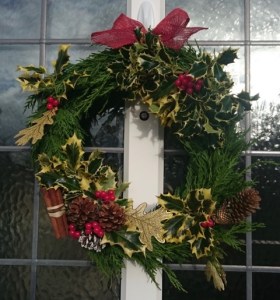
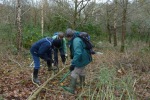 A pleasant morning and eleven of us turned out to help Steve Joul thin out the trees in the hospice woodland.
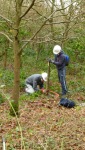 If you are wondering why this is necessary, it is because they have been planted too close together. Mature trees need to have up to ten metres of space on either side. Many of the trees in the hospice woodland are planted no more than two metres from their neighbours and are growing into each other. Left unmanaged, the trees will not prosper.
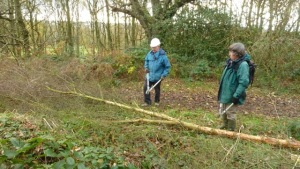 Steve demonstrated how to safely fell a tree using a bow saw (the bird’s beak method) and then we set to in teams – felling trees which Steve had marked, and then cutting the fallen timber up into smaller pieces which will rot down, providing habitat for beetles and insects.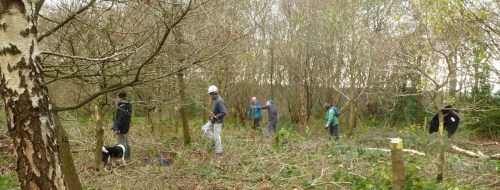
 Friends of Adel Woods