 Today we started our 8th annual survey of the forty two nest boxes which we have put up since 2010.
We had an enthusiastic team of six, including Steve Joul (senior ranger with Leeds Parks and Countryside), and we were out from 10 am to 4 pm. It was a chilly start, but it warmed up during the day. In many ways it was a perfect day: dry and no wind!
The nest boxes are positioned:
- in the woods to the north of Old Leo’s rugby club
- along Crag Lane between the rugby club and Adel Crag; and
- along the Meanwood Valley Trail from the picnic area near the Crag down to the Seven Arches.
Immediately to the north of Old Leo’s club house, on the other side of Crag Lane, there are some nest boxes with very large holes in the front. These are tit boxes put up by Steve Joul 25 years ago, and they are not part of our survey. The large holes are due to the action of woodpeckers over the years.
Friends of Adel Woods have put up thirty six tit boxes, five robin boxes and one treecreeper box.
A tit box is the typical nest box with a hole in the front. The ones which we have put up have holes of varying sizes between 28mm (suitable for blue tits) and 32 mm (suitable for blue tits, great tits, sparrows and nuthatches). We have positioned these on trees between about ten and twenty feet from the ground.
A robin box is the same size as a tit box but, instead of having a small round entrance hole, the upper half of the front of the box is completely open. Robins are shy and secretive nesters and their nest boxes are placed a few feet from the ground in the middle of holly bushes.

Tree creeper nest box
The treecreeper box is a bit unusual. Tree creepers are so called because they creep up the side of tree, looking for bugs to eat (incidentally, unlike nuthatches, they can’t creep down trees, and when they get to the top of a tree they have to fly off to the bottom of the next one). They nest high up in small gaps behind the bark of trees and the tree creeper nest box is intended to offer something similar to the gap behind bark. It is about twice the depth of a tit box, and the entrance is on the side of the box, near the bark of the tree. Here is a link to a nice video of a tree creeper nesting in a hide: tree creeper
Today we surveyed and cleaned 32 nest boxes.
As usual, nearly all of the tit boxes were used. The nests are made of moss, grass, dog 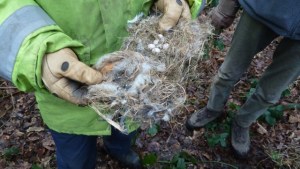 hair and similar fibres. Over the years (including this year) many tit nests contain luminous green manmade fibres. The best we can come up with is that they are fibres from lost green tennis balls! Some of the nest boxes contain unhatched eggs. If there is just one, it often seems to be smaller than a typical egg and it may be that it was not a viable egg. In some cases there are more than one egg which indicates something dramatic may have happened. In the picture of Steve examining the contents of a tit nest, we found seven unhatched eggs between two layers of nesting material, so it looks as if a nest was built, eggs laid, and something happened which caused the nest to be abandoned and a new nest built above it.
Excitingly, two of the tit boxes – including the last we surveyed today were used by nuthatches. One of the nest boxes – the one by the bridge between the Slabbering Baby and Adel Pond – was used by nuthatches last year.
You can tell when a nuthatch has used a tit box because it fills all the gaps between the lid and the sides and front of the box with mud. Inside the nest is totally different from a tit nest: instead of a nest of moss, grass, dog hair and similar materials, with a saucer shape where the eggs are laid, the nest is made of bark chips – and looks rather like a layer of bran flakes in the bottom of the nest box!
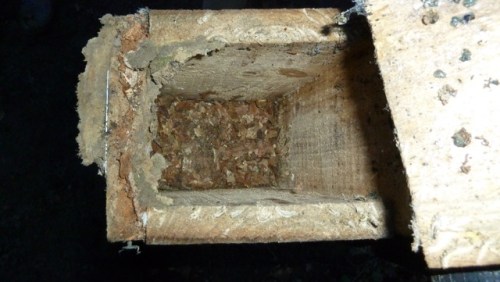
Tit nest box used by Nuthatches: see the mud around the top of the sides and the nest made of bark chips
 None of the robin boxes were used except for one which was full of unusual nesting material. It was not in the form of a bird’s nest and contained a lot of dry grass and leaves. The entrance to the nest seems to have been vigorously chewed: was it used by a squirrel for roosting?
We didn’t reach the tree creeper nest box today: see our entry for Wednesday 17th January to discover what we found!
Thank you to Steve Joul for guiding us through the survey, and thank you to everyone else who helped today.

 Today, David, Rob and your correspondent joined Roger Brookes of Leeds City Council to walk the Meanwood Valley Trail from the Stairfoot Lane car park to the Seven Arches aqueduct. This is the stretch of the trail which falls within the area looked after by Friends of Adel Woods.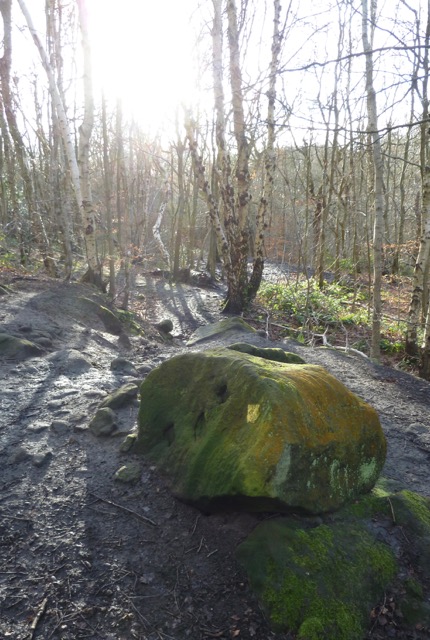
 Despite a very chilly start and a very unpromising weather forecast, we had another great turn out of eight of us this morning for litter picking and clearing brambles from the Hospice Woodland.
 As time passed, it began to snow more persistently and gradually the numbers diminished as people left for other commitments (or warmer climes) until, at 11.45 am we called it a day.
 See our previous blog entry for Saturday 13 January for more information about the nest boxes put up by Friends of Adel Woods and the results of the first part of our survey.
 Four of the tit boxes contained completed tit nests, and the other two contained what seemed to be incomplete nests. One of the tit boxes had been used by nuthatches because they had started to seal the gaps around the lid with mud. However, the nest inside was a typical tit nest, not a nuthatch nest, so it looks as if the nuthatches may have been driven off by some aggressive blue tits or, more likely, great tits. Interestingly, exactly the same thing happened with this nest box last year.
 We had an excellent turn out, meeting in the Stairfoot Lane carpark. While a handful of us went off litter picking, a merry band set off to clear the drainage pipe under Crag Lane near the picnic tables, and thence to repair and tidy up the Stairfoot Lane steps.
 We then moved on to our second task: repairing and tidying up Stairfoot Lane steps.


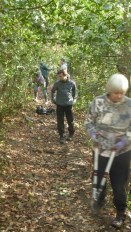 Today’s tasks were litter picking and clearing paths. Twelve of us met in Old Leo’s car park – although two of our number only arrived later on due to buying tickets to see Peter Kay! We had three new members which was very gratifying.
 We then headed along the path which runs from the pond, towards Stairfoot Bridge, pruning back holly and pulling up brambles. Where the path joins the stream we removed two tyres and a cast iron sack wheels which has mysteriously appeared in the stream – “mysteriously”, because it looks as if it has been in the stream for some time, but it was several hundred yards downstream from Stairfoot Lane. It is hard to imagine that it could have been washed down by the current.
 This brought us to 12 noon and triumphantly we headed to the Stairfoot Lane car park to discover that flytippers had dumped there seven or eight bags of potting compost – probably from a cannabis farm – and an old shower cubicle.
 Friends of Adel Woods