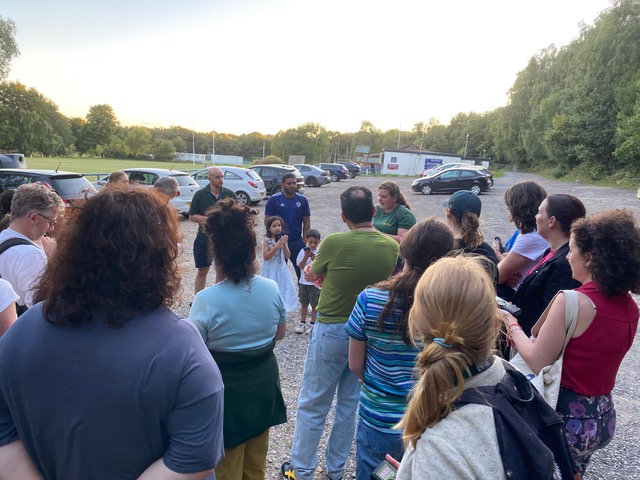
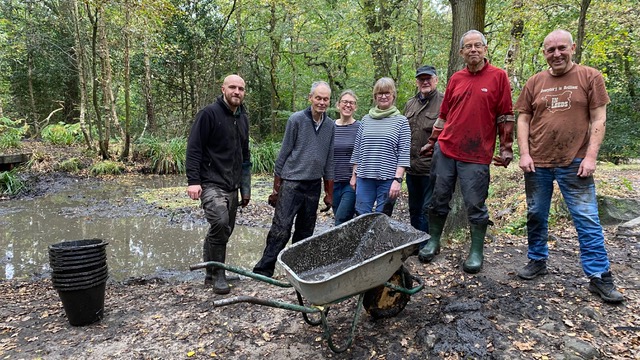
A pleasant and dry morning, and nine of us gathered by the cricket pavilion at 10 am for a morning of sprucing up the woods by picking up litter and clearing paths. Three of us chose to litterpick and the rest of us to clear paths.
Path clearing
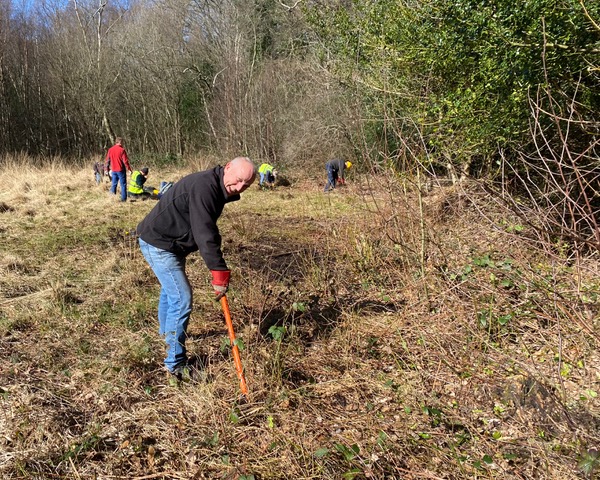
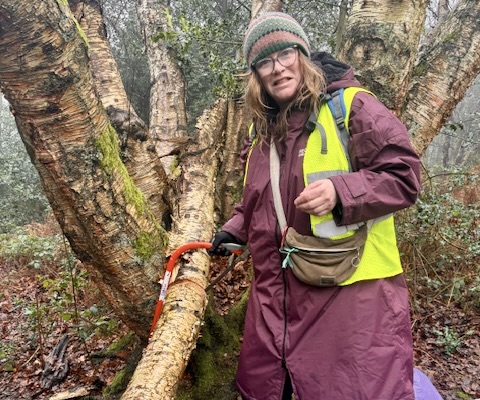
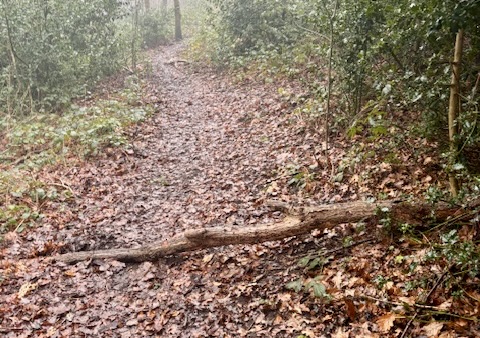
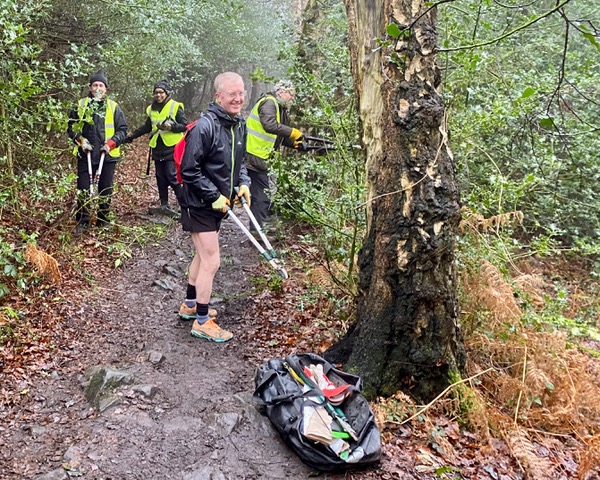
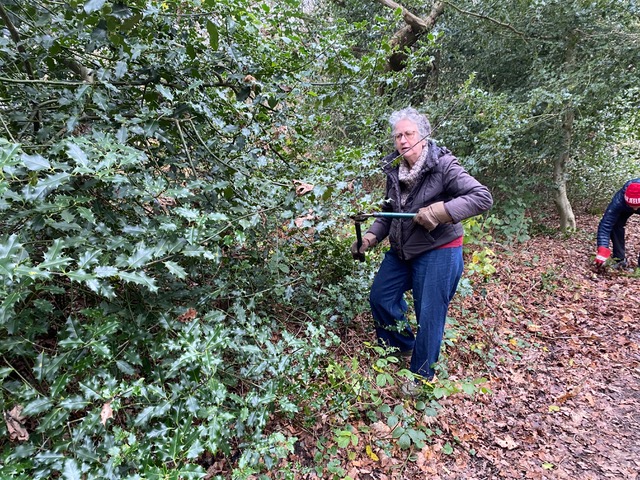
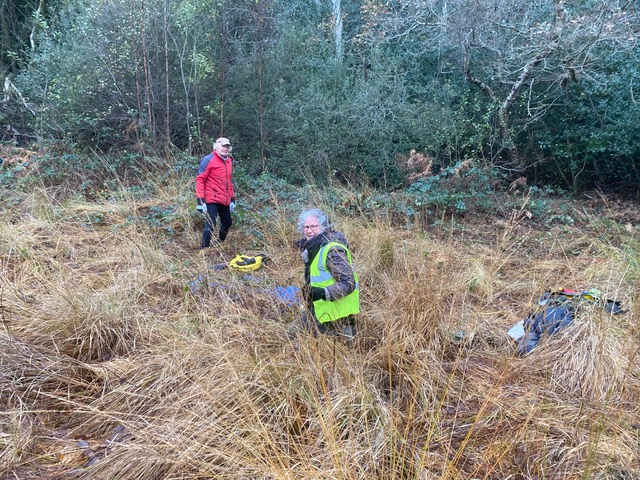
The path clearers started with the “diagonal” path leading from Crag Lane into and westwards through the Plantation. This was fairly clear as we did some work on this path in February. Nevertheless we found a couple of branches to remove and plenty of holly to cut back.
The path alongside the disused rugby pitch
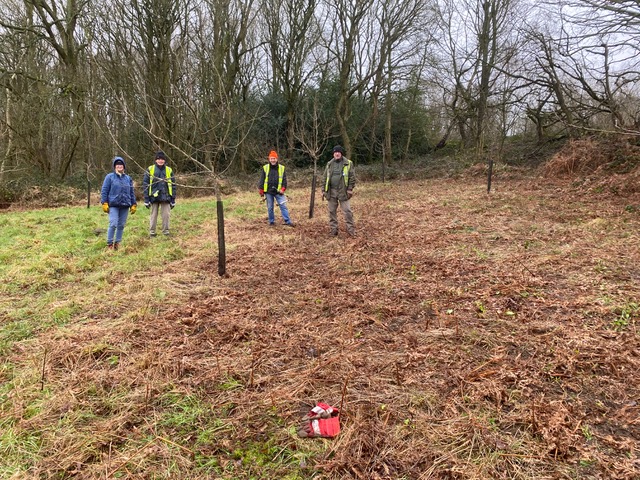
We then worked on the path from the plantation down to Crag Lane alongside the disused rugby field. We spent about an hour on this path cutting back holly and pulling up brambles in order to widen the path.
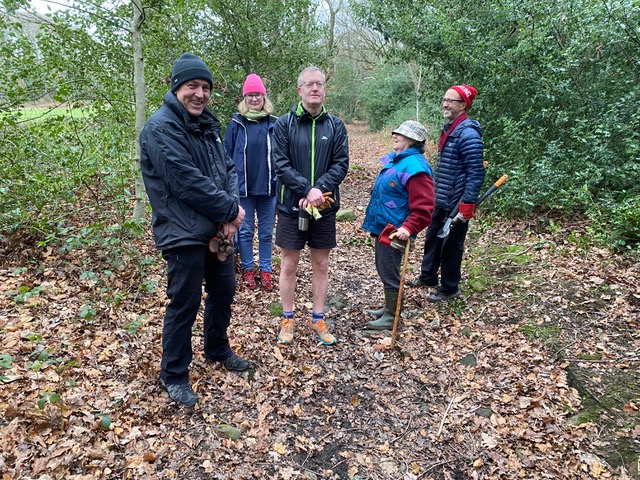
Due to other commitments, we finished work at 11.45 but we still achieved a lot this morning – as well as enjoying pleasant company and interesting conversation.
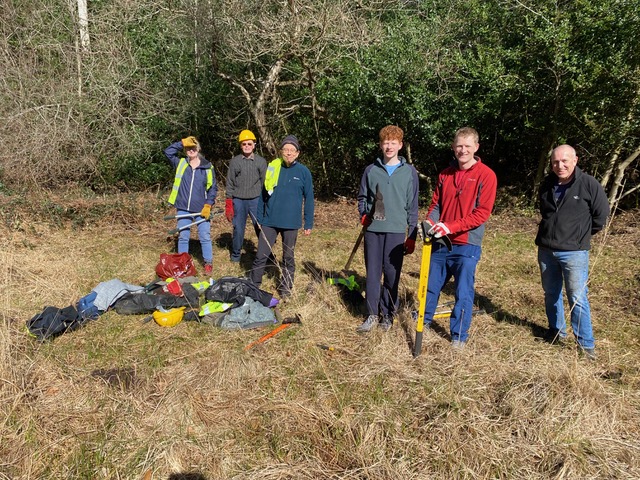
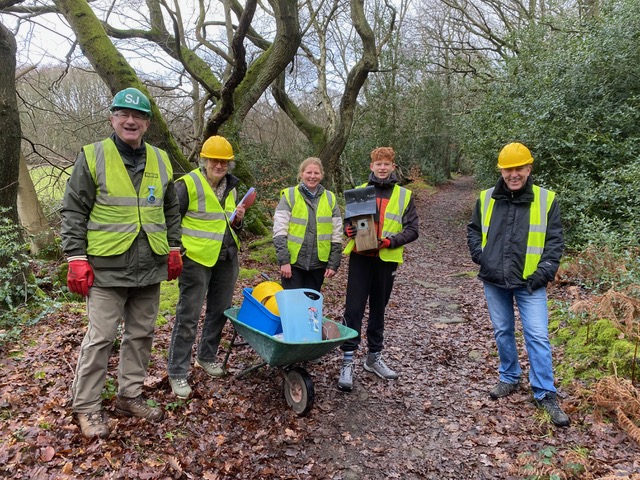
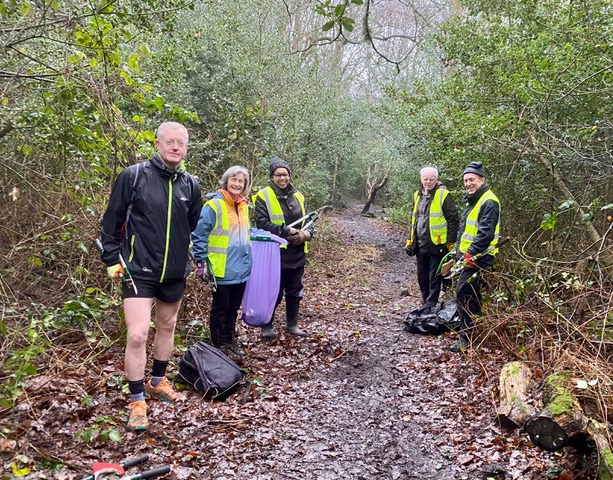
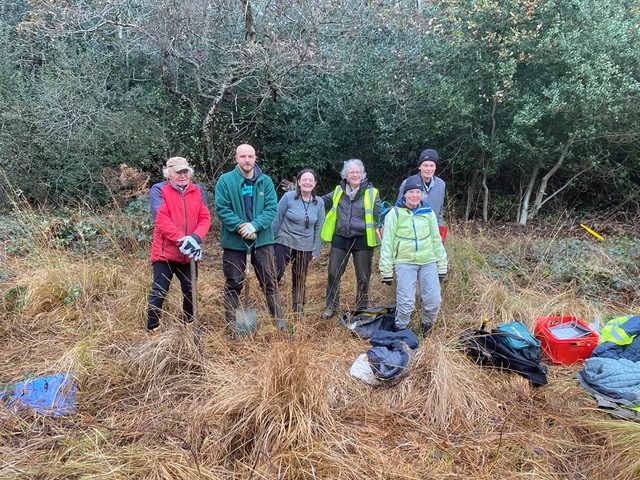
At the end of the morning
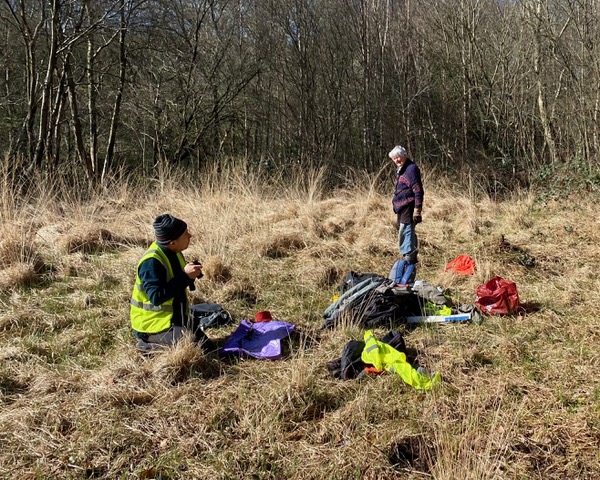
One of our litterpicking team joined us for the last half hour or so.
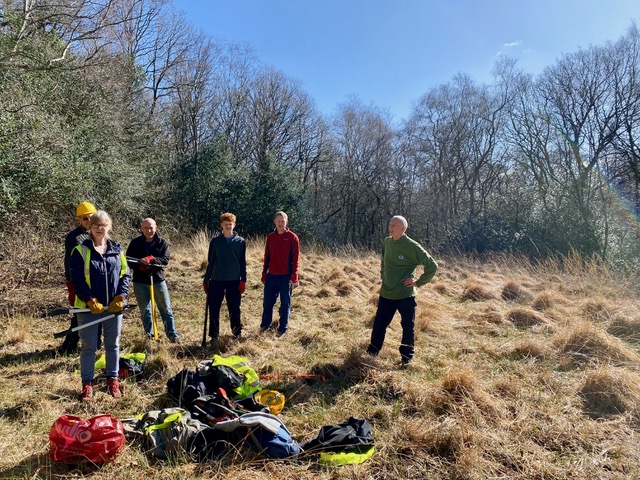
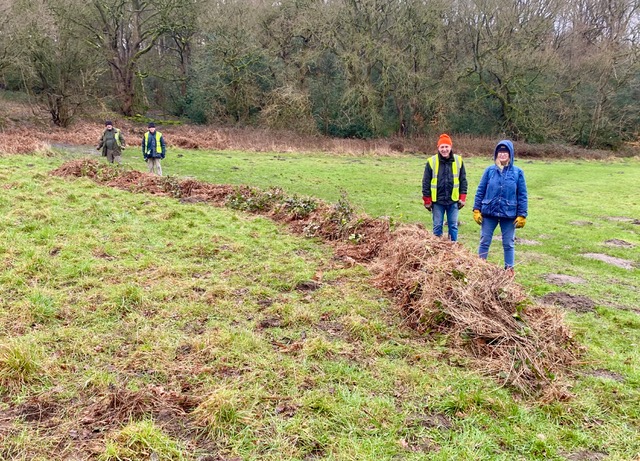
Five of our happy team
Litterpicking
Our litterpicking team walked up to Crag Lane and then turned right to go up the path alongside the disused rugby field. They then made their way to the Hospice Woodland, turned left down to the Stairfoot Lane carpark and returned to the cricket pavilion via Crag Lane. They picked up a bag of rubbish – a lot of it being full dog poo bags 🤢🤢.
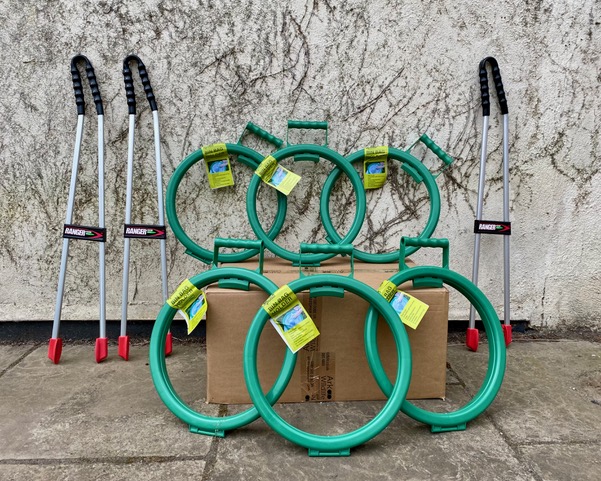
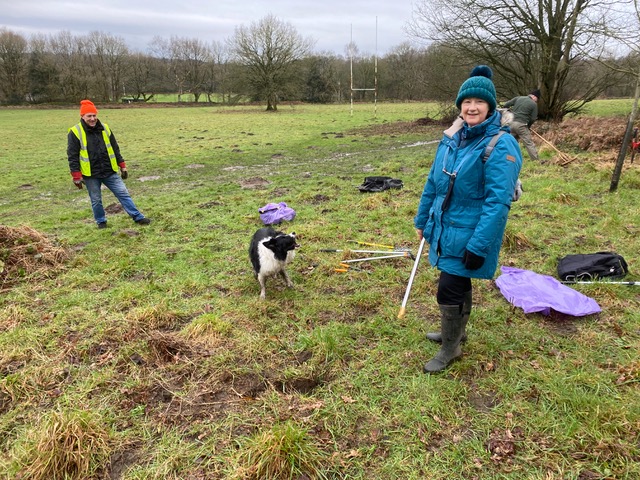
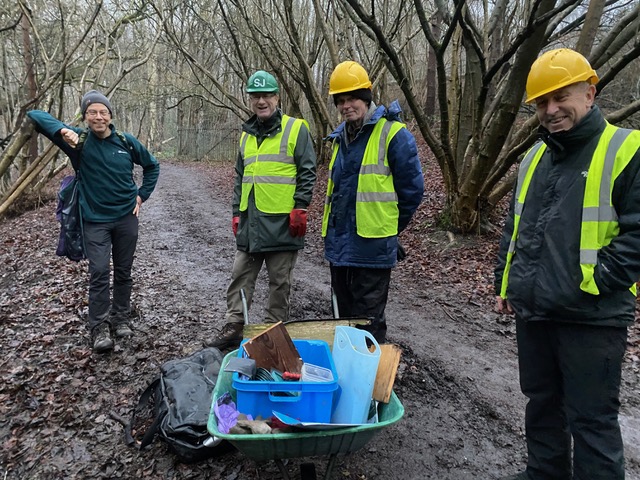
One of our litterpicking team with some of our litterpicking equipment
About Friends of Adel Woods
We hope that you have enjoyed reading about our activities and would be delighted if you would like to join us.
Friends of Adel Woods were formed in 2009 to help maintain Adel Woods and encourage people to enjoy them. We meet one weekend morning a month to carry out various jobs or ”work parties”, and we also put on educational events such as bat walks, fungal forays and birdsong walks.
We are a very friendly group and welcome new members who want to help preserve our special woods, enjoy fresh air and exercise in the woods, and make new friends. 
If you would like to take part in our activities, keep an eye on our Home Page.
You don’t need to book to come along to one of our work “parties”: just come along!
If you would like to join our email mailing list, please get in touch by leaving a comment on this website – you should be able to see a comment button at the bottom of this page.
Today, despite an unpromising weather forecast, we had a magnificent turn out of fifteen volunteers, six to litterpick, and nine to help Joe Craig-Jackson, our local ranger, to work on Adel Bog.
Litterpicking
Our team of six litterpickers divided into a trio, a duo and a soloist who took separate routes covering the Village Green, the disused rugby field, Crag Lane, Adel Crag, the Stairfoot Lane carpark, the path along Adel Beck, and the path through the woods from the pond to Stairfoot Lane.
Between them they picked up four bags of litter including lots of wipes, a nitrous oxide cylinder, a large car carpet, a condom, poo bags, sweet and snack wrappers, bottles, cans, two items of clothing and an old Nokia phone.
Some of our litterpicking equipment after the event
Adel Bog
Adel Bog is a lovely secluded part of Adel Woods. In 2010 the Bog was in a poor state as it had been taken over almost in its entirety by Purple Moor Grass, though it still had populations of wild flowers such as heath spotted orchid and bog asphodel.
In 2011 the British Trust for Conservation Volunteers carried out improvement works on the bog, funded in part by a grant from Alwoodley Parish Council. Since then Friends of Adel Woods have worked to maintain the bog, removing bracken, saplings and brambles, and putting a dead hedge around its southern and western boundaries.
“I really enjoyed tackling those brambles, it was very satisfying.”
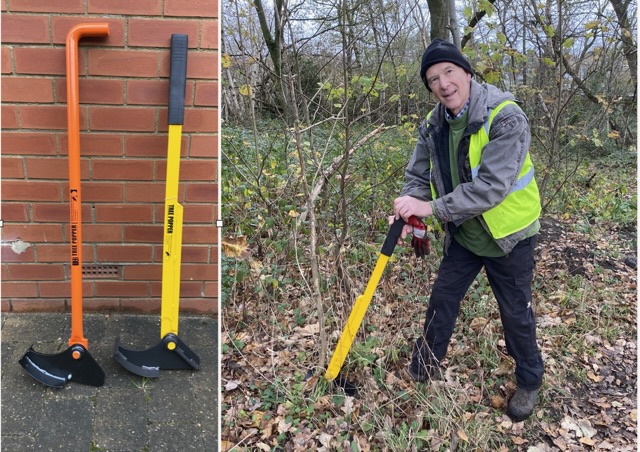
Today we continued our work under the guidance of our local ranger, Joe Craig-Jackson. We also put to good use three tree poppers purchased with the aid of grants from Alwoodley Parish Council. Tree poppers are wonderful tools which enable you to remove a sapling with a trunk size up to about 3 centimetres in a fraction of the time it would take with a mattock or a spade. Today we removed many saplings and lots and lots of brambles.
Joe with some of the Friends of Adel Woods
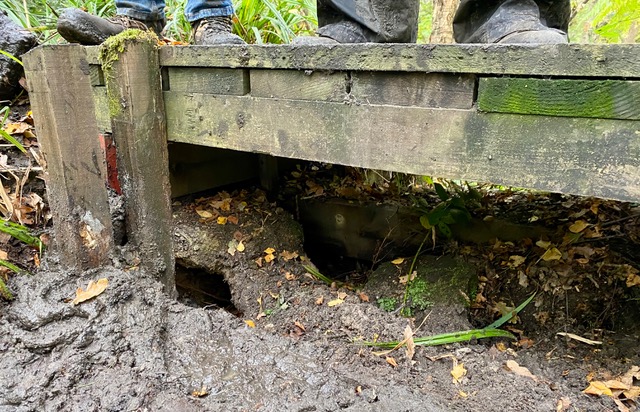
On the way back to our cars at lunchtime, we passed Adel Pond and were delighted that it is in much better condition than it was over the Summer – see our report on the 19th October – though it still needs work to repair a leak.
Adel Pond: water is leaking from under the bridge on the far side
Grant from Alwoodley Parish Council
Friends of Adel Woods are very grateful to Alwoodley Parish Council for a grant in October this year for the purchase of two tree poppers. The council had previously given us a grant for the purchase of our first tree popper in Autumn 2023.
A tree popper is basically a lever with a jaw at the bottom. You put the jaw around the sapling trunk and lever it out of the ground. The tree poppers enable us achieve far more in a morning’s work when removing saplings from Adel Bog, Adel Moor, the orchid meadow and anywhere else in the woods.
Join Friends of Adel Woods
We hope that you have enjoyed reading about our activities and would be delighted if you would like to join us.
Friends of Adel Woods were formed in 2009 to help maintain Adel Woods and encourage people to enjoy them. We meet one weekend morning a month to carry out various jobs or ”work parties”, and we also put on educational events such as bat walks, fungal forays and birdsong walks.
We are a very friendly group and welcome new members who want to help preserve our special woods, enjoy fresh air and exercise in the woods, and make new friends. 
If you would like to take part in our activities, keep an eye on our Home Page.
You don’t need to book to come along to one of our work “parties”: just come along. Our next work party is on Sunday 14th December 2025 when we will be litterpicking and clearing paths.
If you would like to join our email mailing list, please get in touch by leaving a comment on this website – you should be able to see a comment button at the bottom of this page.
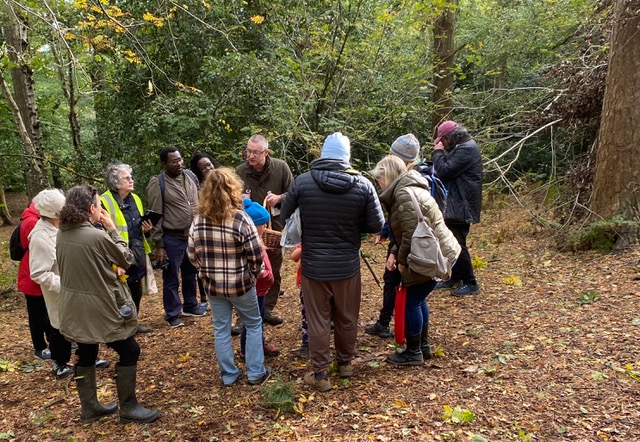
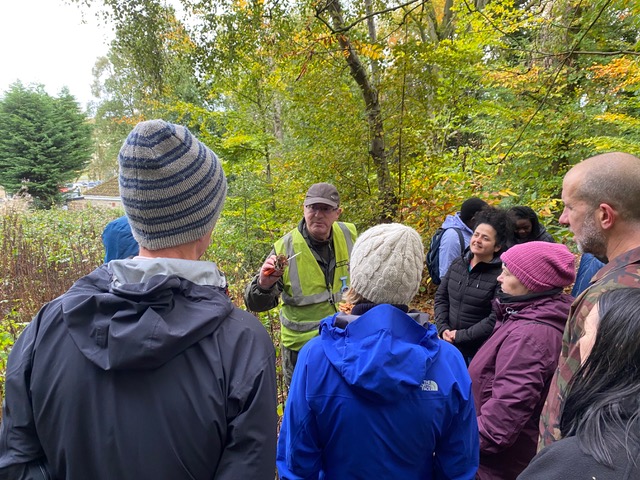
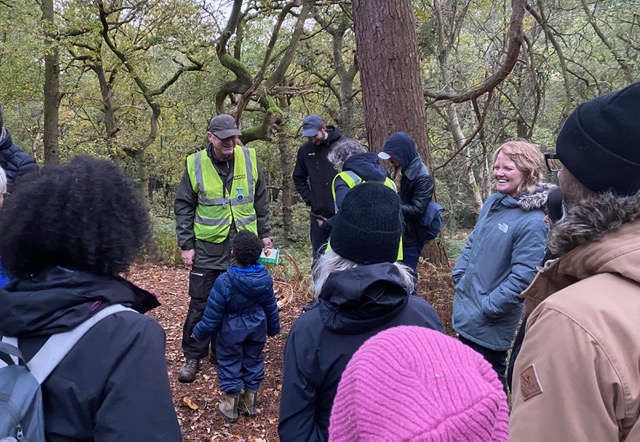
Steve shows a specimen to an enthusiastic audience
This was our second Fungal Foray with Steve Joul this October: our Foray on the 5th October was so overbooked that we hardly needed to advertise this one!
We met at 1.45 pm in the Village Green carpark where our Chair welcomed our participants, introduced Steve, and explained that this was not a foraging event for edible fungi, but an opportunity to learn about the many and varied fungi to be found in Adel Woods.
After the Chair’s introduction, Steve led us along Crag Lane into the woods and, after passing the bungalow, into Alwoodley Plantation.
Candlesnuff fungus (Xylaria hypoxylon)
Once in the plantation, Steve explained that what we think of as fungi and mushrooms are in fact the fruiting bodies of organisms whose main body is concealed in the soil or wood in which they are growing.
There are many thousands of different fungi and mushrooms in the UK which means that it is impossible to know the names of all of them. However, Steve has a list of the two hundred or so most common species which we are likely to find in Adel Woods.
He explained that Identifying fungi involves taking into account such factors as:
where the fungus is growing – for example on or nearby a particular species of tree;
its shape, colour, size, and smell;
how it scatters its spores, the reproductive cells: for example, some drop spores, and some shoot them out!
In some cases it is only possible to identify a fungus with the aid of a magnifying glass or a microscope and a text book. Correct identification is essential because most fungi are inedible and many are poisonous.
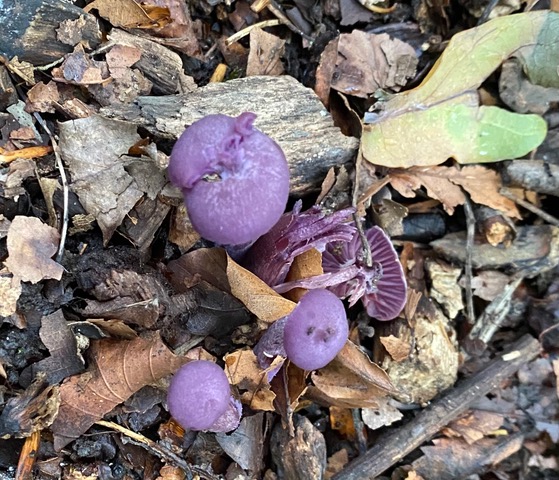
Amethyst deceivers (Laccaria amethystina)
The task of identifying fungi is made more difficult because there is often more than one common name for a species and their Latin names can change as species are re-classified as more is learned about them. Impressively, Steve knows the common names and the Latin names of most of the common species.
He explained that some fungi have a special relationship with particular species of trees whereby the fungus provides nutrients to the roots of the tree and the tree provides nutrients to the fungus.
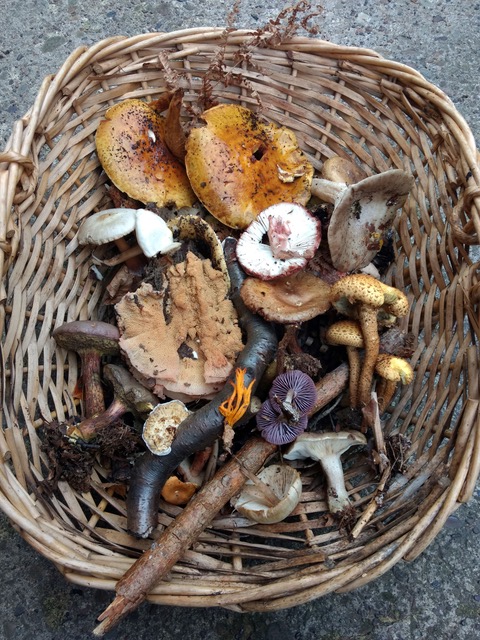
After Steve’s introduction we made our way further into the Plantation searching for fungi on logs, trees, and in the leaf litter. Fortunately we had some very good fungi hunters in our group, especially among the future adults, and during the course of the afternoon, we found forty one species of fungus, many of which Steve collected in his basket. You can find a complete list of the species, giving common English and formal Latin names, at the end of this post.
A young person asks Steve a question
A selection of the fungi found during today’s foray
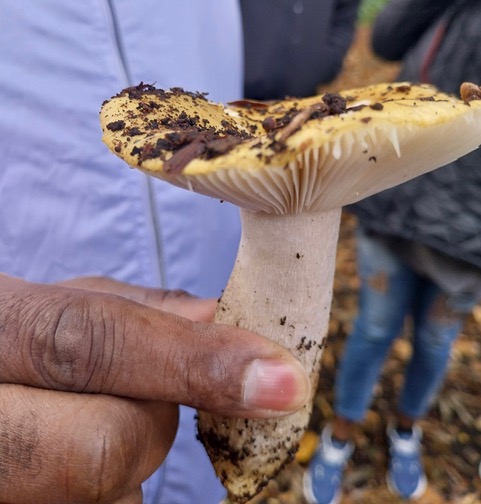
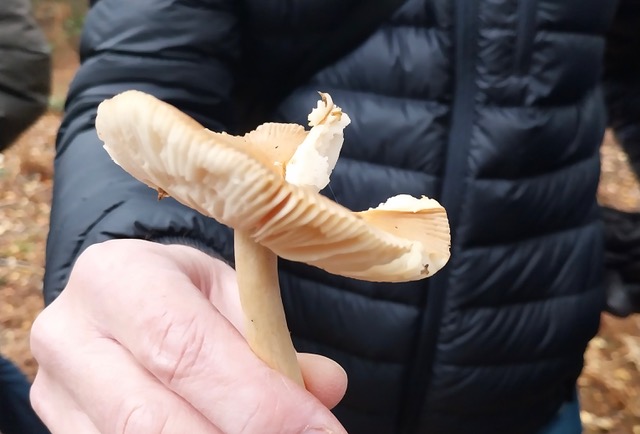
Here are photographs of some of the fungi we found this afternoon…
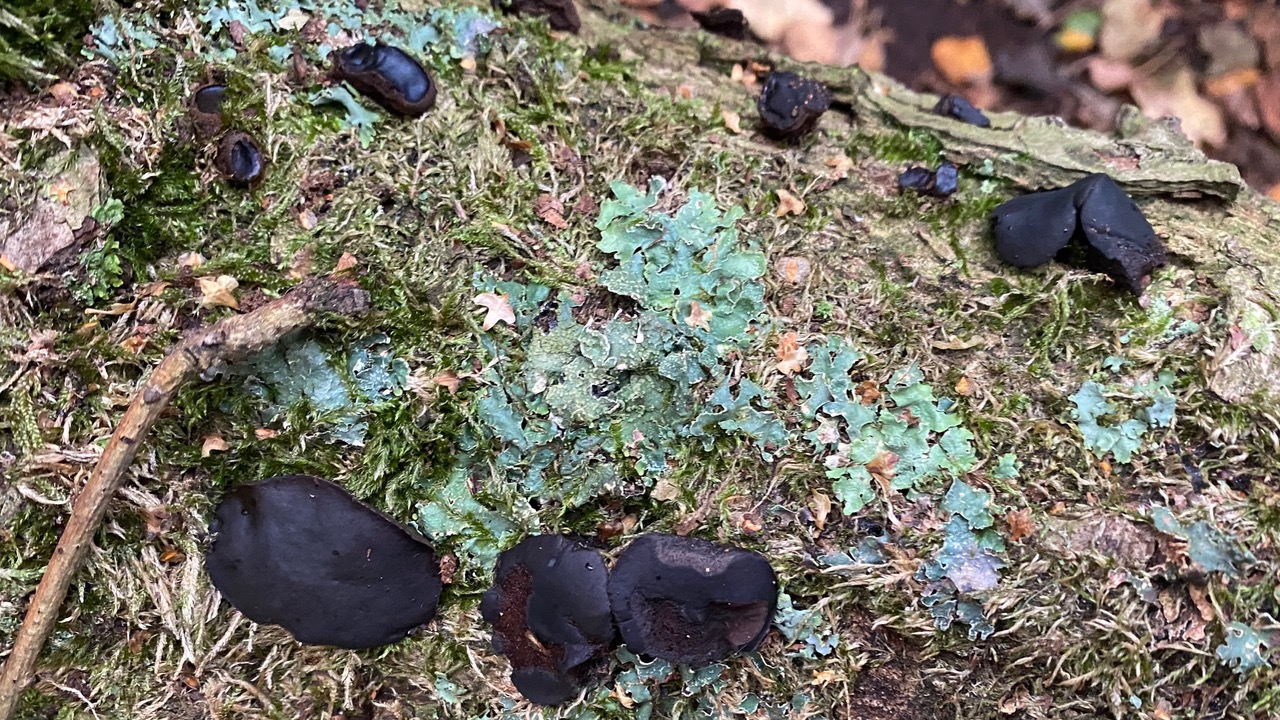
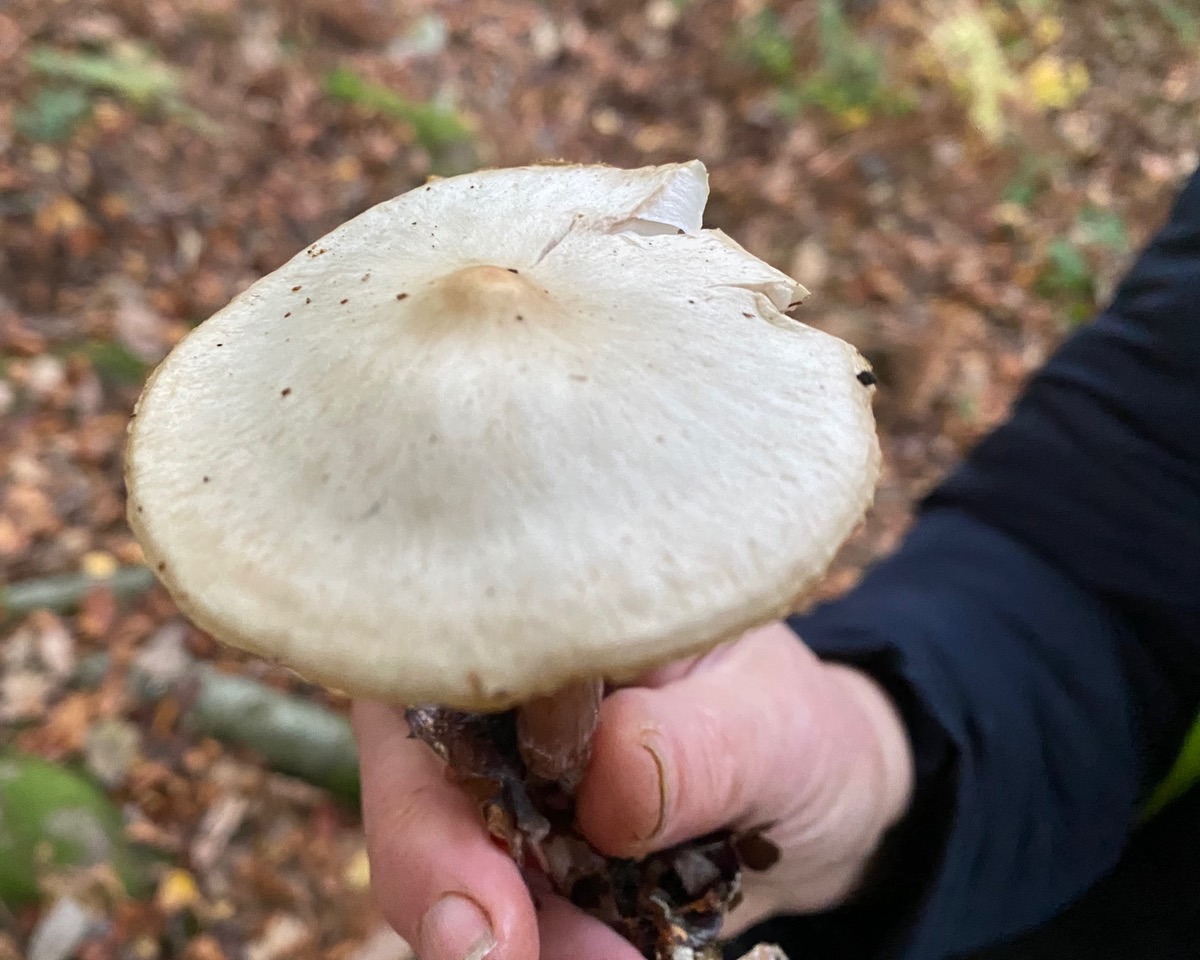
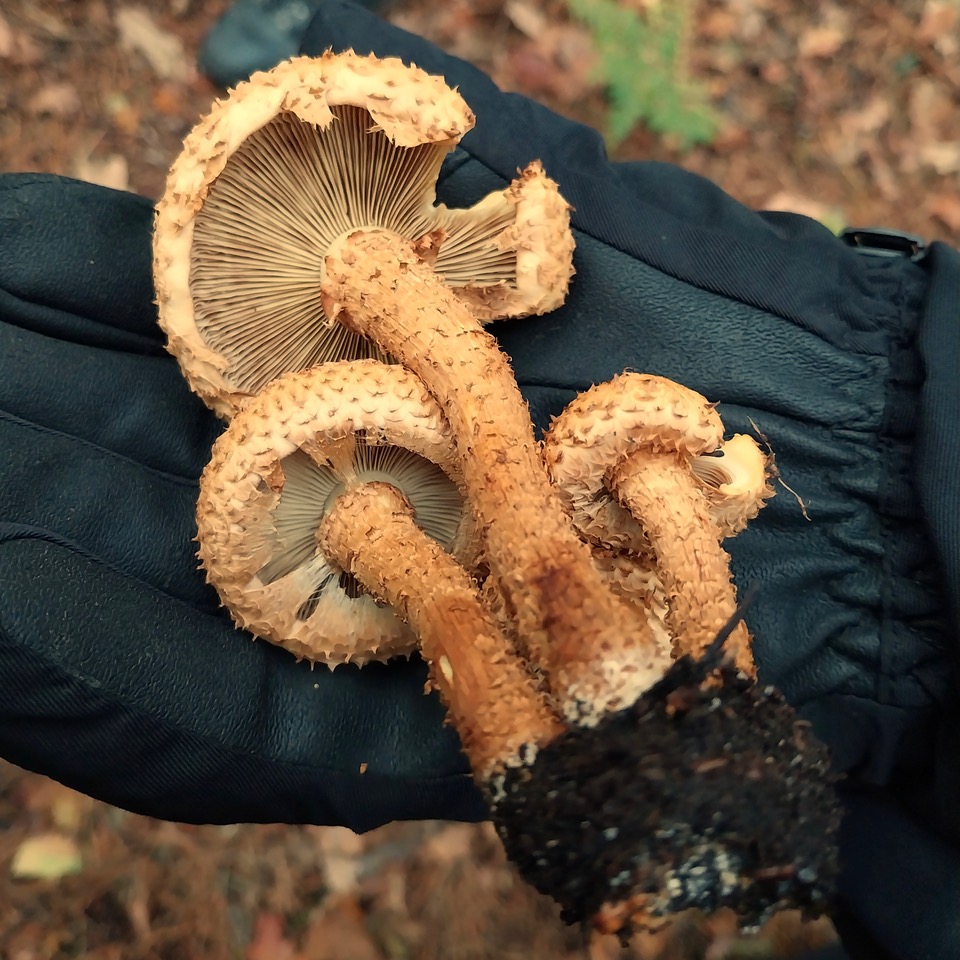
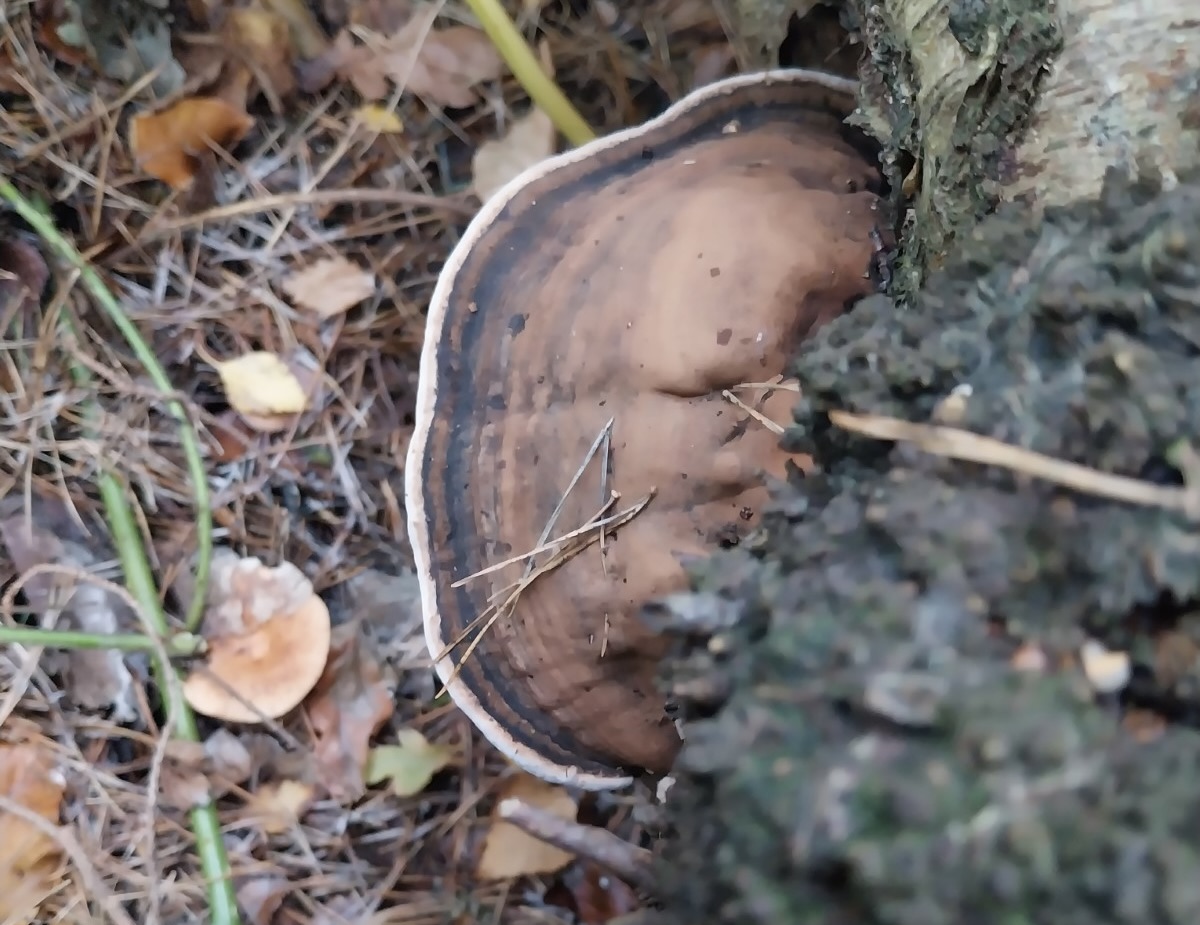
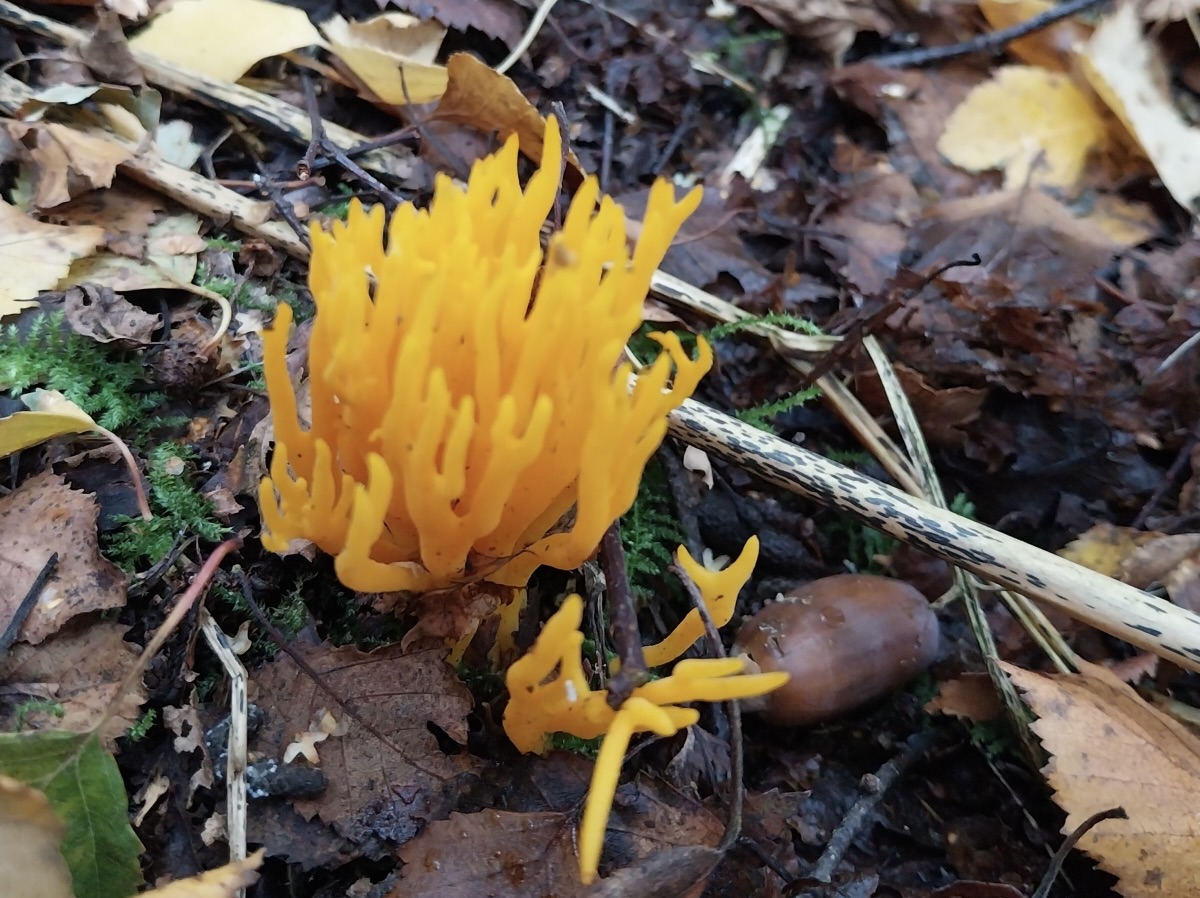
Steve’s basket at the end of the forayTripe fungus (Auricularia mesenterica)Ochre brittle gill (Russula ochroleuca)Blushing bracket (Daedaleopsis confragosa)Tawny grisette (Amanita fulva)Black bulgar (Neobulgaria pura)Butter cap (Collybia butyracea)Shaggy scalycap (Pholiota squarrosa)Milkcap – precise species uncertain. These owe their name to the latex they produce when cut or bruisedRufous milkcap (Lactarius rufus)Southern bracket (Ganoderma adspersum)Yellow stagshorn (Calocera viscosa)
A list of the forty one species found during this afternoon’s foray
Amethyst Deceiver Laccaria amethystina
Bay Bolete Imleria badia
Beech Woodwart Hypoxylon fragiforme
Beech Milkcap Lactarius blennius
Birch Milkcap Lactarius tabidus
Birch Polypore Fomitopsis betulina
Birch Woodwart Jackrogersella multiformis
Black Bulgar Neobulgaria pura
Blusher Amanita rubescens
Blushing Bracket Daedaleopsis confragosa
Branching Oyster Pleurotus cornucopiae
Brown Rollrim Paxillus involutus
Butter Cap Collybia butyracea
Candlesnuff Fungus Xylaria hypoxylon
Chicken Of The Woods Laetiporus sulphureus
Clustered Bonnet Mycena inclinata
Clustered Toughshank Gymnopus confluens
Common Bonnet Mycena galericulata
Deer Shield Pluteus cervinus
False Chanterelle Hygrophoropsis aurantiaca
Goldleaf Shield Pluteus romellii
Jelly Ear Auricularia auricula-judae
Leafy Brain Tremella foliacea
Mild Milkcap Lactarius subdulcis
Oakbug Milkcap Lactarius quietus
Ochre Brittlegill Russula ochroleuca
Peppery Milkcap Lactarius piperatus
Poisonpie Hebeloma crustuliniforme
Purple Brittlegill Russula atropurpurea
Red Cracking Bolete Xerocomellus chrysenteron
Rufous Milkcap Lactarius rufus
Shaggy scalycap Pholiota squarrosa
Smoky Bracket Bjerkandera adusta
Southern Bracket Ganoderma adspersum
Spectacular Rustgill Gymnopilus junonius
Sulphur Tuft Hypholoma fasciculare
Tawny Grisette Amanita fulva
Tripe Fungus Auricularia mesenterica
Turkeytail Trametes versicolor
Ugly Milkcap Lactarius turpis
Yellow Stagshorn Calocera viscosa
Join Friends of Adel Woods!
We hope that you have enjoyed reading about our activities and would be delighted if you would like to join us.
Friends of Adel Woods were formed in 2009 to help maintain Adel Woods and encourage people to enjoy them. We meet one weekend morning a month to carry out various jobs or ”work parties”, and we also put on educational events such as bat walks, fungal forays and birdsong walks.
We are a very friendly group and welcome new members who want to help preserve our special woods, enjoy fresh air and exercise in the woods, and make new friends. 
If you would like to take part in our activities, keep an eye on our Home Page. You don’t need to book to come along to one of our work “parties”: just come along.
If you would like to join our email mailing list, please get in touch by leaving a comment on this website – you should be able to see a comment button at the bottom of this page.
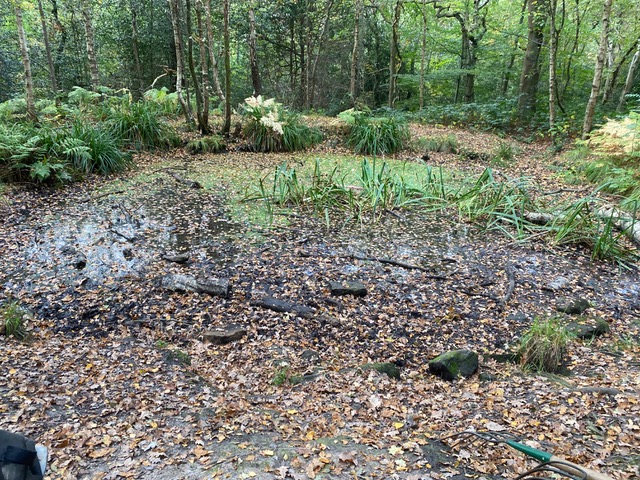
Before: Adel Woods Pond at 10.23 on Sunday the 19th October 2025 – looking Southwards
Today we had a fantastic turn out of seventeen volunteers – seven for litterpicking and ten to work with our local Parks and Countryside ranger, Joe Craig-Jackson, on Adel Pond.
Adel Woods Pond
Adel Woods pond is an important habitat for frogs, newts, dragonflies and other invertebrates and every Autumn Friends of Adel Woods work with our local ranger to dredge silt from the pond.
However, as can be seen from the photograph above, the pond has had a difficult year. It is fed by a ditch on the north side, and water flows out via a sluice gate in the southern bank. Unfortunately, a leak developed in the sluice gate about a year ago, and the situation was exacerbated because very little water has flowed into the pond over the very dry summer: a month ago it was possible to walk to the middle of the pond without getting wet feet!
Joe Craig-Jackson tests the water depth in Adel Woods Pond
We made our way to the pond and, having outlined our aims for the morning, Joe tested the depth of the water with a stick. There was little water in the northern half of the pond, but with the recent rain the ground had turned to mud. There was a foot or more of water in the southern half of the pond.
One of the things that surprises us each Autumn is the number of sticks, branches, logs and large stones which end up in the pond. Each year we remove them, but each year we find a lot more have arrived. Some of the sticks and branches must fall in from the neighbouring trees, but some of them -and the logs and the large stones – must be thrown in by passers-by for a lark.
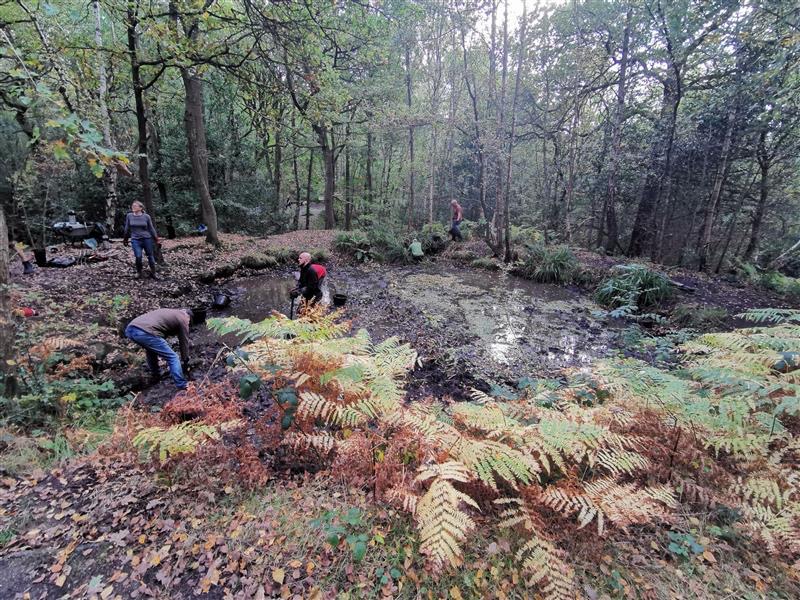
Removing debris and silt from Adel Woods Pond
The first job was therefore to remove all logs, branches and stones. In addition to the many to be seen lying on the mud, in the southern half of the pond there were many more concealed under the surface of the water.
The second job was to clear the ditch feeing the pond and to dig as much mud as possible from the pond, load it into buckets and dispose of it well away from the pond.
The outflow from Adel Woods Pond
Our third task was to clear all the vegetation and mud from around the leaking sluice gate so that we could see work out what needs to be done to repair the leak.
Some of our happy volunteers at the end of a morning’s work
We had a very successful couple of hours work as can be seen by comparing the photograph below with the photograph at the beginning of this post.
After:Adel Woods Pond at 12.24 pm
Litterpicking
Seven of our Friends picked up litter today.
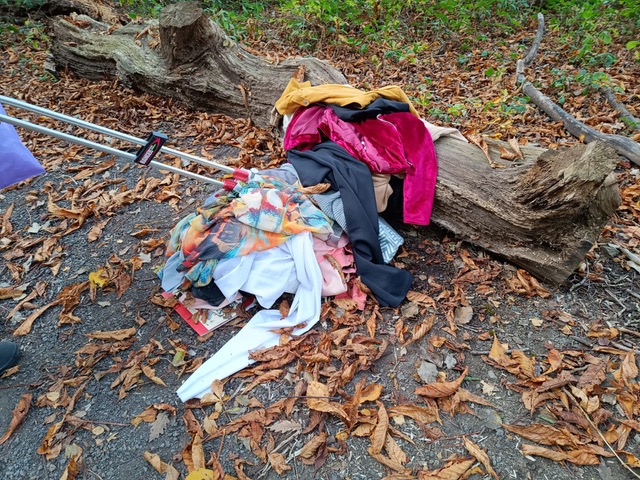
Flytipping in Adel Woods
Starting from our meeting point on Buckstone Road, they picked up litter on the recreation ground, along Crag Lane, around Adel Crag, the Stairfoot Lane carpark and Alwoodley Plantation. In addition to the normal bottles, cans, paper litter, and bags of dog poo, they found two lots of flytipping – a bag of clothes and a table football table.
More flytipping in Adel Woods
Join Friends of Adel Woods!
We hope that you have enjoyed reading about our activities and would be delighted if you would like to join us.
Friends of Adel Woods were formed in 2009 to help maintain Adel Woods and encourage people to enjoy them. We meet one weekend morning a month to carry out various jobs or ”work parties”, and we also put on educational events such as bat walks, fungal forays and birdsong walks.
We are a very friendly group and welcome new members who want to help preserve our special woods, enjoy fresh air and exercise in the woods, and make new friends. 
If you would like to take part in our activities, keep an eye on our Home Page. You don’t need to book to come along to one of our work “parties”: just come along.
If you would like to join our email mailing list, please get in touch by leaving a comment on this website – you should be able to see a comment button at the bottom of this page.
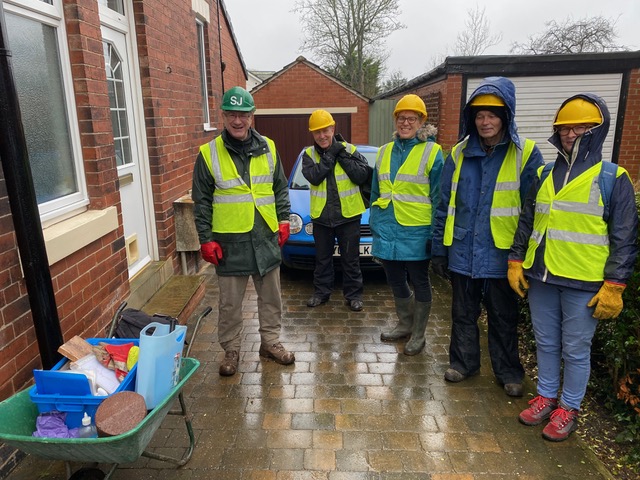
This afternoon nineteen adults and eight children gathered in Alwoodley Village Green carpark for a Fungal Foray led by Steve Joul. This was not a foraging event for edible fungi, but an opportunity to learn about the many and varied fungi to be found in Adel Woods.
After a brief introduction to Friends of Adel Woods by our Chair, Steve led us along Crag Lane into the woods and, after passing the bungalow, into Alwoodley Plantation.
Once in the plantation, Steve explained that what we think of as fungi and mushrooms are in fact the fruiting bodies of organisms whose main body is concealed in the soil or wood in which they are growing.
There are many thousands of different fungi and mushrooms in the UK which means that it is impossible to know the names of all of them. However, Steve has a list of the two hundred or so most common species which we are likely to find in Adel Woods.
He explained that Identifying fungi involves taking into account such factors as:
where the fungus is growing – for example on or nearby a particular species of tree
its shape, colour, size, and smell
how it scatters its spores, the reproductive cells: for example, some drop spores, and some shoot them out!
In some cases it is only possible to identify a fungus with the aid of a magnifying glass or a microscope and a text book. Correct identification is essential because most fungi are inedible and many are poisonous.
Sulfur tuft mushroom
The task of identifying fungi is made more difficult because there is often more than one common name for a species and their Latin names can change as species are re-classified as more is learned about them. Impressively, Steve knows the common names and the Latin names of most of the common species.
Amethyst Deceiver (laccaria amethystina)
He explained that some fungi have a special relationship with particular species of trees whereby the fungus provides nutrients to the roots of the tree and the tree provides nutrients to the fungus.
After Steve’s introduction we made our way further into the Plantation searching for fungi on logs, trees, and in the leaf litter. Fortunately we had some very good fungi hunters in our group, especially among the future adults, and during the course of the afternoon, we found fifty species of mushroom, many of which Steve collected in his basket. You can find a complete list of the species, giving common English and formal Latin names, at the end of this post.
That’s an interesting find!
Some of the fungi have very strange common names: “turkey tail”; “hairy curtain crust”; “leafy brain”; “earpick fungus” and “ugly milkcap”. During the afternoon one of our number was heard to exclaim to Steve: “You’re making these names up: you could tell us anything and we’d believe it!”
The foray finished at 4 pm by which time we had gathered a wonderful diversity of fungi species.
Steve’s basket at the end of the walk
Once again it was a fantastic afternoon of discovery, learning and fun. Thank you to Steve and everyone who took part.
“I just wanted to thank you for a thoroughly enjoyable afternoon. We were indeed blessed with the weather. I learnt a great deal about the wonderful world of fungi and hope to continue expanding my knowledge.”
————————–
“Thank you for organising today’s excursion. We thoroughly enjoyed it and look forward to future ones. Please convey our thanks to Steve as well.”
A selection of the fungi found during today’s foray
Here are photographs of some of the fungi we found this afternoon – more or less in the order we found them…
Clustered Bonnet, and Deceiver (probably – not all features visible)Angel BonnetAmethyst Deceiver viewed directly from aboveA variety of milkcap – so called because it produces a white milky substance when handledEarpick Fungus (auriscalpium vulgare) – typically found on decaying pine conesEarpick fungus (auriscalpium vulgare) viewed from belowBay Bolete (imleria badia) – a fungus which develops blue bruises when handledTwo for the price of one: a pipe club fungus lying on top of what is probably a brown rollrimAniseed Funnel (clitocybe odora), so named because it smells of aniseedYellow Brain Fungus (tremella mesenterica)Fly Agaric (amanita muscaria)
A list of all the fungi found during today’s foray
Alder Scalycap (Pholiota alnicola)
Amethyst Deceiver (Laccaria amethystina)
Aniseed Funnel (Clitocybe odora)
Bay Bolete (Imleria badia)
Beech Barkspot (Diatrype disciformis)
Beech Milkcap (Lactarius blennius)
Beech Woodwart (Hypoxylon fragiforme)
Birch Milkcap (Lactarius tabidus)
Birch Polypore (Fomitopsis betulina)
Black Bulgar (neabulgaria pura)
Blusher (amanita rubescens)
Branching Oyster (pleurotus cornucopiae)
Brown Mottlegill (panaeolina foenisecii)
Brown Rollrim (paxillus involutus)
Buttercap (collybia butyracea)
Candlesnuff Fungus (xylaria hypoxylon)
Common Bonnet (mycena galericulata)
Common Earthball (scleroderma citrinum)
Common Funnel (infundibulicybe gibba)
Common Puffball (lycoperdon perlatum)
Deceiver (laccaria laccata)
Deer Shield (pluteus cervinus)
Earpick Fungus (auriscalpium vulgare)
Fly Agaric (amanita muscaria)
Ganoderma Bracket (ganoderma sp.)
Glistening Inkcap (coprinellus micaceus)
Grisette (amanita vaginata)
Hairy Curtain Crust (stereum hirsutum)
Honey Fungus (armillaria mellea)
Hoof Fungus (fomes fomentarius)
Jelly Ear (auricularia auricula-judae)
Leafy Brain (tremella foliacea)
Oakbug Milkcap (lactarius quietus)
Ochre Brittlegill (russula ochroleuca)
Penny Bun (boletus edulis)
Pipe Club (macrotyphula fistulosa)
Purple Brittlegill (russula atropurpurea)
Red Cracking Bolete (xerocomellus chrysenteron)
Rufous Milkcap (lactarius rufus)
Russet Toughshank (gymnopus dryophilus)
Shaggy Parasol (chlorophylum rhacodes)
Shaggy Scalycap (pholiota squarrosa)
Silky Rosegill (vovariella bombycina)
Smoky Bracket (bjerkandera adusta)
Sulphur Tuft (hypholoma fasciculare)
Turkeytail (trametes versicolor)
Ugly Milkcap (lactarius turpis)
White Brain (exidia thuretiana)
Yellow Brain (tremella mesenterica)
Yellow Stagshorn (calocera viscosa)
JOIN FRIENDS OF ADEL WOODS!
We hope that you have enjoyed reading about our activities and would be delighted if you would like to join us.
Friends of Adel Woods were formed in 2009 to help maintain Adel Woods and encourage people to enjoy them. We meet one weekend morning a month to carry out various jobs or ”work parties”, and we also put on educational events such as bat walks, fungal forays and birdsong walks.
We are a very friendly group and welcome new members who want to help preserve our special woods, enjoy fresh air and exercise in the woods, and make new friends. 
If you would like to take part in our activities, keep an eye on our Home Page.
You don’t need to book to come along to one of our work “parties”: just come along. Our next work party is on Saturday 22nd November 2025 when we will be working with our local ranger, Joe Craig-Jackson.
If you would like to join our email mailing list, please get in touch by leaving a comment on this website – you should be able to see a comment button at the bottom of this page.
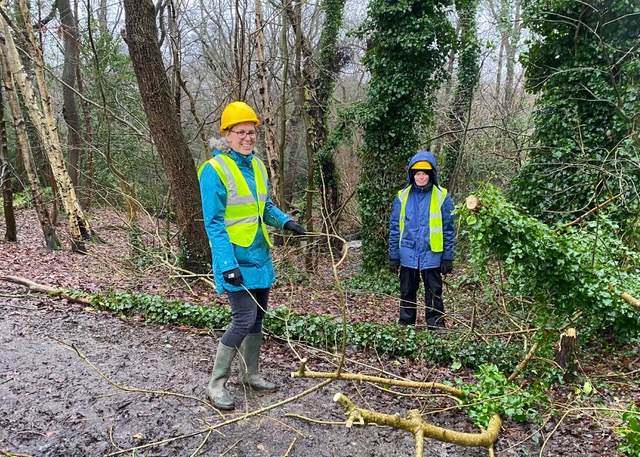
Friends of Adel Woods had a stall at the Alwoodley Parish Community Picnic this afternoon. Alwoodley Parish Council, Alwoodley 2030, Incredible Edible Alwoodley, and Incredible Edible Moortown were also there.
Just setting up our stall
Though overcast at 2 pm, it turned into a beautiful afternoon and we all really enjoyed the event.
Steve Joul, our committee member and ace naturalist, brought two quizzes and spent the afternoon entertaining the public, and yours truly led a twenty minute “mindfulness walk” along Crag Lane and back.
“I really enjoyed yesterday, especially the mindfulness walk and the quizzes. Thank you everyone.”
“…some great networking went on between the groups and people clearly enjoyed the quiz.”
We were also grateful to Dan Cohen, the Lord Mayor of Leeds, who came with the Lady Mayoress to support the event.
Join Friends of Adel Woods
We hope that you have enjoyed reading about our activities and would be delighted if you would like to join us.
Friends of Adel Woods were formed in 2009 to help maintain Adel Woods and encourage people to enjoy them. We meet one weekend morning a month to carry out various jobs or ”work parties”, and we also put on educational events such as bat walks, fungal forays and birdsong walks.
We are a very friendly group and welcome new members who want to help preserve our special woods, enjoy fresh air and exercise in the woods, and make new friends. 
If you would like to take part in our activities, keep an eye on our Home Page and come along to one of our work parties. Our next work party is on Saturday 13th September, and we are putting on a Fungal Foray on the 5th October.
If you would like to join our email mailing list, please get in touch by leaving a comment on this website – you should be able to see a comment button at the bottom of this page.
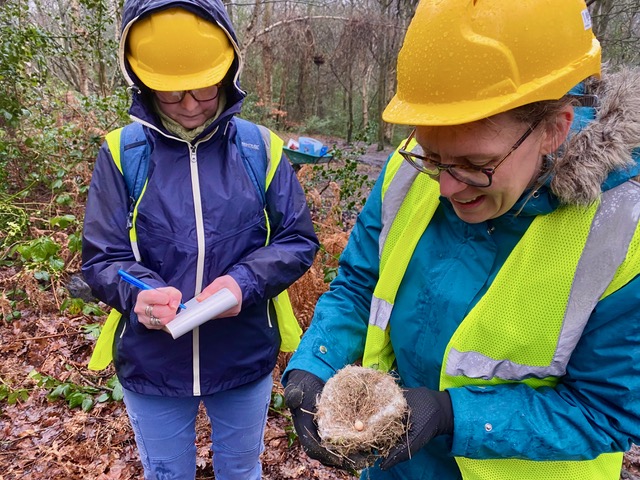
A beautiful evening and twenty nine adults and eleven children gathered in Alwoodley Village Green car park at 7.45 pm for a bat walk led by Leeds City Council rangers, Rachel Todner and Joe Craig-Jackson.
To begin the event, the Chair of Friends of Adel Woods gave a brief address describing the various habitats in Adel Woods, and the work done by our volunteers, before introducing Rachel and Joe. We then made our way along Crag Lane to the peace and quiet of Old Leo’s car park.
Rachel and Joe addressing demonstrating how to use bat detectors
Once in Old Leo’s car park Rachel and Joe distributed bat detectors and cards listing the species of bat that can be found living in the UK.
Two bat detectors
An introduction to bats and bat detectors
When we all had bat detectors, Rachel gave an introductory talk about bats. She explained that contrary to popular belief, bats have good eyesight. However, because they hunt at dusk and night they have evolved an echolocation method of hunting and navigating around their environment. They send out high pitched sounds and use the echos which bounce off insects and objects in their surroundings to locate obstacles and their prey.
She explained that there are seventeen breeding species of bat in the UK which each make echolocation sounds at specific pitches, and this is one of the ways that we can tell which bat species are flying in the vicinity.
Because the echolocation sounds made by bats are too high pitched for humans to hear, we need to use bat detectors to pick up the sounds and convert them to a pitch we can hear. By adjusting the detection frequency of the detector we are able to tell which bats are around.
A table showing the echolocation frequencies of UK bats
The batwalk
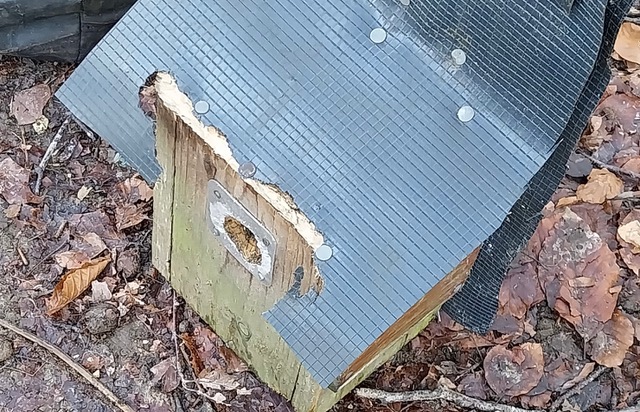
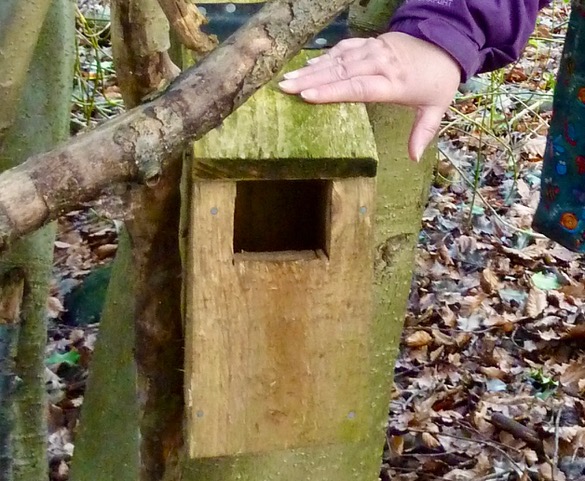
From Old Leo’s we made our way into the woods to have a look at some bat boxes made and put up by Friends of Adel Woods in 2010 to provide roosting. The chair of FOAW explained that these differ from tit boxes in that there is no round hole in the front of the box. Instead, the back board of the box extends down below the box and bats land on this and crawl up into the box through a slit in the base.
FOAW put up seven bat boxes – four on one tree and three on another, each of the boxes facing in different directions so that the bats could choose which box they preferred to roost in. We do not know if the bat boxes have been used as it is a criminal offence to look into them.
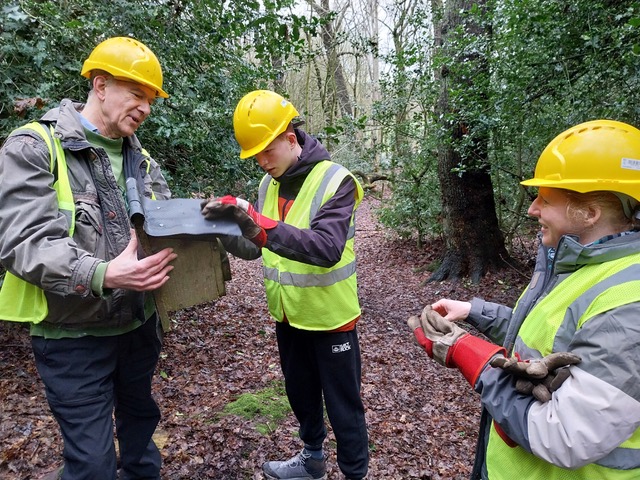
One of the bat boxes made and put up by FOAW in January 2010
From the bat boxes we made our way along Crag Lane to the picnic area where we were excited to see our first bats of the evening. The frequency of their echolocation, 55kHz, indicated they were soprano pipistrelle bats.
From the picnic area we continued to Adel Crag, which the sculptor Henry Moore said was one of his sources of inspiration (along with the slag heaps of Castleford!). There we saw a number of bats which we identified as soprano pipistrelle and common pipistrelle (45kHz).
From the Crag we made our way back along Crag Lane to the disused rugby field to the north of Crag Lane. Here we saw many bats, including soprano pipistrelle, pipistrelle and noctule bats (25kHz). Rachel also wondered if we saw a brown long eared bat in the middle of the field based on the frequency of its echolocation (48kHz) and its size.
Friends of Adel Woods bat detecting in the disused rugby field
Finally, at about 9.30 pm we made our way back along Crag Lane to the Village Green car park. On the way we picked up many calls from noctule bats.
If you would like to find out more about bats in the UK, have a look at the bat conservation trust website.
It was a very successful and enjoyable evening and we received some lovely messages of thanks from the participants.
“Thanks for arranging the bat walk last night. Very enjoyable.“
“Thank you for the very enjoyable bat walk last night!“
“Just wanted to thank you for running the bat walk, the kids and I had a blast.”
Join Friends of Adel Woods
We hope that you have enjoyed reading about our activities and would be delighted if you would like to join us.
Friends of Adel Woods were formed in 2009 to help maintain Adel Woods and encourage people to enjoy them. We meet one weekend morning a month to carry out various jobs or ”work parties”, and we also put on educational events such as bat walks, fungal forays and birdsong walks.
We are a very friendly group and welcome new members who want to help preserve our special woods, enjoy fresh air and exercise in the woods, and make new friends. If you would like to take part in our activities, keep an eye on our Home Page and come along to one of our work parties.
If you would like to join our email mailing list, please get in touch by leaving a comment on this website – you should be able to see a comment button at the bottom of this page.
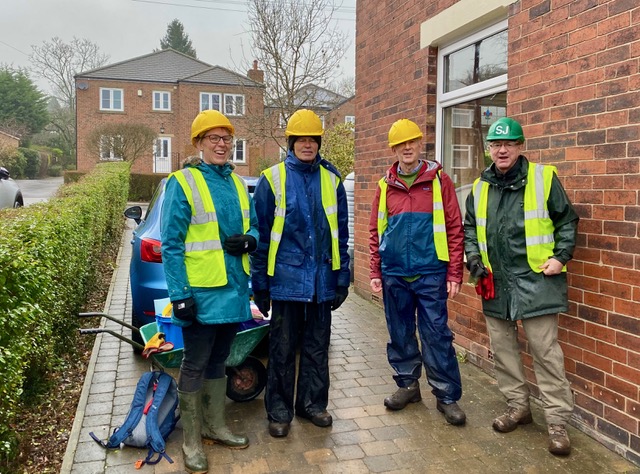
This morning fourteen of us met at the Slabbering Baby entrance to the woods on Buckstone Road. We had two tasks scheduled: litterpicking, and working with ranger Joe Craig-Jackson on the orchid meadow.
Litterpicking
Four of us chose to pick up litter – three working together, and one choosing to work on her own (with her dog). Here are their reports:
“Three of us and we collected three bags of litter. Dave left us to collect litter on his way back home and two of us walked to the picnic tables, Adel Crag and the Stairfoot Lane Car Park. It was quite challenging with the wind gusts so the bin bag hoops proved their worth. There was very little litter on the main paths and car parks – most was in the woods adjacent to paths. There was plenty of dog poop, mercifully bagged, and the usual plastic bottles, cans and paper waste.”
“This morning I went from Buckstone Road to the village green. There was a fair bit of rubbish around – mainly cans, plastic bottles, sweet wrappers and a couple of wipes!! From there through the woods to Devil’s Rock and then to St Gemma’s field. I targeted an area tucked away in the middle, previously used as a chill out zone – lots of rubbish etc. Returned to the Orchid Field with one large bag of rubbish.“
The orchid meadow (aka the cricket meadow)
Joe going through the Risk Assessment before we start work
Ten of us chose to work on the orchid meadow (also known as the cricket meadow).
Friends of Adel Woods have been looking after the meadow since 2014. It is home to many beautiful common spotted orchids which flower in June andJuly each year, as well as other wild flowers. To keep it in good condition, we need to mow it in August each year and rake off the mowings. If we don’t, the meadow will be soon be taken over by brambles, bracken and saplings – which was its state in 2014.
This year, Leeds City Council rangers Rachel Todner and Louise Gibson mowed the meadow a week or so ago, and raked the mowings into long piles to allow them to dry out in the sun and drop any seeds.
However, they left an area of the meadow unmown so that Joe could show members of Friends of Adel Woods how to use a scythe. Several of our group chose this option and they made a good job of it.
Gathering up the mowings – and in the distance, learning to use a scythe
The rest of us raked the mowings into piles and transported them into compost heaps in the woodland edge.
We also took the opportunity to pull up a lot of Himalayan Balsam from the woodland margin around the meadow.
One of our compost heaps
We finished working just after 12 noon and Joe got out the brew kit and some biscuits to provide much needed refreshment.
Some of our happy team
Join Friends of Adel Woods
We hope that you have enjoyed reading about our activities and would be delighted if you would like to join us.
Friends of Adel Woods were formed in 2009 to help maintain Adel Woods and encourage people to enjoy them. We meet one weekend morning a month to carry out various jobs or ”work parties”, and we also put on educational events such as bat walks, fungal forays and birdsong walks.
We are a very friendly group and welcome new members who want to help preserve our special woods, enjoy fresh air and exercise in the woods, and make new friends. If you would like to take part in our activities, keep an eye on our Home Page and come along to one of our work parties.
If you would like to join our email mailing list, please get in touch by leaving a comment on this website – you should be able to see a comment button at the bottom of this page.
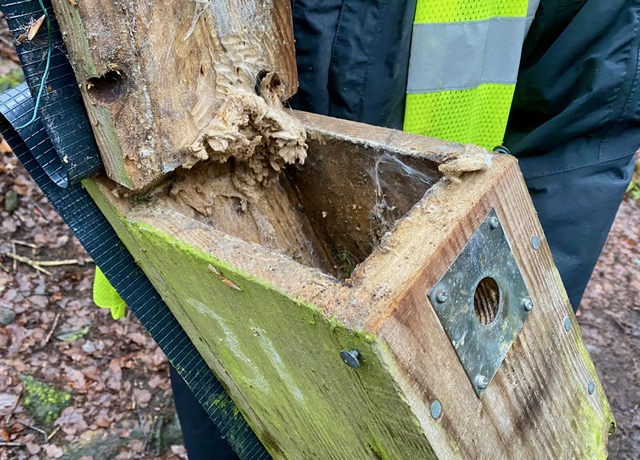
Adel Pond: 24th June 2025 looking towards the sluice gate on the southern side.
Adel Pond is an important breeding place for frogs and palmate newts but it has suffered inthis year’s drought. A leak of water from the pond around the sluice gate on the southern side of the pond has made the situation worse.
Today Steve Joul and the chair of Friends of Adel Woods met with members of the Parks and Countryside department of Leeds City Council to ascertain what work needs to be carried out to repair the pond and to improve it. We were able to establish that water was not actually leaking through the sluice gate but flowing out through the clay below or to the side of the gate. It is possible that the leak has been caused by tree roots.
Adel Pond: 23rd July 2025
This was a great opportunity to meet up with rangers Nick Denman and Joe Craig-Jackson who will be working with Friends of Adel Woods from now on, and with senior ranger Joe Green and Jodie Robertson, conservation and woodland creation officer.
After inspecting the pond we had a quick look at the orchid (or cricket) meadow where Nick or Joe will be working with FOAW on 11th August. It was agreed that the meadow will be mown by two of the ranger team in advance of the 11th August, so that members of FOAW can rake up and compost the mowings when working with Joe. It was also agreed that a small area of the meadow would be left so that members of FOAW can have a go at mowing with scythes.
Adel Moor on 23rd July2025
On the way back to our vehicles, we had a look at Adel Moor to discuss the work required to look after it. The moor was looking magnificent.
The continued drought since the 23rd July has left the pond almost completely dry, as shown in this photograph taken on the 10th August.
Adel Pond on 10th August 2025
Join Friends of Adel Woods
We hope that you have enjoyed reading about our activities and would be delighted if you would like to join us.
Friends of Adel Woods were formed in 2009 to help maintain Adel Woods and encourage people to enjoy them. We meet one weekend morning a month to carry out various jobs or ”work parties”, and we also put on educational events such as bat walks, fungal forays and birdsong walks.
We are a very friendly group and welcome new members who want to help preserve our special woods, enjoy fresh air and exercise in the woods, and make new friends. If you would like to take part in our activities, keep an eye on our Home Page and come along to one of our work parties. Our next work party is on the Saturday the 9th August and our local ranger will be leading a batwalk for us the evening of Thursday the 14th August.
If you would like to join our email mailing list, please get in touch by leaving a comment on this website – you should be able to see a comment button at the bottom of this page.
A beautiful morning, and even though the forecast was for extremely hot sun, we still had an excellent turnout of fifteen volunteers – including four new Friends!
We met on Buckstone Avenue at 9.55 am with two tasks on the agenda: litterpicking and clearing away scrub from around the Buck Stone.
Litterpicking
Setting off from the Buck Stone to litterpick
Five people and Coco the collie chose to go litterpicking.
A group of four litterpicked as they made their way to the Village Green and around the play area and the Village Green carpark. Between them they picked up two full bags of litter including litter from Nanny Beck.
The fifth litter picker and Coco walked through the woods from the Buck Stone to the Village Green, returning to the Buck Stone by a different route. She collected one bag of litter, mainly from the Village Green.
The Buck Stone
The north face of the Buck Stone at 10.30 am
The Buck Stone is a well-known landmark in Alwoodley and the Buckstone estate is named after it. The earliest known reference to it on a map dates back to the 1770’s when the local landowners, the Lane Fox family, had the map prepared in relation to a property dispute.
The south face of the Buck Stone at 10.30 am
In the 1960’s, the Buck Stone was a popular place for children to play, but by 2012 the stone was completely obscured by an oak tree. In March of that year, Friends of Adel Woods removed the bulk of the tree and have subsequently removed the scrub – bracken, rosebay willow herb, saplings and Himalayan balsam – from around the stone several times.
Bindweed growing counter-clockwise up a bracken stem.
Today the main plants we removed were bracken, Himalayan balsam and bindweed.
The path behind Buckstone Avenue at 10.30 am
We also took the opportunity to clear the path that leads from the Buck Stone to Adel Moor along the back of the houses on Buck Stone Avenue.
The path behind Buckstone Avenue at 12 noon
Fortunately, though very warm, the weather did not live up to the inferno predicted in the press! No one called upon our supplies of cold water and sunscreen, and we all enjoyed our morning’s exercise and socialising.
The north face of the Buck Stone at 12 noonThe south face of the Buck Stone at 12 noon
Join Friends of Adel Woods
We hope that you have enjoyed reading about our activities and would be delighted if you would like to join us.
Friends of Adel Woods were formed in 2009 to help maintain Adel Woods and encourage people to enjoy them. We meet one weekend morning a month to carry out various jobs or ”work parties”, and we also put on educational events such as bat walks, fungal forays and birdsong walks.
We are a very friendly group and welcome new members who want to help preserve our special woods, enjoy fresh air and exercise in the woods, and make new friends. If you would like to take part in our activities, keep an eye on our Home Page and come along to one of our work parties. Our next work party is on the Saturday the 9th August and our local ranger will be leading a batwalk for us the evening of Thursday the 14th August.
If you would like to join our email mailing list, please get in touch by leaving a comment on this website – you should be able to see a comment button at the bottom of this page.