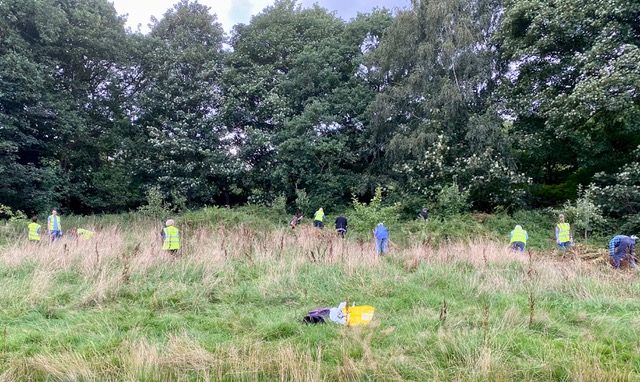
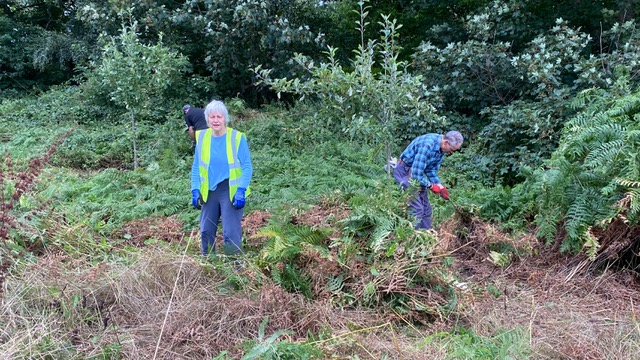
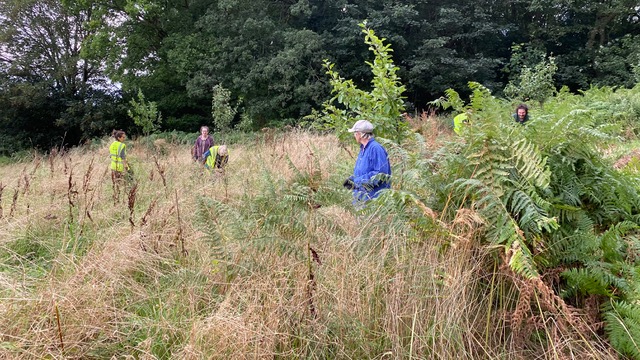
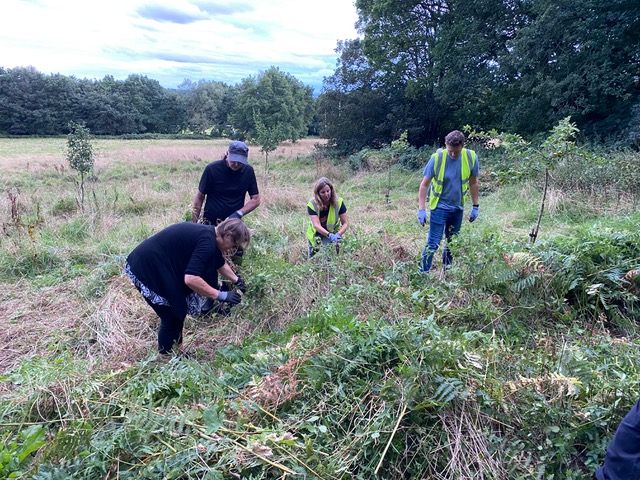
Friends of Adel Woods and Alwoodley 2030 volunteers working on the community orchard
This evening, Friends of Adel Woods had our first ever evening “work party” led by our secretary, Stephanie.
It was a joint event with Alwoodley 2030 who are a group set up about a year ago under the umbrella of Climate Action Leeds. The aim of Alwoodley 2030 is to “activate community-driven solutions to address the loss of biodiversity and nature and the climate emergency”. You can find out more at their very active Facebook page: Alwoodley 2030: Climate Action Hub.
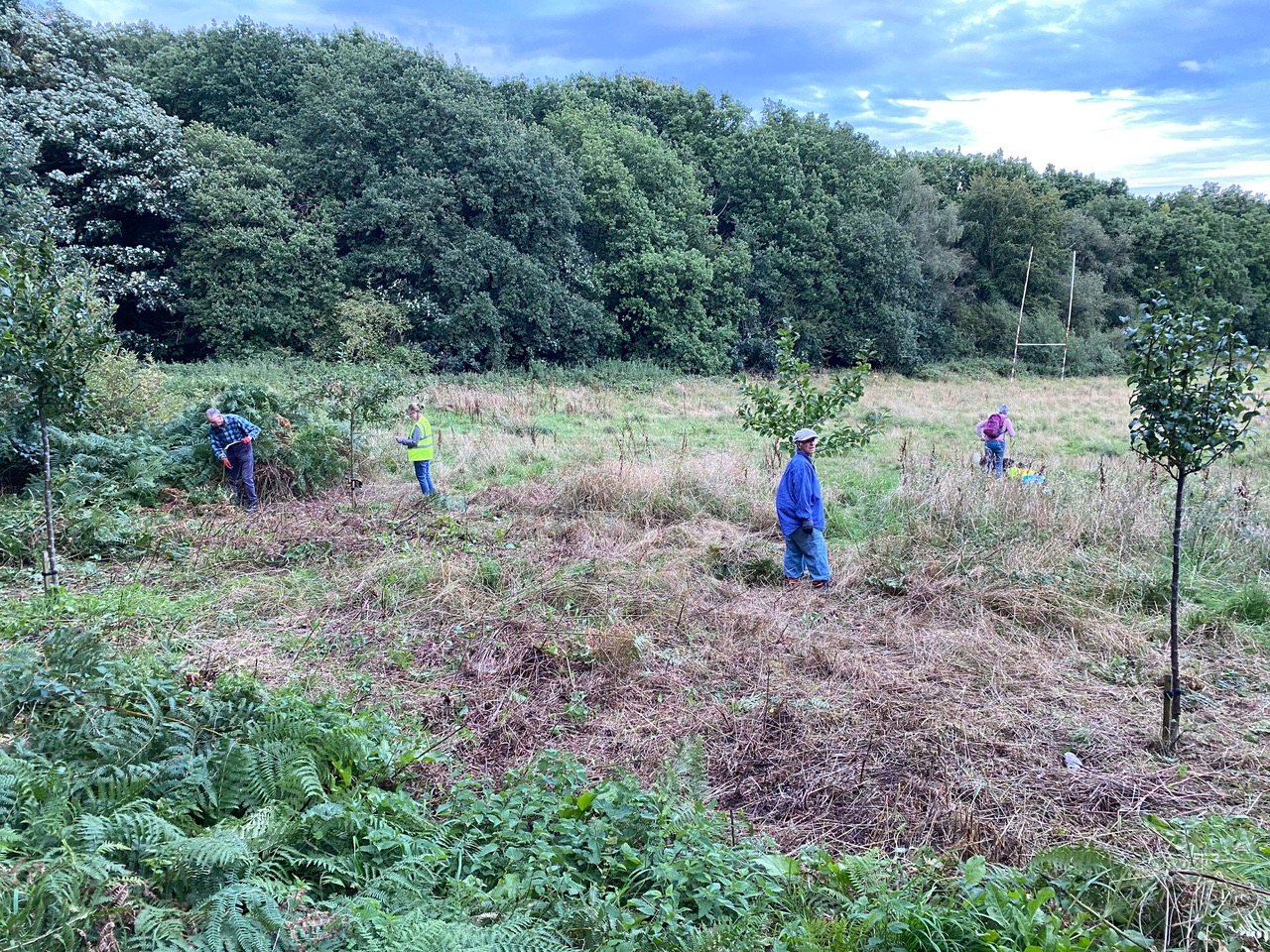
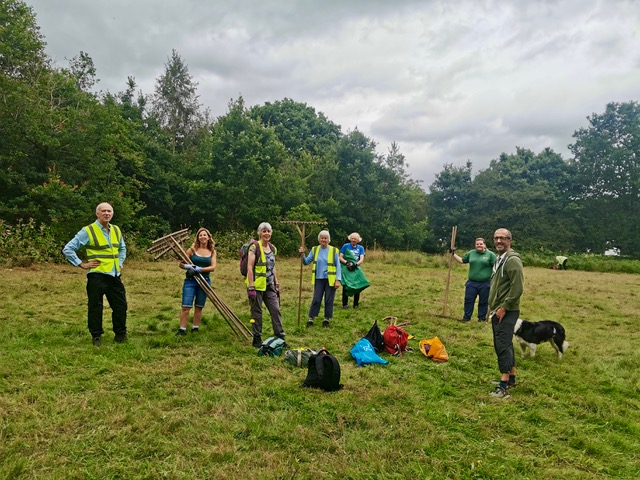
Our task this evening was to clear bracken and brambles that have grown up around the community orchard in Adel Woods. We had a great turn out of FOAW and Alwoodley 2030 volunteers – fifteen in all – and in an hour and a half of hard work, they made a huge difference.
The orchard was planted in March 2021 by Leeds Parks and Countryside Ranger, Steve Joul, assisted by his son, as part of Leeds City Council’s woodland creation scheme. There are ten trees comprising a range of varieties of apple and pear trees.
The trees were planted as very young saplings. If they seem far apart in the photos, it is because, before planting them, Steve researched the space each would need to grow into a fully mature tree.
Spot the four trees in the photo!
If you would like to find out more about the planting of the trees and their varieties, have a look at our blog entry for the 18th March 2021 – the link is given below.
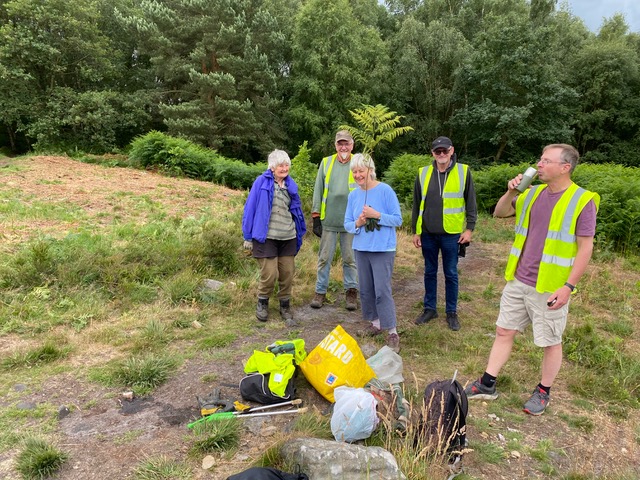
Can you spot four more four fruit trees in the photo?Some of the team of volunteers enjoying a sense of achievement for a good evening’s work!
Since the trees were cleared, Steve has put some labels on them. For more information about the orchard, here is a link to our blog post for the 18th March 2021
I hope you have enjoyed reading this blog post.
Friends of Adel Woods were set up in 2009 to protect, enhance and maintain Adel Woods and to work with other groups and organisations to that end. We welcome everyone would like to help us look after the beautiful woods on our doorstep.
The next Friends of Adel Woods “work party” is on Saturday the 16th September 2023, when we will be litterpicking and clearing scrub from around the Buck Stone. Have a look at our home page for more information.
Today we had a magnificent turnout of twelve volunteers to litterpick and to help Leeds City Council ranger, Rachel, work on the Orchid Meadow.
Three of our number chose to litterpick and ranged widely through the woods from Buckstone Road, where we met, to the pond, Crag Lane and the Stairfoot Lane carpark. They picked up up three bags of litter on the way.
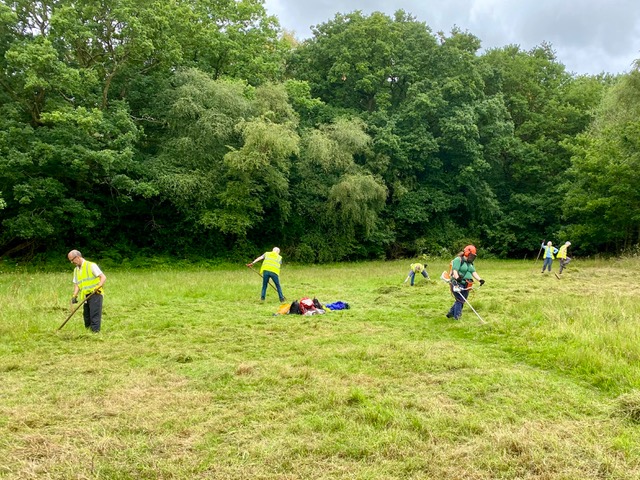
The rest of us set off to the Orchid Meadow with Rachel, armed with a brush cutter, scythes, rakes and tarpaulins.
The existence of the Orchid Meadow came to our attention in Summer 2014 when our treasurer Judith discovered lots of orchids flowering there. At that time there were lots of young trees growing in the meadow and it was surrounded by swathes of himalayan balsam. Since then we have done a lot of work on the meadow, under the leadership of Steve Joul, and it has blossomed into a wonderful wildflower meadow – as can be seen from the photograph above.
What you cannot see in the photograph are the many common spotted orchids concealed among the buttercups.
Here is a photograph of one of them.
Common spotted orchid, Adel Woods, 14th June 2023
Traditionally meadows were mown in mid to late Summer. The cuttings were then allowed to dry and removed after a few days to produce hay to feed livestock. This allowed flowering plants the chance to set seed, and the removal of the mowings reduced the nutrient levels in the soil and allowed flowers to compete with more vigorous grasses.
Much of Adel Woods was originally farmland, as evidenced by the many dry stone wall field boundaries – the farmhouse for Crag Farm used to stand in the area now used as a picnic area. Without regular mowing meadows will soon turn into scrubland and eventually woodland as shown in this photograph of the same field, taken in July 2016.
Steve Joul in the Orchid Meadow, Adel Woods, 16th July 2016
So over the last few years, as a ranger with Leeds City Council Steve Joul has mown the orchid meadow in late Summer – and last year as a private citizen he scythed the meadow and raked off the cuttings on his own!
Last week, Rachel cut about half of the meadow with a brush cutter last week, and our task today was to continue the mowing – Rachel with a brush cutter and three of us with scythes – and rake off the mowings.
Friends of Adel Woods working on the orchid meadow
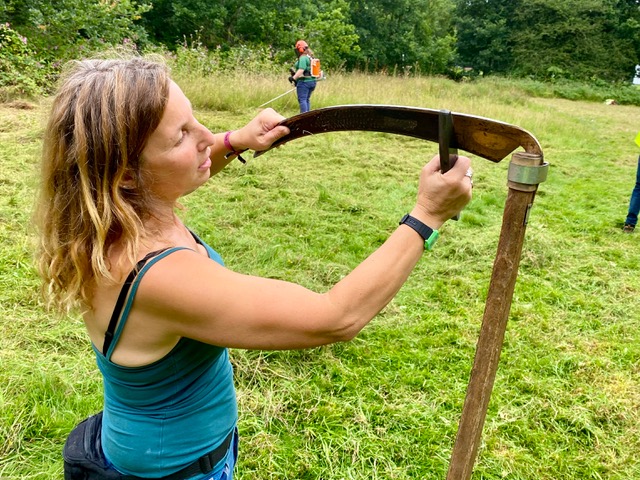
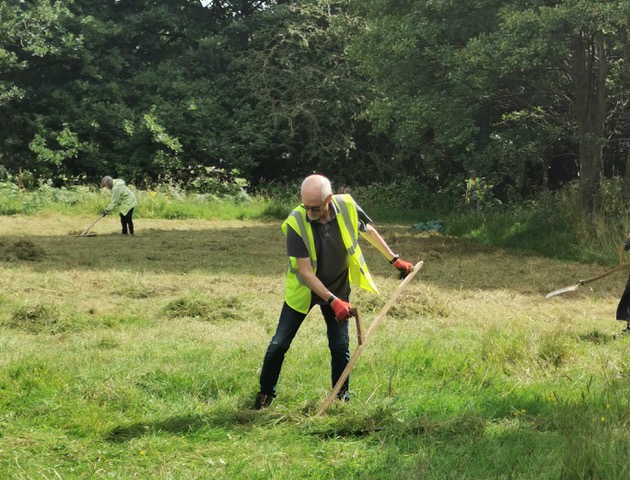
None of us had used a scythe before and Rachel showed us what to do. One essential part of using a scythe is to sharpen it with a whetstone every five minutes or so to keep it cutting well.
Friends of Adel Woods: sharpening a scythe with a whetstoneFriends of Adel Woods: scything the orchid meadow
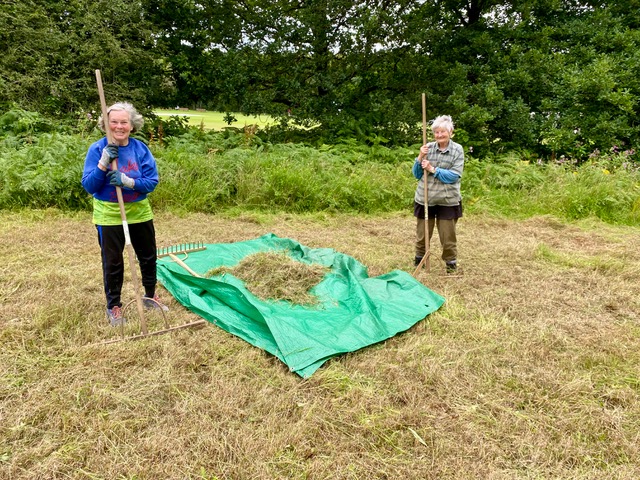
Due to the fact that we are a volunteer group, we are not able to leave the cuttings to dry, so the next step today was to rake up the cuttings and transport them to compost heaps in the adjacent woods.
Two happy workers raking up the mowingsTwo more happy workers putting the cuttings onto a tarpaulin for transfer to a compost heap.Feeling happy after a good morning’s work
Friends of Adel Woods are a friendly group and we are always looking for new members. If you would like to help look after our woods, get some fresh air and exercise in beautiful surroundings, and make new friends, please get in touch.
Our next work party is on Saturday the 16th September 2023 when we will be clearing scrub from around our local landmark, the Buck Stone.
Today was our final “Bracken Pulling Wednesday” on Adel Moor, and our fourth morning of working on the moor during July. Today we had an excellent team of six volunteers – and the next day a seventh who turned up a day late, but still did an excellent morning’s work on his own!
Over the years Friends of Adel Woods, the Leeds City Council Rangers and various other groups have done a lot of work on the moor to keep it in good shape. The difference that the work has made can be seen by comparing views below of the northern area of the moor with the south western area which has not received as much attention.
The north eastern area of Adel MoorThe south western section of the moor: a profusion of heather, bracken, brambles and saplings
Our aim during our four July events has been to reduce the amount of bracken to allow other plants such as heather, bilberry and gorse to thrive. Clearing saplings in the western section of the moor is a task for another day using tools like tree poppers and mattocks.
We focused today on clearing areas of bracken where heather or bilberry were still present under the canopy of bracken.
We started in the southern area of the moor where we expected (based on our work last Saturday) to find a lot of heather surviving under the bracken. However, we found that much of the ground under the bracken was bare. We therefore moved round to the south western area where we did find a lot of heather surviving under the bracken.
Getting stuck in!
However, it was very clear that a lot of work needs to be done in the south western and western areas of the moor to clear saplings. There are a lot of young oak trees and birch trees.
Rose Bay WillowherbJuniper Polytrichum Moss
There is a modest amount of rose bay willow herb on the moor. We cleared some of this. It was considered rare until about 150 years ago but it has spread dramatically over the last hundred years probably due to the corridors provided by railways. After the second world war it was called “bomb weed” due to its tendency to appear in bomb sites. It has a beautiful flower.
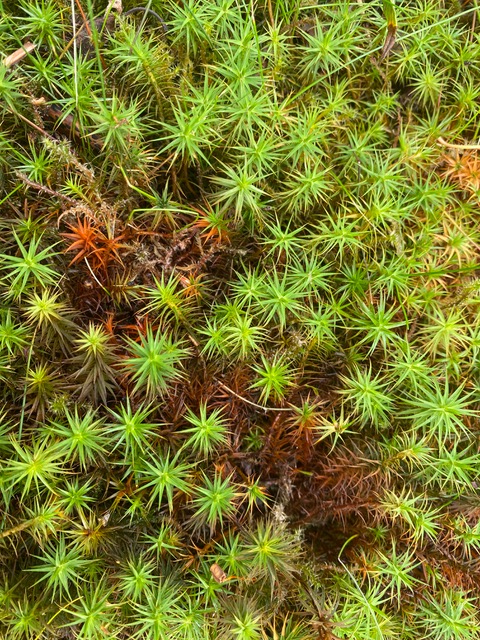
During our bracken pulling we revealed a beautiful patch of star shaped moss -see the photo above. A quick look on an iPhone app told us it was Juniper Polytrichum Moss.
Thank you to all who have participated in bracken pulling during July – including the Meanwood Valley Volunteer Rangers who worked on the moor last Wednesday with David Preston.
PS
Thank you to the person who found my New Zealand sun hat and hung it up on a tree. We found it on Friday and it is now safe and sound!
Today was the first of our three “Bracken Pulling Wednesdays” led by Barbara. The bracken in question is on Adel Moor.
It was a lovely morning and eleven of us met in Buckstone Road at 10 am. On reaching Adel Moor, we were rewarded by the site of a kestrel hovering over the moor. Surely, a good omen!
In case you are wondering why we pull up bracken, it is because, if left to its own devices, it will out-compete other plants and create a mono-culture – as can be seen from the photographs. Adel Moor is a habitat worth preserving: it is the last bit of heathland in Leeds and home to plants like heather and bilberry and a population of lizards (of which we know there have been three sightings this year).
Last August Barbara led three bracken pulling Wednesdays and it is gratifying to see that the area we focused on last year is still largely clear of bracken.
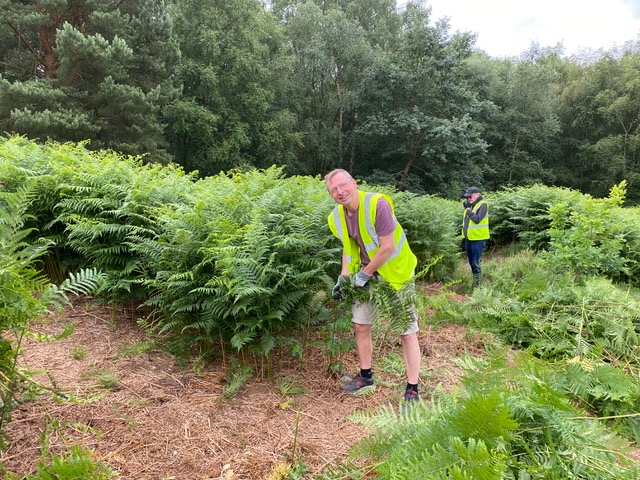
We had a good morning and the eleven of us were able to clear a large area of bracken as can be seen in the photographs.
A big thank you to all the volunteers who helped today!
Five Friends of Adel Woods relaxing after a hard morning’s work!
A beautiful June morning and another great turn out of twelve Friends of Adel Woods, including four new volunteers.
Most of us met with David Preston, our local ranger, at 10 am in Buckstone Road.
Four of us set off litterpicking, starting at the Village Green and the main road near Tesco’s, and then heading along Crag Lane to the picnic area. We had another regular Friend doing some freelance litterpicking too.
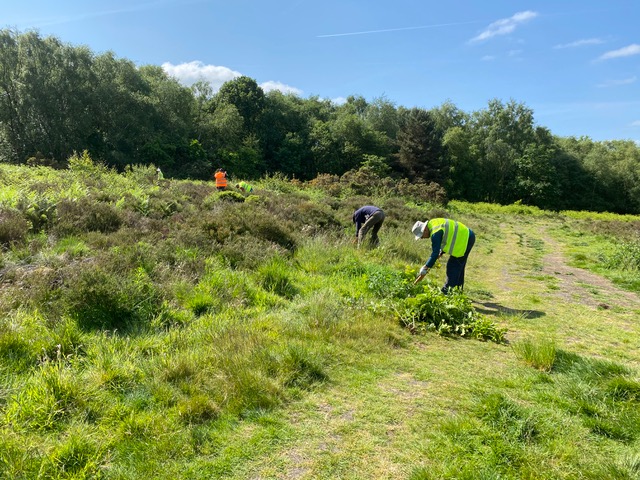
The rest of us joined David in working on Adel Moor – pulling up bracken, rosebay willowherb, brambles and saplings.
The reason we do this is to preserve what is the last piece of moorland in Leeds which is also home to a precious colony of viviparous lizards. We haven’t seen any for a couple of years, but I am pleased – and excited – to say that today we had two separate sitings!! We didn’t get a photograph – as they are very quick and secretive creatures, but the photo below is one we took in April 2014.
Viviparous or common lizard found on Adel moor in April 2014
You may notice that the lizard in the photo has a truncated tail. This is because, if threatened by a predator, a viviparous lizard can shed its still-moving tail to distract the predator and escape. This is called “autotomy”, which is Greek for “self-cut off”.. I am pleased to say that in this instance the autotomy was due to some previous encounter, not the result of FOAW’s intervention, and the lizard can grow a new tail. No lizards were harmed in the taking of the photograph!
These lizards are called “viviparous”, which means giving birth to live young, because the females do not lay eggs: they incubate the eggs inside their bodies and give birth to between three and eleven live young in July.
Friends of Adel Woods with David Preston: 4th June 2023
Getting back to our morning’s work, we were lucky that David was able to bring two “tree poppers” which are excellent tools for rapidly pulling up small saplings up to about a metre tall.
A large and medium sized tree popper
We were able to pull up a large amount of bracken, brambles, rosebay willow herb and many small saplings and we had a very enjoyable – though warm! – morning.
Friends of Adel Woods: tidying up at the end of the morning: 4th June 2023
All except one of our current committee members attended. In addition, David Preston, ranger with Leeds City Council, and three “Friends” attended.
1. Three Friends sent apologies.
2. The minutes of the last AGM on 26th May 2022 were approved subject to minor amendments.
3. The Chair gave a report on activities since the last Annual General Meeting. This is printed in full below.
4. The Treasurer gave a report on the accounts for the last year. In fact, there had been only one item of expenditure in the last year.
5. Rob Hall was elected auditor for the coming year.
6. The following officers were elected unopposed:
Roger Gilbert: chair
Judith White: treasurer
Stephanie Clark: secretary
The existing members of the committee who were present all confirmed that they are willing to continue as members. In addition, another Friend had a rush of blood to the head and agreed to join the committee. The committee members are therefore: R Gilbert; J White; S Clark; R Hall; D Hampshire; S Chambers; S Joul; T Wragg; D Smith.
7. A vote of thanks was given to David Preston for the work he has done with the Friends of Adel Woods in the last year.
8. The meeting concluded with a wide-ranging discussion of other business including:
opportunities to apply for grants from Love Leeds Parks for footpath work;
the tree thinning work around Adel Crag is to continue this year;
the program of works for the coming year;
Steve Joul’s regular work on the one patch of Japanese knotweed over the last many years seems to have paid off as Steve could not find any remaining shoots this year;
how to deal with the problem of dog poo on Adel Moor.
The Chair’s Report
Star of Bethlehem in Adel Woods: 21 May 2023
We are very lucky to live near Adel Woods. Steve Joul did a walk around the woods on 16th April this year when he recorded: 23 bird species; 17 plants in flower; 4 species of insects; 7 species of fungi; and 20 grey squirrels. You can find the details in the blog post for 16th April.
The last year has been our first complete year of activities uninterrupted by Covid 19 since 2018-19. It was a bumper year.
We have two types of activities: work parties, and educational walks and talks.
WORK PARTIES
We had 18 work parties when we carried out the following work (NB the total number of activities adds up to more than 18 because each work party involves both litterpicking and some other work such as path clearing):
13 mornings of litterpicking;
4 mornings working on Adel Moor – removing bracken, brambles and saplings;
2 mornings on Adel Pond and ditches (and Judith cleaning the Slabbering Baby);
3 mornings on Adel Bog;
6 mornings of path clearing;
A day and a half of surveying and cleaning nest boxes
1 morning of working on the hospice woodland (plus a morning in October when Judith cleaned the monument at the entrance on Stairfoot Lane).
Litterpicking and path clearing in Adel Woods 21st January 2023
Of the eighteen work parties most were led by our chair, but three were led by David Preston; the nest box cleaning and surveying was led by Steve Joul; three of the mornings on Adel Moor were led by Barbara Wakefield; two litterpicking and path clearing events were led by Judith; and one by Rob. It is good that we have a range of people who are able and willing to lead a morning in the woods.
Working on Adel Bog with David Prestonon 30th November 2023
The mornings led by Barbara were a new venture – on a Wednesday morning and focussing on one task which did not need tools, pulling up bracken on the moor. These were very successful, attracting some new volunteers and achieving a great deal. We are going to repeat this in July this year.
Friends of Adel Woods pulling up bracken on Adel Moor: August 2023
EDUCATIONAL EVENTS
We had two educational events in the last year.
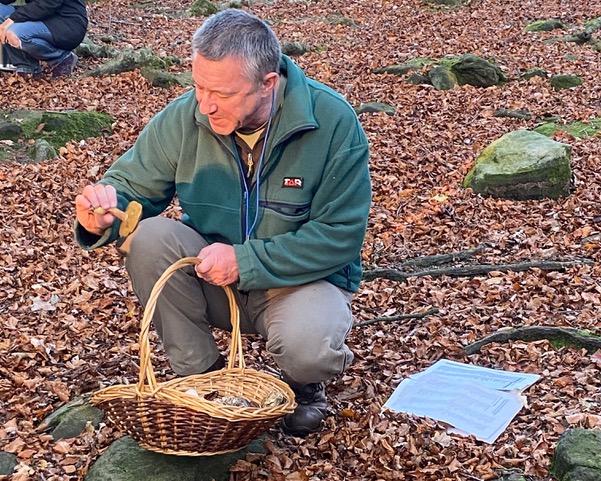
The first was a fungal foray with Steve Joul on the 12th November.. It was a beautiful afternoon and we had something like 45-50 attendees.
Steve Joul describing a fungus to a rapt audience on 12th November 2022
The second was our our annual birdsong walk on Sunday 14th May, again led by Steve Joul. We had about a dozen attendees. It was a very successful morning: we saw or heard 19 species of bird, and we saw woodpeckers entering and leaving a hole in a tree; a pair of jays on their nest; a woodpigeon sitting on its nest; tits using a Friends of Adel Woods nest box; and treecreepers entering a nesting hole in a tree near the entrance to Old Leo’s car park.
Steve Joul leading our birdsong walkon 14th May 2023
If you would like to know more about our activities, please have a look at our blog entries. They are written by someone I know well and love and respect, and they have some really good pictures!
There are a couple of other things worth noting during the year.
Firstly, in August last year, Steve single handedly scythed and raked the orchid meadow and made a brilliant job of it.
Secondly, in February of this year, David Preston and the Meanwood Valley Volunteer Rangers thinned trees, scrub and holly in front of Adel Crag and they have really improved the crag as a feature of the woods.
A view of Adel Crag (middle left) in February 2023 after clearance of scrub, trees and holly
Finally, at this time of year it is worth popping into Adel Woods to have a look at a beautiful, fragrant yellow azalea near the Stairfoot Lane carpark. If you go down the steps towards the stream, turn left onto the path after about the fifth step down, the azalea is about 25 yards along. It blooms in May and it has beautiful yellow flowers and a wonderful fragrance.
Yellow azalea in Adel Woods
On the same theme, in the next month, a large lime tree in the Stairfoot Lane car park will be coming into blossom in June, exuding a beautiful fragrance across the area. Make a note to enjoy it!
THANK YOUS
So as usual, I would like to thank our brilliant committee for all the work they have done: likewise all our wonderful volunteers. FOAW would not exist without the committee and volunteers. And I am looking forward to another year of fun, laughter and friendship with you all.
Thank you to Steve Joul for leading two wonderful educational walks over the last year – and for letting use his ladder for the nest box survey.
Thank you to David Preston for leading the events over the last year and we are looking forward to working with you again this coming year.
Finally, thank you to Old Leo’s for allowing us to use their carpark over the last year.
Alwoodley Plantation: Adel Woods; 12th November 2022
This morning, Steve Joul, a member of the committee of Friends of Adel Woods, and former senior ranger with Leeds Parks and Countryside, went for a walk around Adel Woods between 7 and 10 am. As you will see, there is a lot of “nature” to enjoy in Adel Woods. Highlights for Steve this morning were seeing a pair of tree creepers; a pair of mandarin ducks; a close view of a female great spotted woodpecker; and a peacock butterfly basking in the sun.
Below there is a list of some of the other flora and fauna he saw. NB I have included archive photographs showing activities of Friends of Adel Woods and other flora and fauna which can be found in Adel Woods, but which Steve did not see this morning.
Adel Woods truly are something to treasure! If you would like to join in the activities of Friends of Adel Woods, please get in touch through this website.
Birds: 23 species
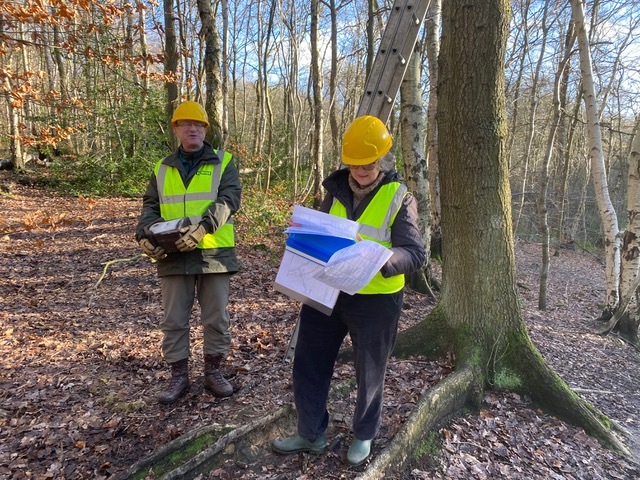
Surveying nest boxes in Adel Woods on 13th January 2023
Blackbird – over 20 seen
Blackcap – 3 males singing
Blue Tit – over 20 seen
Carrion Crow – 5 seen
Chiffchaff – over 10 males singing
Coal Tit – 3 males heard singing
Dunnock – 1 male singing
Goldcrest – 1 male singing
Great Spotted Woodpecker – female good views, another drumming
Great Tit – over 10 males seen
Jackdaw – 5 birds flying over woodland together
Jay – pair seen
Magpie – 5 birds seen
Mallard – a pair near the stream and a drake on the pond
Mandarin – a pair on the stream
Mistle Thrush – alarm heard
Nuthatch – over 10 birds calling or singing
Red Kite – single over woodland
Robin – over 20 seen
Song Thrush – 2 singing males seen, another heard
Treecreeper – pair near to Treecreeper nestbox but didn’t go in
Woodpigeon – over 20 seen
Wren – over 10 seen
Plants in flower
Bluebells in Adel Woods on 1st May 2023
American Skunk-cabbage – two patches on stream bank
Blackthorn
Dandelion
Flowering Currant
Garden Daffodil
Garden Yellow Archangel
Green Alkanet
Hybrid Bluebell – an early example
Lesser Celandine
Marsh Marigold
Meadow Foxtail – an early-flowering grass
Opposite-leaved Golden-saxifrage – stream banks
Ramsons – an early example
Red Currant
Wild Cherry
Wood Anemone
Wood Forget-me-not
Insects
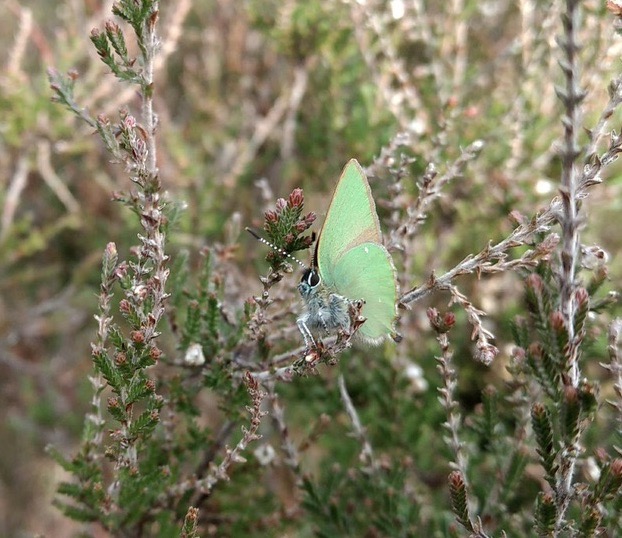
Green Hairstreak butterfly photographed on Adel Moor on 17th April 2022 (photo taken by Joseph Worrilow)
Buff-tailed Bumblebee
Common Carder Bee
Peacock Butterfly
Seven-spot Ladybird
Fungi
Alder Bracket
Birch Polypore
Blushing Bracket
Glistening Inkcap
Hoof Fungus
Willow Bracket
Witches Broom
Steve Joul leading a fungal foray attended by about fifty people on 12th November 2022
Mammals
Grey squirrel – over 20 seen.
Friends of Adel Woods working on Adel Moor: 15th May 2022
The entrance to the Hospices Woodland on Stairfoot Lane
Spring was definitely in the air this morning. On getting up, your correspondent drew the curtains to a glorious blue sky and sunrise. The temperature outside was 4 degrees centigrade, but by 10 am it was a lovely mild morning, perfect for working in Adel Woods!
The projects this morning were litterpicking and tidying up the Hospices Woodland, the latter being something we have been doing since March 2010.
We met in the Stairfoot Lane carpark and had a wonderful turn out of ten Friends (including two who joined us later in the Hospices Woodland).
Clearing brambles in the Hospices Woodland in Adel Woods; 19th February 2023
Three of us litterpicked while the rest of us spent the morning clearing brambles from the trees and paths in the Hospices Woodland.
The Hospices Woodland is on the South side of Stairfoot Lane, to the North East of the Stairfoot Lane carpark. It is called the Hospices Woodland because in about 2000 St Gemma’s and Wheatfields hospices had heard about a tree sponsorship scheme and were keen to contribute to tree planting in Leeds, and raise funds for their work. They approached the Parks and Countryside department of Leeds City Council and it was agreed that Parks and Countryside would provide the land adjacent to Stairfoot Lane and manage the trees, while the hospices would administer the scheme. People could sponsor a tree for £25 of which £15 went to the hospices, and £10 to Parks to pay for purchasing the tree and ensuring its establishment.
It was very successful in the first year and a hectare of new native woodland was planted. Sponsorship money continued to come in and so a second phase was planted in the following years. Money continued to come in so a further woodland was planted at Temple Newsam alongside one of the main roads into the estate.
A large stone monolith was installed at both sites sponsored by a local quarry.
Friends of Adel Woods: picking up litter in the Hospices Woodland: 19th February 2023
On our way back to the Stairfoot Lane carpark, we cleared from the path a substantial tree which had fallen across it.
Another successful and enjoyable morning.
Friends of Adel Woods are always keen to attract new volunteers, so if you would like to help maintain Adel Woods, make new friends, and get some fresh air and exercise, please get in touch!
A beautiful morning, but – By Gum – it was cold first thing! It took your correspondent 20 minutes to scrape the ice off the car windows – including inside! Nevertheless, eleven Friends turned out for this morning’s work party. Five of us litterpicking. and the rest of us path clearing. And it was a lovely day for working in the woods.
The litter pickers picked up about six bags of rubbish on Buckstone Road, the Village Green, Crag Lane, the Hospice Woodland and on the track down to the cricket pavilion.
For the path clearers the objective this morning was to improve the path running alongside Adel Beck. Historically, there has been a path by the beck on the Alwoodley side all the way from Stairfoot Lane bridge down to the Spring Hill bridge, just downhill from the Slabbering Baby. However, in recent years the path has become overgrown and muddy and its route unclear at the halfway point, in the region of Adel Bog. Our focus today was to work on the path from Spring Hill bridge up to the midway point.
Getting under way: the path by Adel Beck – Spring Hill bridge can just be seen to the right
Near Spring Hill bridge, the path had been eroded away by the beck, making it a bit hazardous, as can be seen in the photograph above. One of our first jobs was therefore to move the route of the path further away from the stream and remove brambles and a large sapling which was growing across the path.
Looking towards Spring Hill Bridge
The main things to tackle today were brambles and holly which were making the path very narrow – even before the growing season starts again.
Making our way home
In the space of two hours we were able to accomplish our aims, though there is still a lot to do – principally to improve the muddy sections of the path and to improve way marking.
BeforeAfterViews of Spring Hill Bridge before and after clearing brambles and saplings
The two photographs show the difference made in the vicinity of Spring Hill bridge. The tree on the left can just be seen in the “before” photograph though it is obscured by the brambles which we removed. You can also see to the right of the tree the stump of the large sapling which we removed because it was growing across the path.
Adel Beck path looking upstream from the vicinity of Spring Hill bridge – after clearing and widening the path
Another satisfying and successful morning for the Friends of Adel Woods!
Today was the second (and concluding) part of the Friends of Adel Woods annual nest box survey and Spring clean. Yesterday (in part 1) we started by surveying the nest boxes to the north of Crag Lane and spent the afternoon surveying the nest boxes on the Meanwood Valley Trail from the picnic area down to just short of Adel Pond.
This was another day which defied the weather forecast and turned out to be a lovely harbinger of the nesting season.
We met at 10 am in Old Leo’s car park. Five Friends turned out, including two who were taking part in the nest box survey and Spring clean for the first time!
Today, our first task was to put up “Tina’s nest box”, so named because Tina gave it to us! Situated on Crag Lane, near Old Leo’s car park, it is without doubt our best nest box, being made of woodcrete, a mixture of concrete and straw. It is spacious, dry, and designed to let the inhabitants nest well back from the entrance hole, away from the reach of predators. We cleaned it out yesterday, but found it too heavy to put back. Today with the use of a “stand off” to the ladder, we were able to put it back up.
From the car park, we made our way down to the pond with our wheelbarrow, ladders and equipment and started with box 42, just to the north of the pond. This contained a blue tit nest (we know because the entrance hole is 25 mm, so too small for birds like great tits) and the presence of droppings indicated that it had been used for roosting.
Cleaning out nest box 42
Incidentally, the reason we clean out the nest boxes each year, is that the species which use our nest boxes – like blue tit, great tit, sparrow and nuthatch – do not re-use nests from previous years. This was made clear by the lockdown in January 2021 which prevented us from cleaning our nest boxes that year. When we surveyed the boxes in January 2022, most nest boxes contained two nests, one on top of the other. It is also clear why the birds evolved to make new nests each year: when we clean out the boxes, the old nests are often full of lice and mites, droppings from roosting birds, and damp, rotted moss – not a great environment for young birds.
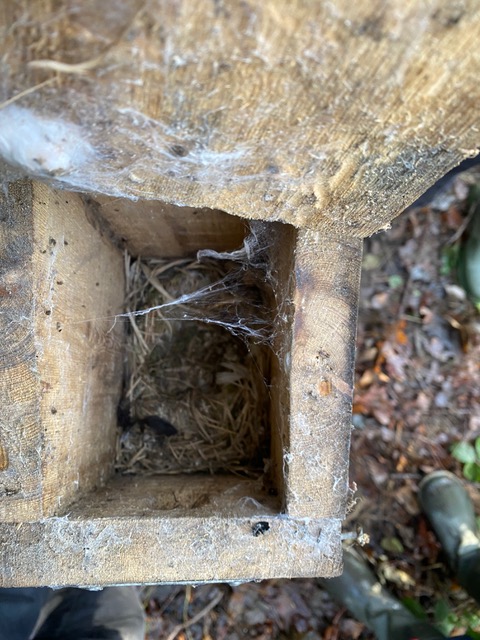
Nest box 38 – a sparrow nest?
Our next nest box was number 38, just by the bridge below the pond. This was unusual in that it seemed to contain a sparrow nest – which is made of straw – rather than a tit nest which is made of moss and fine grass. On several occasions, nuthatches have nested in this location, but not this year.
We then surveyed and cleaned out the nest boxes on the Meanwood Valley Trail from the Slabbering Baby down to Seven Arches, finishing at about 1.45 pm.
In all, we cleaned and surveyed seventeen nest boxes today. This is the overall summary:
twelve boxes contained tit nests;
one box contained an incomplete tit nest;
one appeared to contain a sparrow nest, but strangely it had a small amount of moss (which is typical of a tit nest) on the top;
two small nest boxes which we put up last year were not used, but one contained a small amount of moss;
one of the boxes containing a tit nest had clearly been used initially by nuthatches, but it looks as though they were driven out;
another box showed extensive work by nuthatches, but there was no nest.
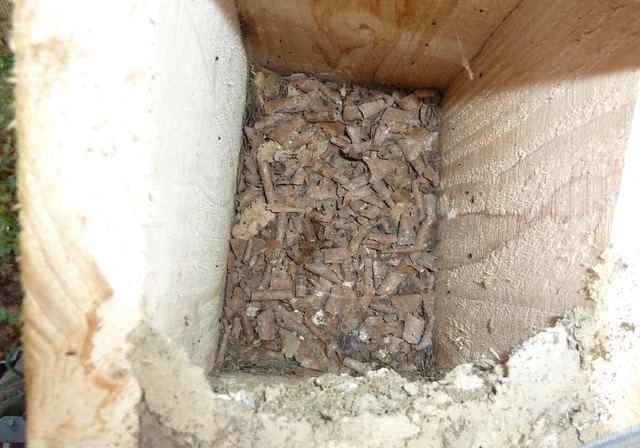
I mentioned above that there was some evidence of nuthatches in the nest boxes but no nuthatch nests. In some years we have found one or two nuthatch nests. They are very distinctive for two reasons. Firstly, nuthatches seal all possible gaps in the nest box with copious amounts of mud, both on the inside and outside – and sometimes make the entrance hole smaller. Secondly, the nest is not made with moss and grass but with bark chips, so the nest box looks rather as if someone has tipped some bran flakes into it.
Courtesy of RSPB websiteA nuthatch and a nuthatch nest: note the mud around the top of the box
Nuthatches are very sleek looking birds which are the only UK bird that can climb headfirst down a tree trunk!
A view of Meanwood Beck through the trees in Adel Woods: 15th January 2023






















 Friends of Adel Woods