The original intention this morning was toclear the ditches feeding Adel Pond, and litterpick around the cricket club, and Crag Lane. However, yours truly and his better half have had covid this week, so plans had to be modified.
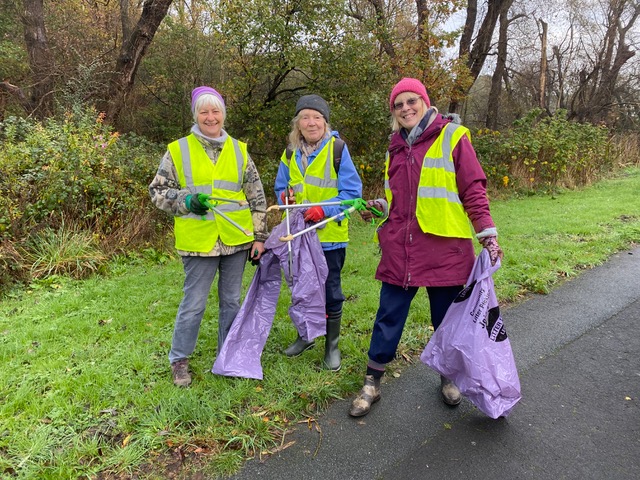
Judith, our ever resourceful treasurer, stepped into the breach and led a successful litterpicking team of five litter pickers, focusing on Stairfoot Lane carpark, Adel Crag and the area around the picnic tables.
They found plenty to keep them busy – mainly doggy doo doo bags and glass bottles.
So thank you to all who picked up litter today!
Since David Preston and his team of Meanwood Valley Volunteer Rangers cleared a lot of the scrub around Adel Crag, it is looking a lot better.
The entrance to the Hospices Woodland on Stairfoot Lane
Spring was definitely in the air this morning. On getting up, your correspondent drew the curtains to a glorious blue sky and sunrise. The temperature outside was 4 degrees centigrade, but by 10 am it was a lovely mild morning, perfect for working in Adel Woods!
The projects this morning were litterpicking and tidying up the Hospices Woodland, the latter being something we have been doing since March 2010.
We met in the Stairfoot Lane carpark and had a wonderful turn out of ten Friends (including two who joined us later in the Hospices Woodland).
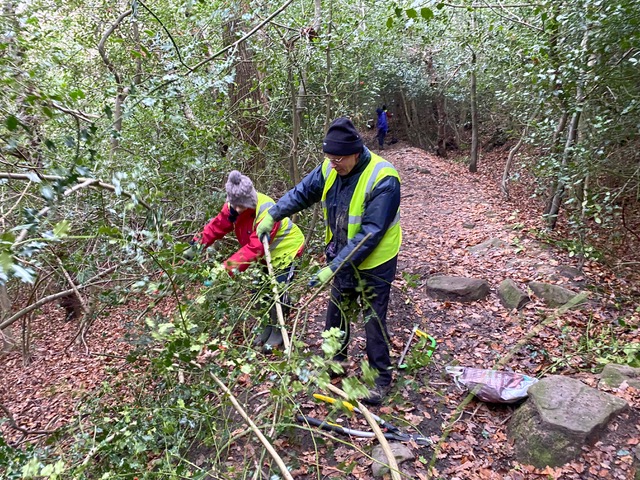
Clearing brambles in the Hospices Woodland in Adel Woods; 19th February 2023
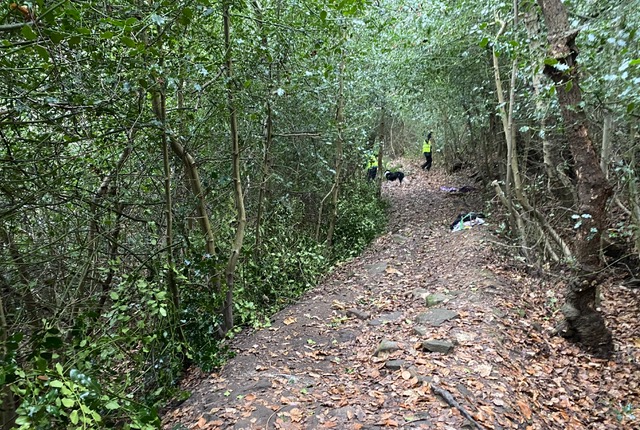
Three of us litterpicked while the rest of us spent the morning clearing brambles from the trees and paths in the Hospices Woodland.
The Hospices Woodland is on the South side of Stairfoot Lane, to the North East of the Stairfoot Lane carpark. It is called the Hospices Woodland because in about 2000 St Gemma’s and Wheatfields hospices had heard about a tree sponsorship scheme and were keen to contribute to tree planting in Leeds, and raise funds for their work. They approached the Parks and Countryside department of Leeds City Council and it was agreed that Parks and Countryside would provide the land adjacent to Stairfoot Lane and manage the trees, while the hospices would administer the scheme. People could sponsor a tree for £25 of which £15 went to the hospices, and £10 to Parks to pay for purchasing the tree and ensuring its establishment.
It was very successful in the first year and a hectare of new native woodland was planted. Sponsorship money continued to come in and so a second phase was planted in the following years. Money continued to come in so a further woodland was planted at Temple Newsam alongside one of the main roads into the estate.
A large stone monolith was installed at both sites sponsored by a local quarry.
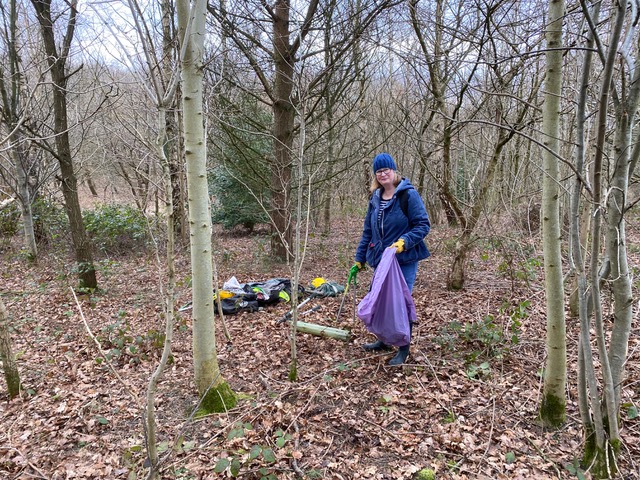
Friends of Adel Woods: picking up litter in the Hospices Woodland: 19th February 2023
On our way back to the Stairfoot Lane carpark, we cleared from the path a substantial tree which had fallen across it.
Another successful and enjoyable morning.
Friends of Adel Woods are always keen to attract new volunteers, so if you would like to help maintain Adel Woods, make new friends, and get some fresh air and exercise, please get in touch!
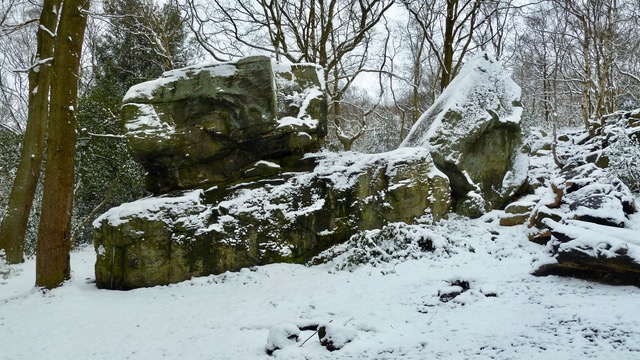
Adel Crag is a wonderful feature of Adel Woods which which one Friend of Adel Woods has likened to the Sphinx of Egypt – not all that fancifully!
Adel Crag or the Sphinx of Alwoodley on 18th March 2018
It is due to the Crag that Crag Lane and Crag Farm gained their names – the farmhouse was situated near the Crag – somewhere near today’s picnic area – until demolished by Leeds City Council in the 1950s.
Over the years, trees and holly have grown around the Crag obscuring it from view. However, only a hundred years ago the Crag was situated in more or less open fields. One of the writer’s neighbours told us that when she was a child – now a hundred years ago – she and her family had picnics atop the Crag with wonderful views across Leeds.
Adel Crag in about 1903
It has long been planned to do some work to open up the area around Adel Crag to make the Crag more visible and today David Preston, countryside ranger with Leeds City Council, led a team of fifteen Meanwood Valley Volunteers (including one Friend of Adel Woods!) in thinning trees and clearing scrub and holly between Crag Lane and the Crag.
Adel Crag – invisible before scrub clearance at 9.30 am
I think that when you compare the before and after photos, they did a very good job!
Adel Crag after scrub clearance at 1.23 pm
A big thank you to David and the Meanwood Valley Volunteer Rangers!
A beautiful morning, but – By Gum – it was cold first thing! It took your correspondent 20 minutes to scrape the ice off the car windows – including inside! Nevertheless, eleven Friends turned out for this morning’s work party. Five of us litterpicking. and the rest of us path clearing. And it was a lovely day for working in the woods.
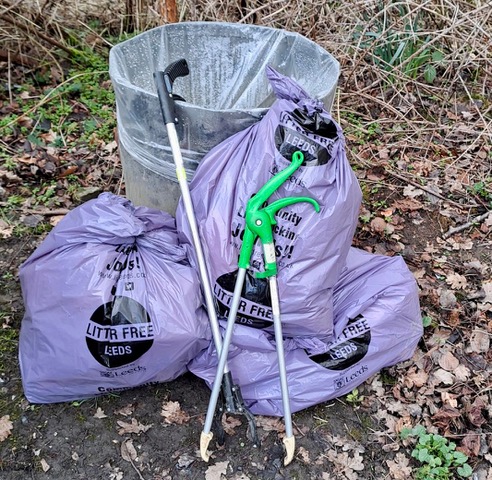
The litter pickers picked up about six bags of rubbish on Buckstone Road, the Village Green, Crag Lane, the Hospice Woodland and on the track down to the cricket pavilion.
For the path clearers the objective this morning was to improve the path running alongside Adel Beck. Historically, there has been a path by the beck on the Alwoodley side all the way from Stairfoot Lane bridge down to the Spring Hill bridge, just downhill from the Slabbering Baby. However, in recent years the path has become overgrown and muddy and its route unclear at the halfway point, in the region of Adel Bog. Our focus today was to work on the path from Spring Hill bridge up to the midway point.
Getting under way: the path by Adel Beck – Spring Hill bridge can just be seen to the right
Near Spring Hill bridge, the path had been eroded away by the beck, making it a bit hazardous, as can be seen in the photograph above. One of our first jobs was therefore to move the route of the path further away from the stream and remove brambles and a large sapling which was growing across the path.
Looking towards Spring Hill Bridge
The main things to tackle today were brambles and holly which were making the path very narrow – even before the growing season starts again.
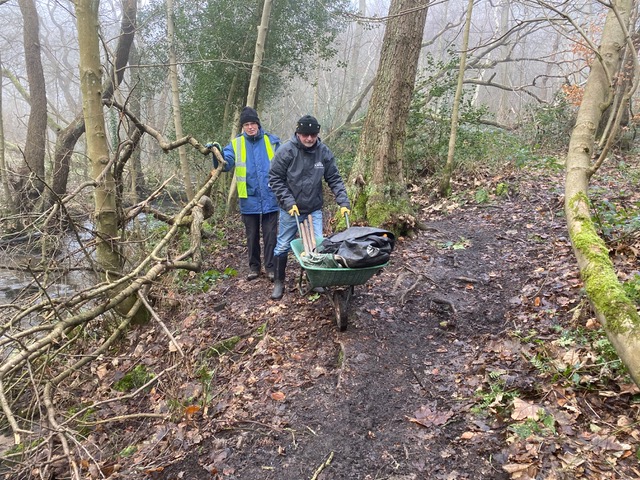
Making our way home
In the space of two hours we were able to accomplish our aims, though there is still a lot to do – principally to improve the muddy sections of the path and to improve way marking.
BeforeAfterViews of Spring Hill Bridge before and after clearing brambles and saplings
The two photographs show the difference made in the vicinity of Spring Hill bridge. The tree on the left can just be seen in the “before” photograph though it is obscured by the brambles which we removed. You can also see to the right of the tree the stump of the large sapling which we removed because it was growing across the path.
Adel Beck path looking upstream from the vicinity of Spring Hill bridge – after clearing and widening the path
Another satisfying and successful morning for the Friends of Adel Woods!
Today was the second (and concluding) part of the Friends of Adel Woods annual nest box survey and Spring clean. Yesterday (in part 1) we started by surveying the nest boxes to the north of Crag Lane and spent the afternoon surveying the nest boxes on the Meanwood Valley Trail from the picnic area down to just short of Adel Pond.
This was another day which defied the weather forecast and turned out to be a lovely harbinger of the nesting season.
We met at 10 am in Old Leo’s car park. Five Friends turned out, including two who were taking part in the nest box survey and Spring clean for the first time!
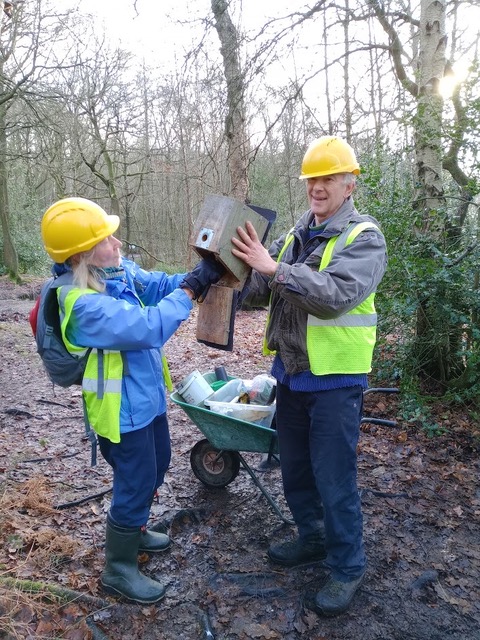
Today, our first task was to put up “Tina’s nest box”, so named because Tina gave it to us! Situated on Crag Lane, near Old Leo’s car park, it is without doubt our best nest box, being made of woodcrete, a mixture of concrete and straw. It is spacious, dry, and designed to let the inhabitants nest well back from the entrance hole, away from the reach of predators. We cleaned it out yesterday, but found it too heavy to put back. Today with the use of a “stand off” to the ladder, we were able to put it back up.
From the car park, we made our way down to the pond with our wheelbarrow, ladders and equipment and started with box 42, just to the north of the pond. This contained a blue tit nest (we know because the entrance hole is 25 mm, so too small for birds like great tits) and the presence of droppings indicated that it had been used for roosting.
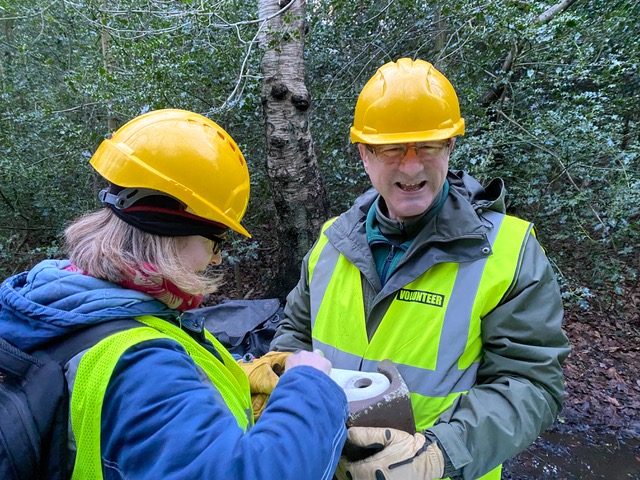
Cleaning out nest box 42
Incidentally, the reason we clean out the nest boxes each year, is that the species which use our nest boxes – like blue tit, great tit, sparrow and nuthatch – do not re-use nests from previous years. This was made clear by the lockdown in January 2021 which prevented us from cleaning our nest boxes that year. When we surveyed the boxes in January 2022, most nest boxes contained two nests, one on top of the other. It is also clear why the birds evolved to make new nests each year: when we clean out the boxes, the old nests are often full of lice and mites, droppings from roosting birds, and damp, rotted moss – not a great environment for young birds.
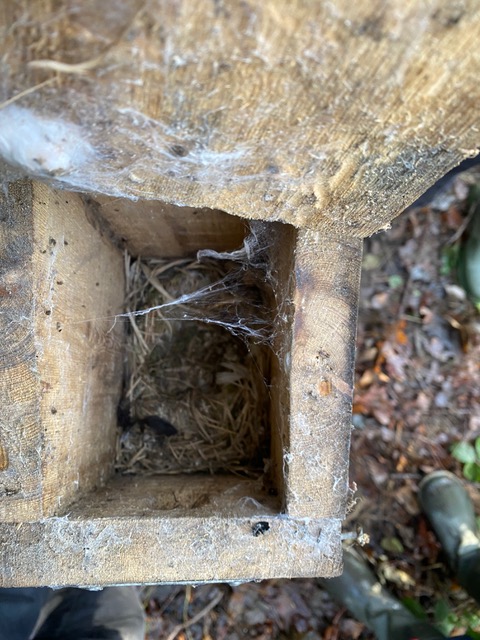
Nest box 38 – a sparrow nest?
Our next nest box was number 38, just by the bridge below the pond. This was unusual in that it seemed to contain a sparrow nest – which is made of straw – rather than a tit nest which is made of moss and fine grass. On several occasions, nuthatches have nested in this location, but not this year.
We then surveyed and cleaned out the nest boxes on the Meanwood Valley Trail from the Slabbering Baby down to Seven Arches, finishing at about 1.45 pm.
In all, we cleaned and surveyed seventeen nest boxes today. This is the overall summary:
twelve boxes contained tit nests;
one box contained an incomplete tit nest;
one appeared to contain a sparrow nest, but strangely it had a small amount of moss (which is typical of a tit nest) on the top;
two small nest boxes which we put up last year were not used, but one contained a small amount of moss;
one of the boxes containing a tit nest had clearly been used initially by nuthatches, but it looks as though they were driven out;
another box showed extensive work by nuthatches, but there was no nest.
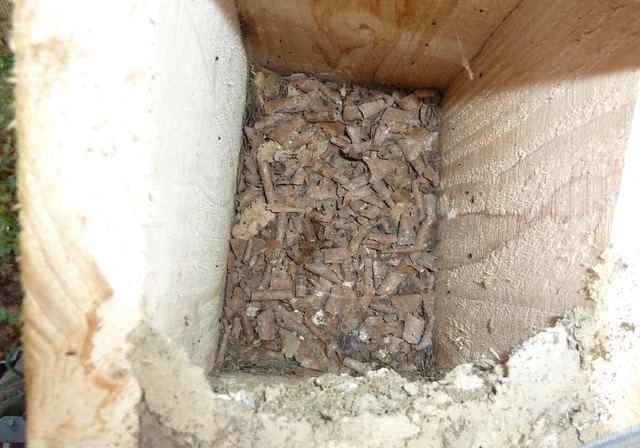
I mentioned above that there was some evidence of nuthatches in the nest boxes but no nuthatch nests. In some years we have found one or two nuthatch nests. They are very distinctive for two reasons. Firstly, nuthatches seal all possible gaps in the nest box with copious amounts of mud, both on the inside and outside – and sometimes make the entrance hole smaller. Secondly, the nest is not made with moss and grass but with bark chips, so the nest box looks rather as if someone has tipped some bran flakes into it.
Courtesy of RSPB websiteA nuthatch and a nuthatch nest: note the mud around the top of the box
Nuthatches are very sleek looking birds which are the only UK bird that can climb headfirst down a tree trunk!
A view of Meanwood Beck through the trees in Adel Woods: 15th January 2023
Time again to get the ladders out, get out in the woods, and clean and survey the Friends of Adel Woods nest boxes! We have put up forty three since 2010 and surveying them is always an interesting and sociable activity.
Despite a dire weather forecast for today, the weather started off quite reasonably and got better and sunnier throughout the morning. Eight of us turned out for this morning’s start on the job, and five of us returned for the afternoon shift.
Meeting in Old Leo’s car park
We met in Old Leo’s car park at 10 am and, led by Steve Joul our wildlife adviser, we set off into Alwoodley plantation.
Our first job was to put up a new bat box which we had been given by two of our Friends.
We put up seven bat boxes in 2010 to provide shelter for bats to roost in over the Summer months, and hopefully hibernate in over the Winter.
We are not allowed to have a look inside the bat boxes, but one fell off the tree a couple of years ago and this was a good opportunity to replace it.
If you look at the photo, you will see that bat boxes are very different from tit boxes: there is no entrance hole on the front! Bats enter the box by landing on the wood protruding downwards beneath the box and then crawling up into the box through a slit in the bottom. So you can see that bats powers to negotiate the environment by echo-location are truly astonishing.
You can also see that there are bat boxes on the left and right hand side of the tree. This is because bats are sensitive to temperature, and we put the boxes on different sides of the tree so that they can choose the one that suits them best.
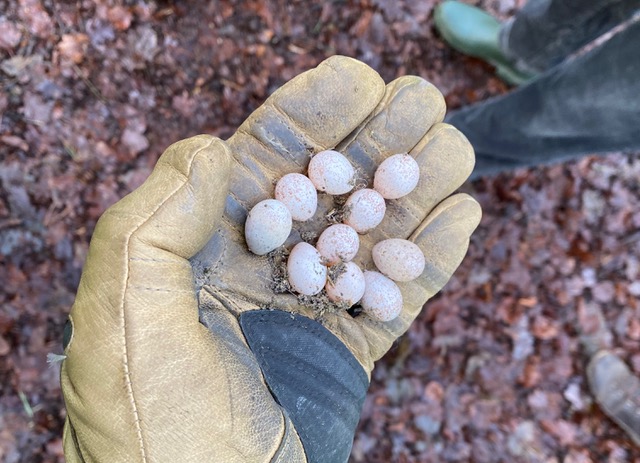
Ten unhatched eggs from nest box 5
Having put up the bat box we headed further into Alwoodley Plantation, our first stop being nest box 5 on a Scots pine near the Devil’s Rock. This contained a nest but there were ten unhatched eggs of various sizes. We measured them and came to the conclusion that they were probably great tit eggs. We’ll never know what happened, but presumably the parents were taken by predators. As you can see the eggs are very small, and it is a source of wonder that in a matter of weeks great tits (or blue tits) can develop into fully adult birds from such small beginnings.
Cleaning nest box 5The new bat boxTaking down “Tina’s” nest box near Old Leo’s
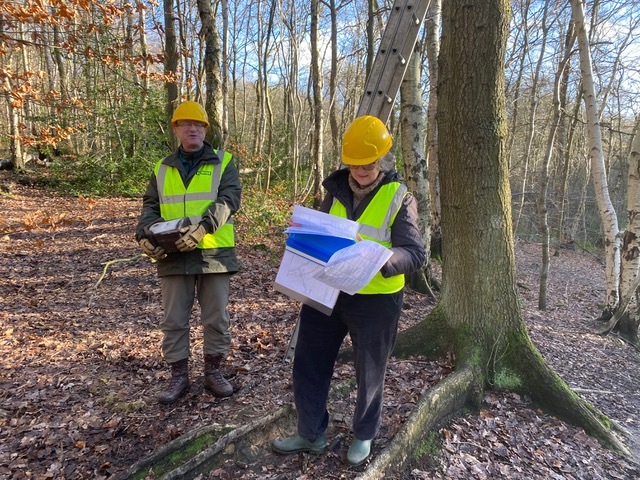
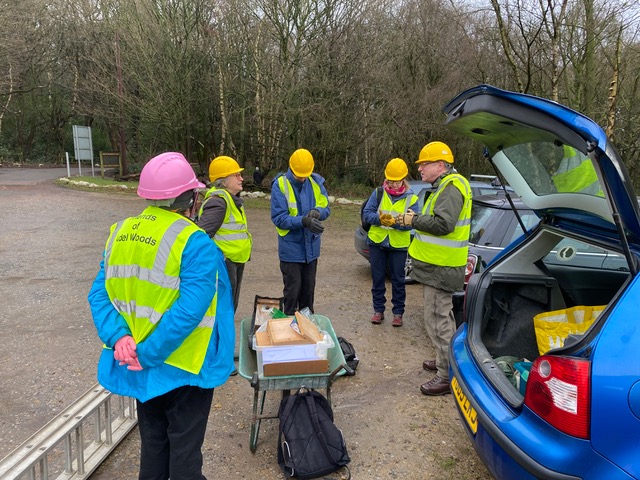
There is always plenty to do on the nest box surveys: Steve carries the ladder; one of us pushes the wheelbarrow loaded with all the tools which are needed to clean and, if necessary repair, the boxes; one of us (usually Steve or yours truly) climbs the ladder to bring the nest boxes down to the ground. We then take it in turns to open the box, and clean it before returning it to the tree. One of us makes a note of what we find, and one of us scouts around to find the next nest box: sometimes it can be very hard to find them and occasionally we don’t!
At about 12.50, having surveyed sixteen nest boxes, we decided it was time for a lunch break and we headed back to yours truly’s home to eat our sandwiches, and have a cup of tea and a piece of cake.
Duly replenished, we were back in the woods by 2.30, when we surveyed two nest boxes on Crag Lane, and then made our way down the Meanwood Valley trail from the picnic area down to Adel Pond – surveying another seven nest boxes until dusk arrived and it started to rain and hail!
In summary, today we surveyed twenty five nest boxes. Twenty one of these were tit boxes and four were robin boxes.
Of the twenty one tit boxes, all had been used for nesting except for one which had fallen off the tree. We cannot say that all of the nests were successful. Some clearly were as the nest looked used and was empty. Some had one or two eggs left in the nest and the assumption is that the other ten or so eggs hatched and the youngsters fledged. As reported above, the first nest box we surveyed contained ten unhatched eggs. Another nest box contained the macabre remains of eleven chicks. Presumably their parents were predated.
Turning to the robin boxes, the RSPB website says this about robin nesting habits:
“Most nests are located on or near the ground in hollows, nooks and crannies, climbing plants, hedgebanks, tree roots, piles of logs and any other situations which provide a fully concealed cavity.
“If a nestbox is provided to attract robins, it needs to be open-fronted, and placed in a hidden location in a climber or other such vegetation. Robins are famous for nesting in all kinds of unlikely locations, including sheds, kettles, boots, hanging baskets, coat pockets, under car bonnets, in farm machinery, even on boats in daily use.“
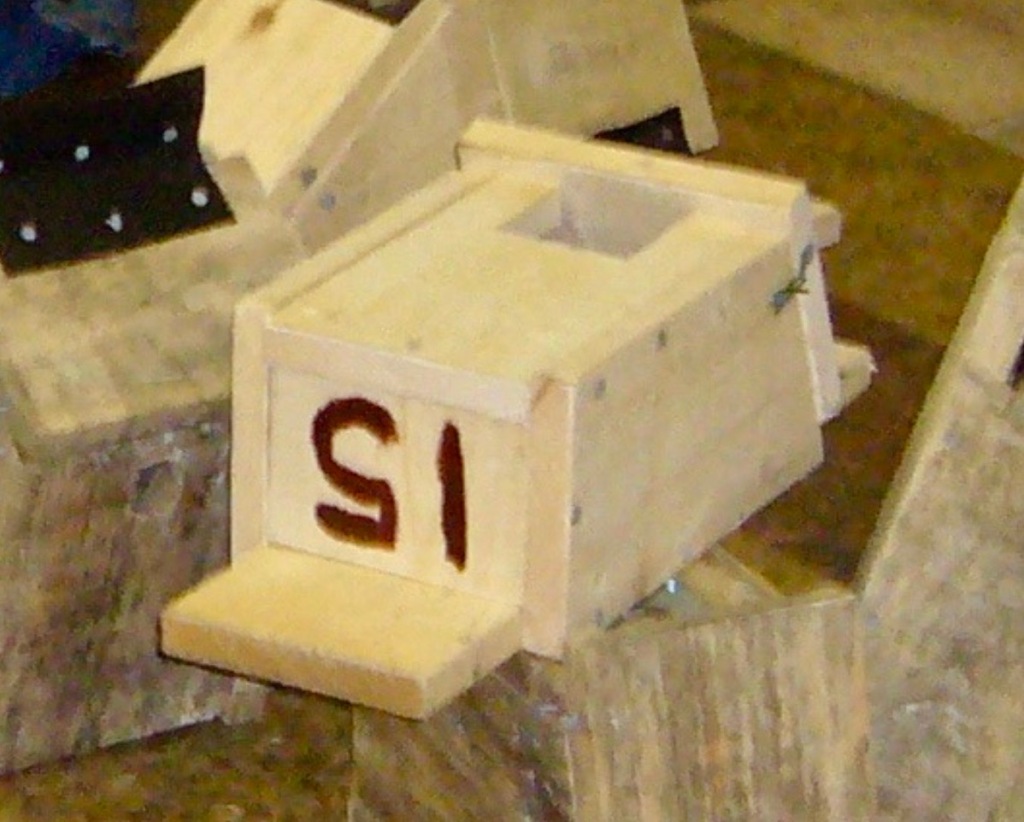
Robin nest boxes differ from tit boxes in that they have a large entrance – as shown in this photo taken when nest box 15 was made.
Clearly a nest box like this is very easy for a predator, such as a squirrel, to enter, so when we put them up in January 2010 we placed them on tree trunks a couple of feet off the ground in the middle of holly bushes. Two unintended consequences of this are (a) that they are very painful to reach to survey and (b) we have never been able to find one of the robin boxes which we put up!
None of the robin boxes have been used by robins for nesting. Occasionally, over the years they have been used by tits for nesting.
This year, two of the robin boxes contained a mass of oak leaves showing that they had been used by squirrels for roosting.
It was a very satisfying and enjoyable day, but yours truly was glad to get home and have a hot bath!
Views of Adel Woods on Saturday the 14th January 2023
Today the plan was to help David Preston to carry out further work on Adel Bog. Unfortunately, due to a puncture to his van tyre, he was unable to join us, and so, while two of us did some litterpicking, six of us did some path clearing.
The path we chose was the raised path which runs from Adel Pond, along the north side of Adel Bog, towards Stairfoot Lane.
The trees on each side of this path are mainly holly which were creating a dark canopy over the path. We removed a great deal of holly from above the path.
We used the offcuts to create some dead-hedging between the path and Adel Bog.
Looking along the path in the direction of Stairfoot Lane: dead hedging on the left of the pathLooking back towards Adel Pond
Another successful and enjoyable morning in the woods.
On Friday, the Chair of FOAW (ie me) attended the inauguration ceremony for the creation of a new area of woodland off King Lane to the north of Alwoodley.
Leeds University has purchased 37 hectares of land (that is about 90 acres) from Clonmore Farm in order to create the new woodland. The precise location is shown below. The boundary is shown in red. To help you orient yourself, Five Lane Ends is the bottom centre of the map, and King Lane runs along the south west boundary.
It was a beautiful afternoon and the event was attended by about 40 people – including two Alwoodley parish councillors, representatives of the Forestry Commission and other interested parties.
The university’s intention in creating the woodland is to:
provide the opportunity for research and teaching
increase biodiversity
reduce carbon in the atmosphere
provide benefits to the university and the local community
The research and teaching opportunities will be across many departments of the university.
The university will be leaving in place the existing woodland adjacent to Eccup Whin (which is owned by Leeds City Council) and leaving some of the land as scrub to study how the land changes over time. Where they plant woodland, they will be planting appropriate broadleaf trees. They will also be planting trees of different ages to try to create the mix of ages to be found in a natural woodland. The existing buildings will be retained but only to provided shelter to lecturers and students. No new buildings are planned.
The long term intention is to allow public access to 20% of the woodland. 80% will be kept as private because the primary purpose of the woodland it to provide opportunities for research and walkers and dogs may well affect the outcome of the research. Public access to the 20% will be allowed in phases. Phase 1 is to provide an alternative route for Leeds Country Way and the Meanwood Valley Trail.
Roger Gair and Professor Simone Buitendijk, Vice-Chancellor of Leeds University, after planting the first tree in Gair Wood.
The woodland is named Gair Wood to honour Roger Gair who retired as secretary of Leeds University last year, and has had a long interest in conservation. He and Professor Simone Buitendijk, Vice-Chancellor of Leeds University, planted the first tree, an oak, and then the rest of us had the opportunity to plant cherry tree whips (ie very young trees which have not yet developed branches).
If you would like the opportunity to plant some trees in the new woodland, the university is organising some planting days and you can book your place by clicking on the following link which will take you to Eventbrite where you can choose a time and date to do your bit. You don’t need any previous experience and you will be shown what to do.
Today we had a team of three litter pickers, who picked up about six bags of rubbish between them, and a team of seven Friends working with David Preston, our local ranger, on Adel Bog.
When we reached Adel Bog, it looked beautiful as the morning sunlight broke through the trees.
Our task this morning was two-fold, to remove saplings and brambles from the bog and use them to strengthen the dead-hedging we started to build in September.
If you are wondering why we are doing this, the bog is a valuable habitat, and home to plants such as bog asphodel, heath spotted orchids, devil’s bit scabious, and cotton grass, and it is a lovely place to do some conservation work. A hundred and twenty years ago it was much more extensive, stretching a further 100 metres or so to Adel Pond, but it has gradually been taken over by trees. That process is continuing as saplings and brambles dry out the soil.
A further problem is that, as it has dried out in the recent dry summers, people have created paths across it, causing further damage. To try and protect the bog we have been creating a “dead hedge” as a natural barrier to deter people from walking across it. A dead hedge is simply a fence made with natural materials – stakes of wood, interwoven with brambles, branches, sprigs of holly and the like.
Hard at work!Another satisfying morning’s work for Friends of Adel Woods!
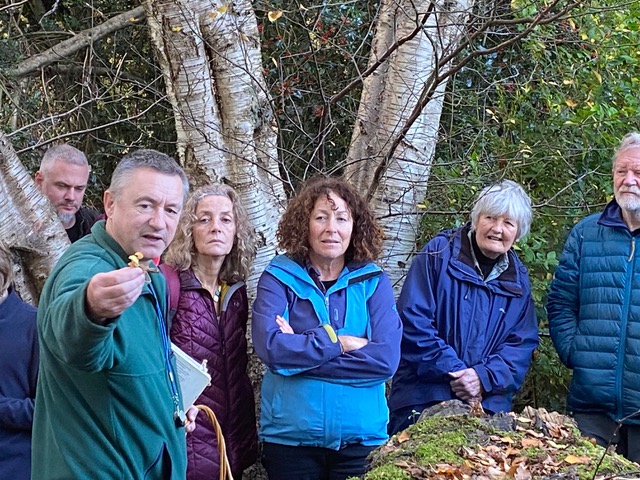
We never know how many people will turn up to a Friends of Adel Woods event, but today wonderful weather, and the chance to learn about fungi from the amazing Steve Joul brought out approximately forty five people including number of enthusiastic youngsters!
We met up in Alwoodley Village Green car park at 2.30 pm, and, after a short introduction, Steve led us into Adel Woods. Our first stop was a few yards along Crag Lane to inspect the remaining trunk of a mighty tree which fell about ten years ago, demolishing part of the garage next to it. This tree trunk always gives a display of numerous species of fungi, and today was no exception.
We then moved on to Alwoodley Plantation to the north of Crag Lane. Here many sharp-eyed fungi hunters brought Steve numerous specimens to identify. Steve astounded us all by his knowledge not only of their common names, but his amazing knowledge of their formal latin names.
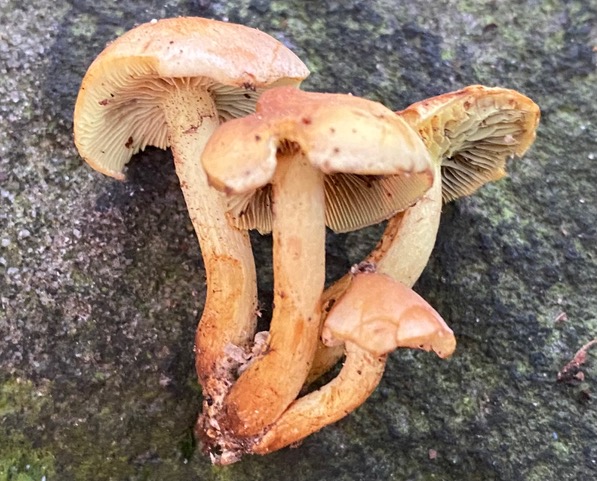
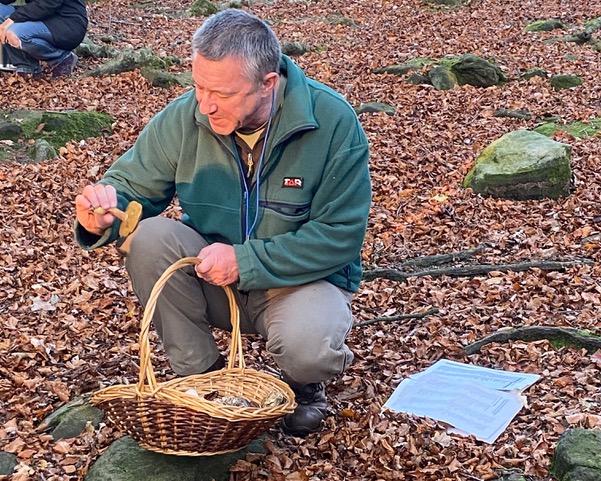
Steve collected the specimens in a wicker basket (an essential tool of the fungi enthusiast) and at the end of the walk paused to do a recap of what we had seen and found. In all we found about twenty five species of fungi and a complete list appears at the end of this report.
Candlesnuff Fungus
The event finished at about 4.30. It was a fabulous afternoon, and the trees looked beautiful in the evening sun. An added and unexpected bonus was the appearance of a handful of bats hunting for insects in the tree canopy (not visible in the photographs).
Alwoodley Plantation: Saturday, 12th November 2022
Here is a list of the species of fungi which we found this afternoon:



























 Friends of Adel Woods