A cool but dry morning when we met at the Slabbering Baby entrance to Adel Woods on Buckstone Road. Our plans this morning were litterpicking and working on Adel Bog with David Preston, our local Parks and Countryside ranger.
Happy litter pickers
Three Friends (of Adel Woods) chose to litterpick. One of them, Steph, also went off to clear, as far as practicable with a pair of loppers, the branches of a tree which had fallen across the path down from the picnic area to the Meanwood Valley Trail.
A fallen tree, after Steph removed small branches
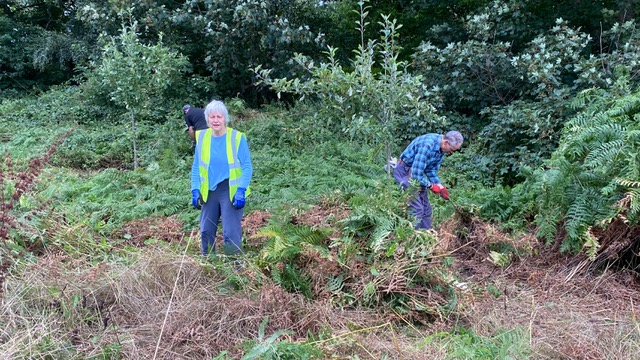
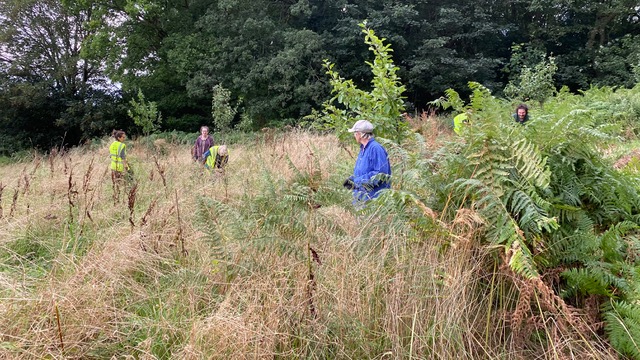
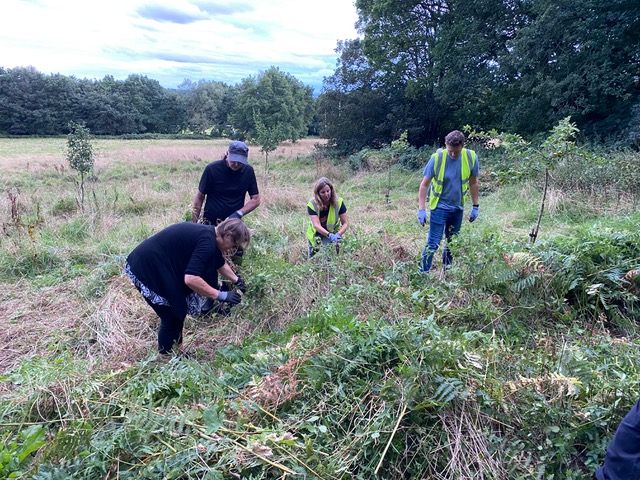
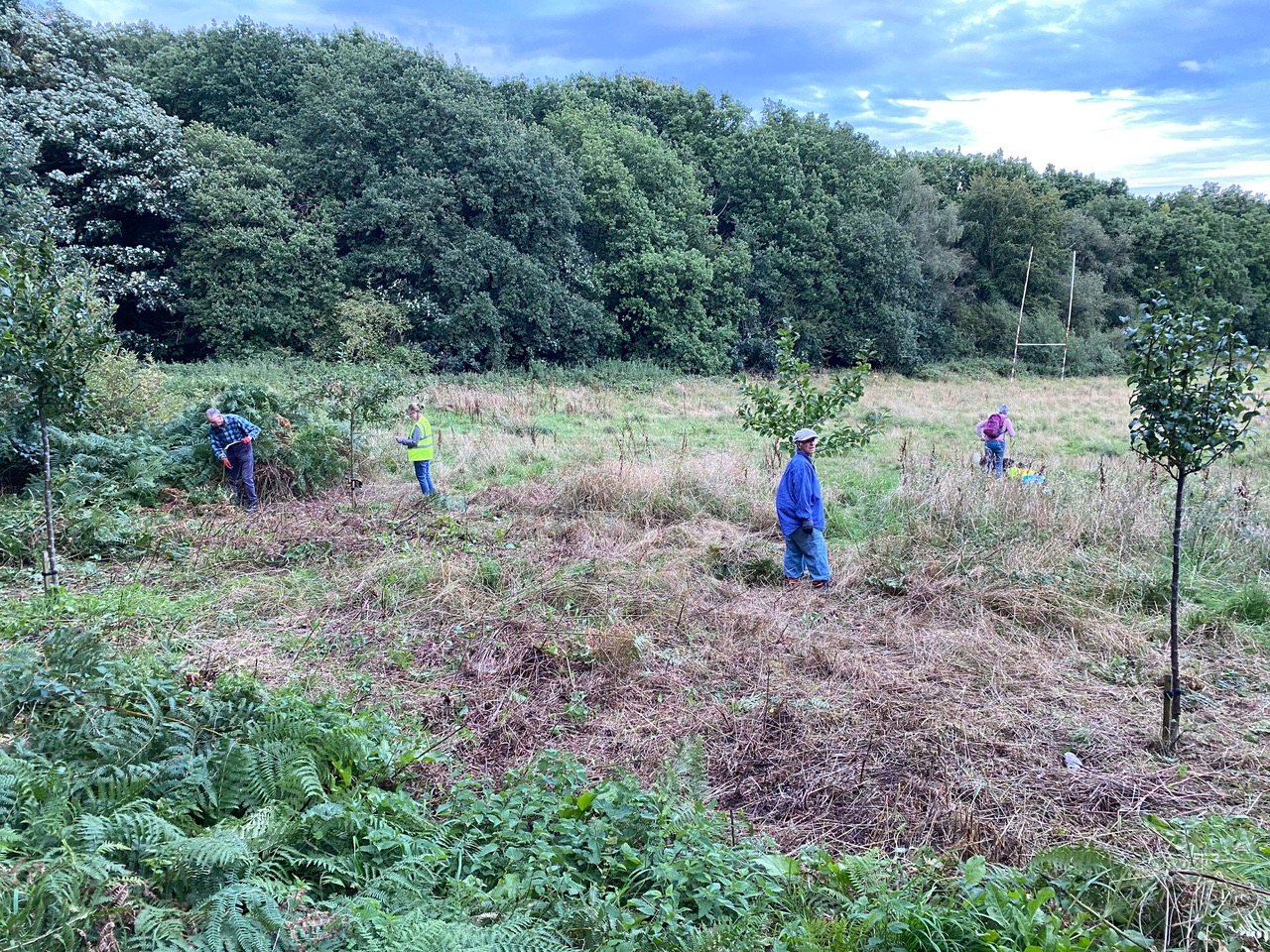
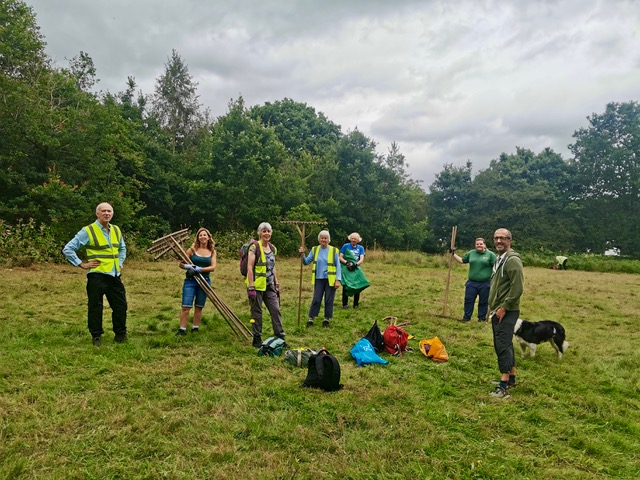
The work party working on Adel Bog was boosted by six strapping lads from Ahmadiyya Youth Association in Bradford who we hope will join us again. So in all we had eighteen volunteers – from memory our second largest turn out ever!
Only three more metres of brambles and saplings
The bog is a a distinctive habitat within Adel Woods and we usually include one morning a year to look after it. It needs care and attention as the surrounding trees drop thousands of seeds on it each Autumn and it is a constant battle to push the boundary back to where it was twelve years ago, so that bog plants like bog asphodel, heath spotted orchids, devil’s bit scabious, and rushes can continue to thrive.
The task today was to remove brambles and saplings from the bog and establish a clear boundary around the perimeter. On the southern edge, our plan was to mark the boundary by creating a “dead hedge”.
David Preston uses a “thumper” to drive a stake into the ground to create a dead hedge
Creating a dead hedge involves driving stakes into the ground to form a framework into which uprooted brambles and saplings, and branches can be interwoven to create a barrier. The stakes are ideally straight branches of trees or trunks of saplings. David had brought with him some stakes gathered from another site. You can find a photograph of the completed dead hedge at the end of this post.
A Friend sharpens the point of a stake using a billhook
Fortunately, apart from a heavy shower at about 11.30 this morning, the weather was dry today. However, one very positive consequence of the heavy rain we have experienced in the last month (Storm Babet in mid-October and Storm Ciarán over the last couple of days) was that Adel Bog was wetter than it has ever been. Everywhere was extremely squelchy – which was not very pleasant for people who had arrived in trainers!
Pulling up brambles!Two happy workers
This was a chance to use for the first time a tree popper which FOAW purchased with the assistance of a grant from Alwoodley Parish Council – for which we are very grateful.
As the photograph shows, a tree popper is a lever with a jaw at the bottom. You put the trunk of a sapling in the jaw, and it is then very easy to lever a sapling out of the ground in a matter of seconds.
Two more happy workers!David P with twelve Friends of Adel WoodsOur new stretch of dead hedging
Thank you David and all our volunteers!
Friends of Adel Woods were formed in 2009 to help maintain Adel Woods and encourage people to enjoy them. We meet one morning a month to carry out various jobs, and we also put on educational events. Recently, we have had a bat walk, and a fungal foray.
Our next “work party” is on Sunday the 10th December, when we will be litter picking, and carrying out path maintenance.
If you would like to take part in our activities, please get in touch by leaving a comment on our website.
A pleasant morning and a good turn out of twelve volunteers.
Five of our volunteers chose to litterpick – including two from Litter Free Leeds! Between them they picked up about four bags of rubbish.
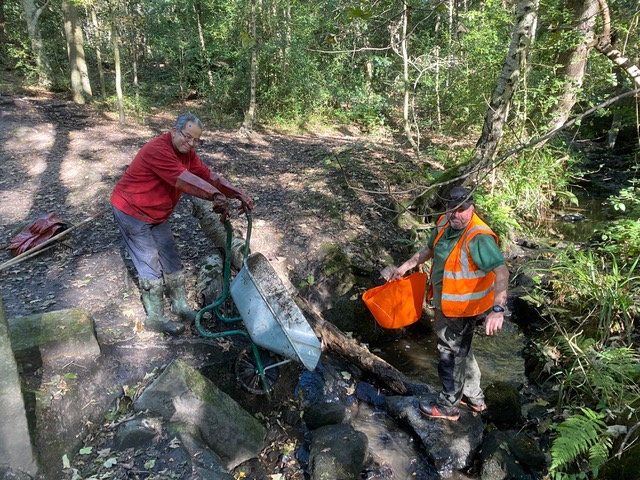
The rest of us helped David Preston, our local ranger, to dredge Adel Pond (also known as Mill Fall pond). This pond is man-made and was dug to supply water to a flax mill that once operated here. The pond fell into disuse and silted up until about thirty years ago when Steve Joul led a team of volunteers in digging it out again. It is now a wonderful habitat for frogs and newts and all sorts of aquatic insects.
Dredging the pond has been an annual task for Friends of Adel Woods every Autumn since (and including) 2009. The first thing we have to do every year is clear out the many large logs and rocks which somehow find their way into the pond. Many are concealed under the water and a bit of a tripping hazard. Fortunately, there was only one minor mishap today!
Once the logs and rocks have been removed, it is a question of digging up silt and putting it into buckets to transport away. Today we had four diggers in the pond, and one principal barrowman.
The pond is fed on the north side by a single ditch bringing in a stream of water throughout the year. Unfortunately, the stream also brings in lots of mud and clay as can be seen in the photos.
It is important, therefore, to clear as much mud and leaves from the ditch as possible and three volunteers focused on this task.
Each year we find in the mud where the stream enters the pond many broken fragments of china. Presumably these are the remains of cups, saucers, jugs and plates thrown into the pond by day trippers when Verity’s Cafe, which used to stand nearby, was in it’s heyday. Or perhaps they were thrown in when Verity’s closed down. This year, one item seemed to be a complete vase but unfortunately it shattered into many fragments as yours truly lifted it out of the mud.
At noon, we ceased work to wash down the equipment before heading home for a shower and a nice Sunday lunch.
Friends of Adel Woods were formed in 2009 to help maintain Adel Woods and encourage people to enjoy them. We meet one morning a month to carry out various jobs, and we also put on educational events.
If you would like to take part in our activities or be added to our mailing list, please get in touch by leaving a comment on our website. Our next event is on Saturday the 4th November when we will be litterpicking and working on Adel Bog with David Preston.
A lovely Autumn afternoon for a Fungal Foray with our very own expert mycologist, Steve Joul.
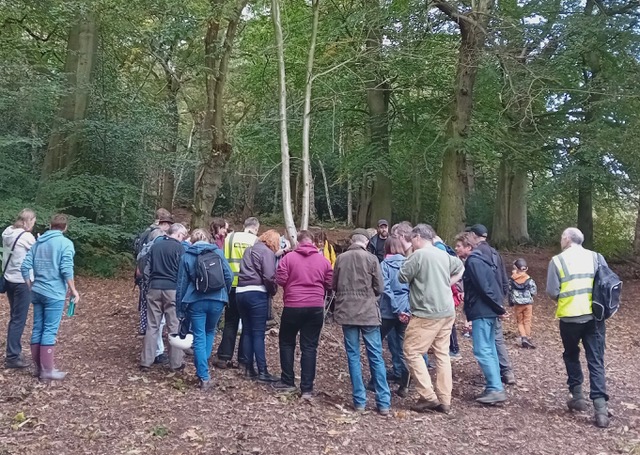
We met at 2 pm in the Village Green car park on King Lane, and forty three adults and children joined us for this free event organised by the Friends of Adel Woods.
Steve gave an introductory talk, explaining that there are 16,500 species of fungi recorded in the UK. Clearly, that is a very large number! The part of the fungi which we see – and which we think of as a mushroom or fungus – is actually the fruiting body which will only appear in certain conditions or at certain times of year: much of their structure is hidden for most of the time in soil or decaying matter.
They can be identified by such factors as their shape, colour, where they are growing and by their physical structure – some times with the aid of a microscope. Steve currently has a list of 168 of the species which we are most likely to find on a fungal foray. However, even with these, the names are constantly changing as science is able to identify their characteristics with greater accuracy – particularly with advances in molecular genetics.
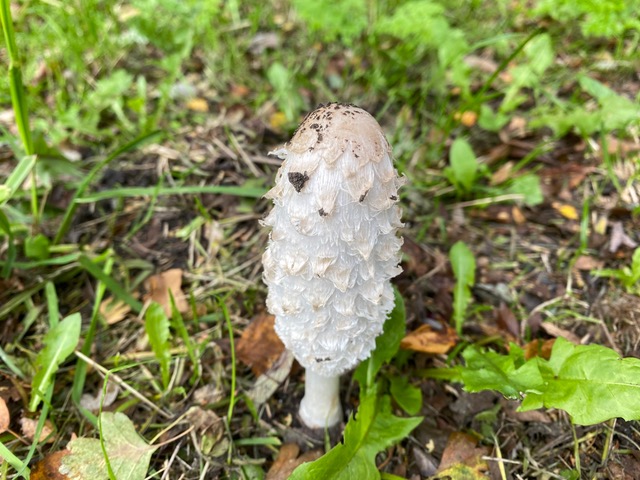
Having given a description of the life cycle and reproduction of a typical mushroom or fungus, Steve led us to have a look first of all at a fine specimen of a shaggy ink cap (or “lawyers wig”) he had spotted in the carpark.
A Shaggy Inkcap in the Village Green carpark, Alwoodley
After we had admired the shaggy ink cap, Steve led us into the woods and up into the Alwoodley Plantation on the north side of Crag Lane.
In the course of our foray, we found thirty eight species of fungus – not bad for about an hour and a half’s walk. This blog includes photos taken during the foray of some of the most striking to look at. There is a list of all the species found at the end of this blog post, giving their latin names too, so that you can look them up to find out more.
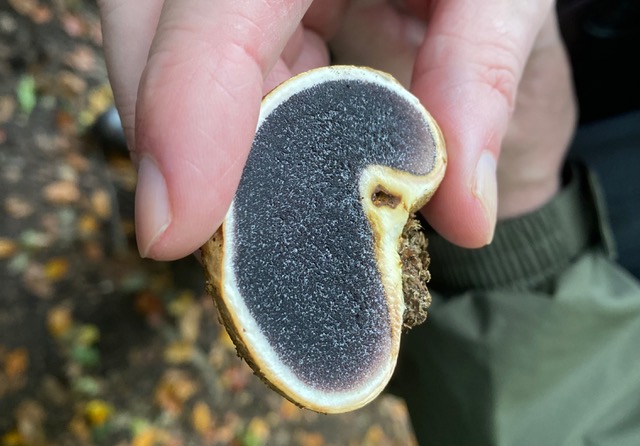
Cross-section of a Common Earthball
The common earthball looks like a warty potato on the ground. Steve cut this one in half to show us the flesh inside which will mature into spores which will eventually be dispersed by wind and rain when the skin on the outside bursts open.
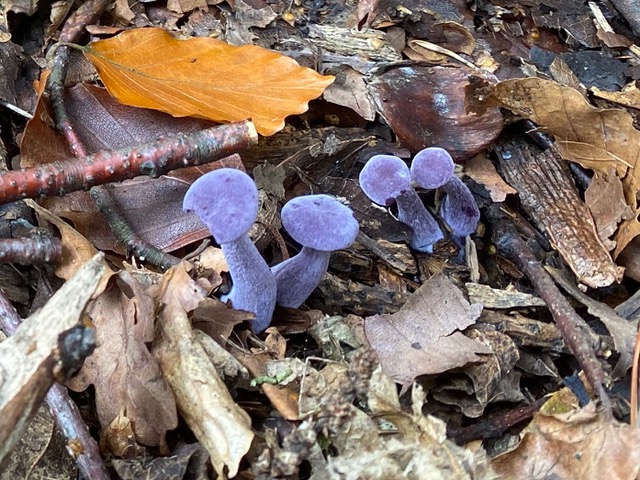
Amethyst Deceivers
Amethyst deceivers are called “deceivers” because, as they age, their colour fades and they become harder to identify.
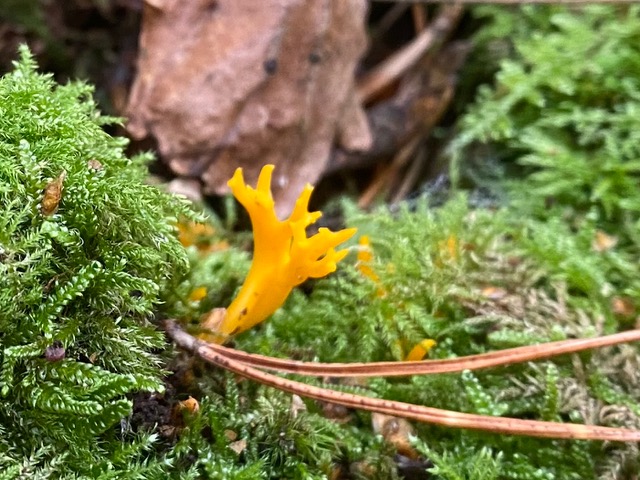
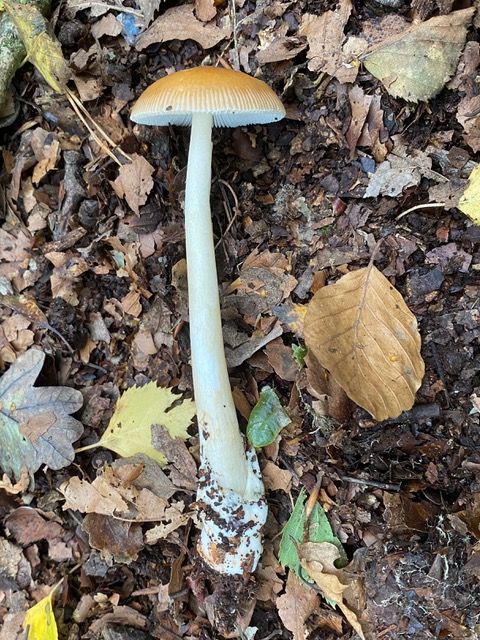
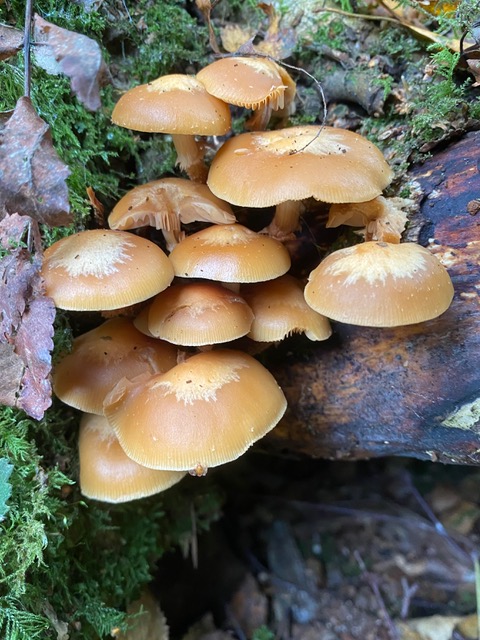
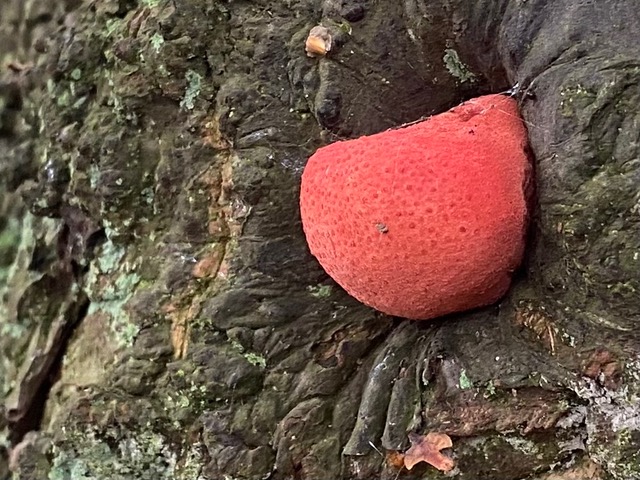
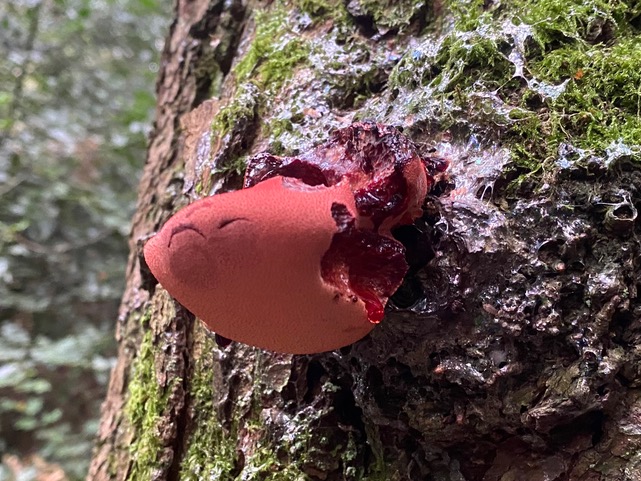
Yellow Stagshorn – it is easy to see why it is so namedTawny GrisetteSheathed WoodtuftBeefsteak fungus– so-called because it can look very like a slab of raw meat
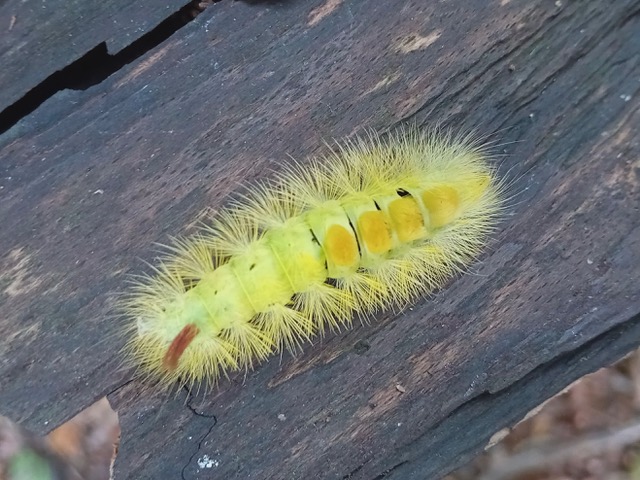
Pale Tussock Caterpillar
One of our Friends found this beautiful pale tussock caterpillar in the leaf litter on the path in Alwoodley Plantation. It was able to move surprisingly fast. Steve explained that it will have come down from the trees to the ground to find somewhere to pupate. Having taken some photographs, we put the caterpillar back on the ground among the leaf litter but well away from the beaten track. The pale tussock moth is not so striking in appearance – at least not to the human eye.
Pale Tussock caterpillar
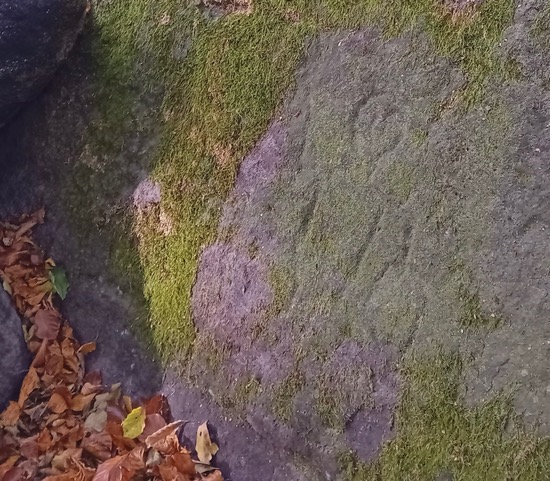
Adel Woods Ancient Monument
After the conclusion of the fungal foray, a group of us went to have a look at Adel Woods’ very own ancient monument – a celtic carving of a god or a warrior dating from Roman times.
And Finally …Two More Photographs
On our way back to the car park, we came across these two specimens of fungi we had seen earlier during the foray.
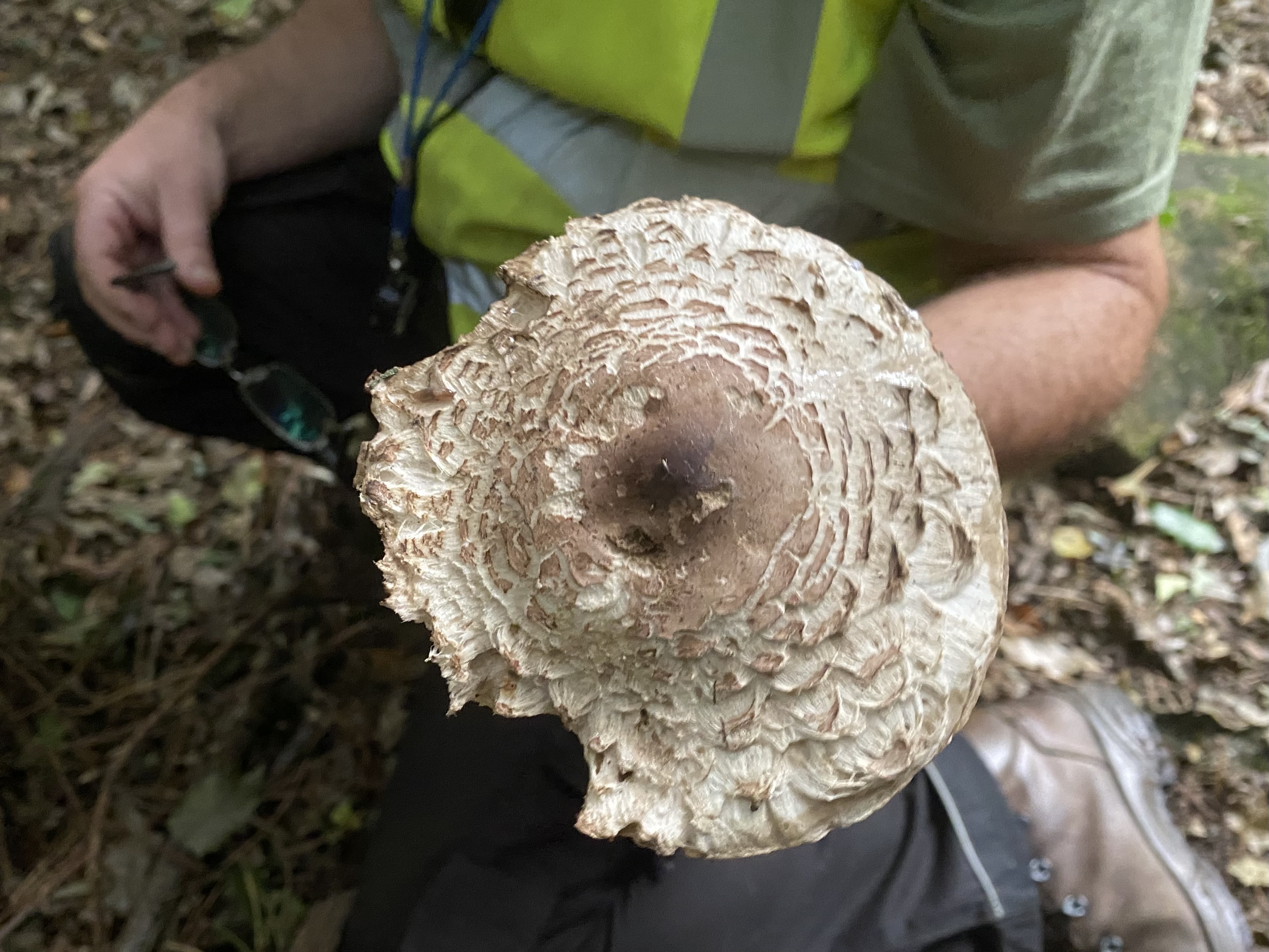
Beefsteak Fungus – partly eaten by slugsShaggy Parasol Fungus
A list of the fungi found in Adel Woods on the 8th October 2023
A nice morning, and a good turnout of nine Friends of Adel Woods.
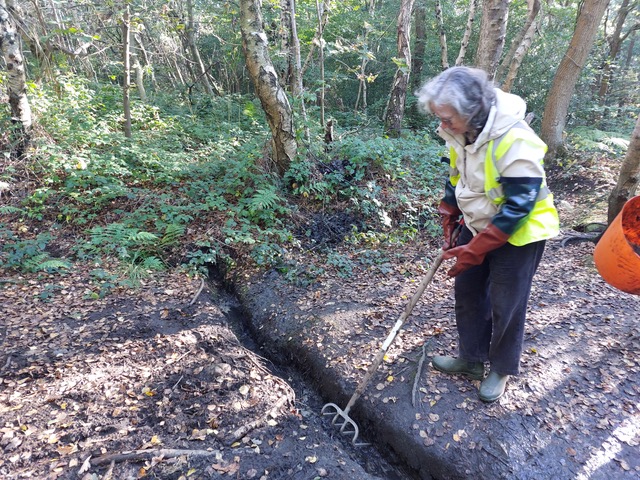
This was an extra “work party” for the specific purpose of repairing the steps leading down from the Stairfoot Lane car park to Adel Beck, and unblocking the drainage pipe under Crag Lane near the picnic area.
However, three Friends came to litterpick and between them filled four bags of litter. A wonderful achievement!
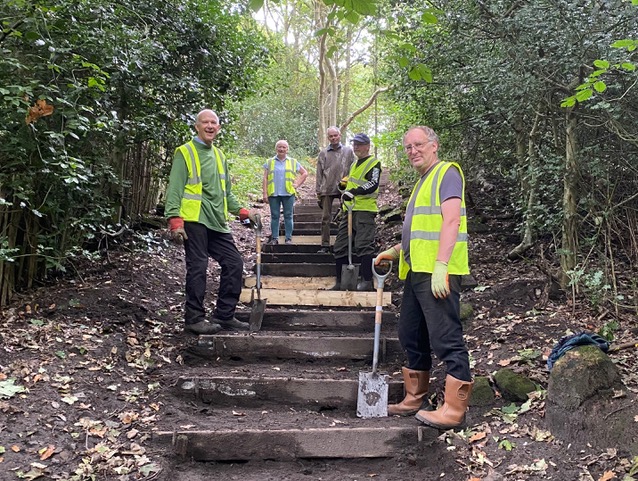
The Stairfoot Lane steps
The steps were constructed by the British Trust for Conservation Volunteers in February 2011. Before that, the traveller had to negotiate a rather steep and muddy bank if walking between the stream and Crag Lane. However, it is a public footpath and so Leeds City Council paid for the work to be done. In October 2012, Friends of Adel Woods added five further steps at the top so there are now thirty six. Sometime in 2013 we replaced the original wooden pegs with iron ones.
Maintaining the steps something we have to do regularly as mud is washed onto the steps when it rains, leaves fall onto the steps each Autumn, and the wooden risers rot. In addition, the local moles like to create mole hills on the steps!
Today, the steps were well on their way to returning to being a steep, muddy slope, and five of the risers needed to be replaced. Two or three more will need to be replaced in a year or so.
Amazingly, the six of us working on this task were able to complete the work, including levelling off all the steps, in an hour and a quarter!
We must have done well because a user of the steps emailed FOAW to tell us that we had done an amazing job – which is always nice to hear.
The drainage pipe under Crag Lane
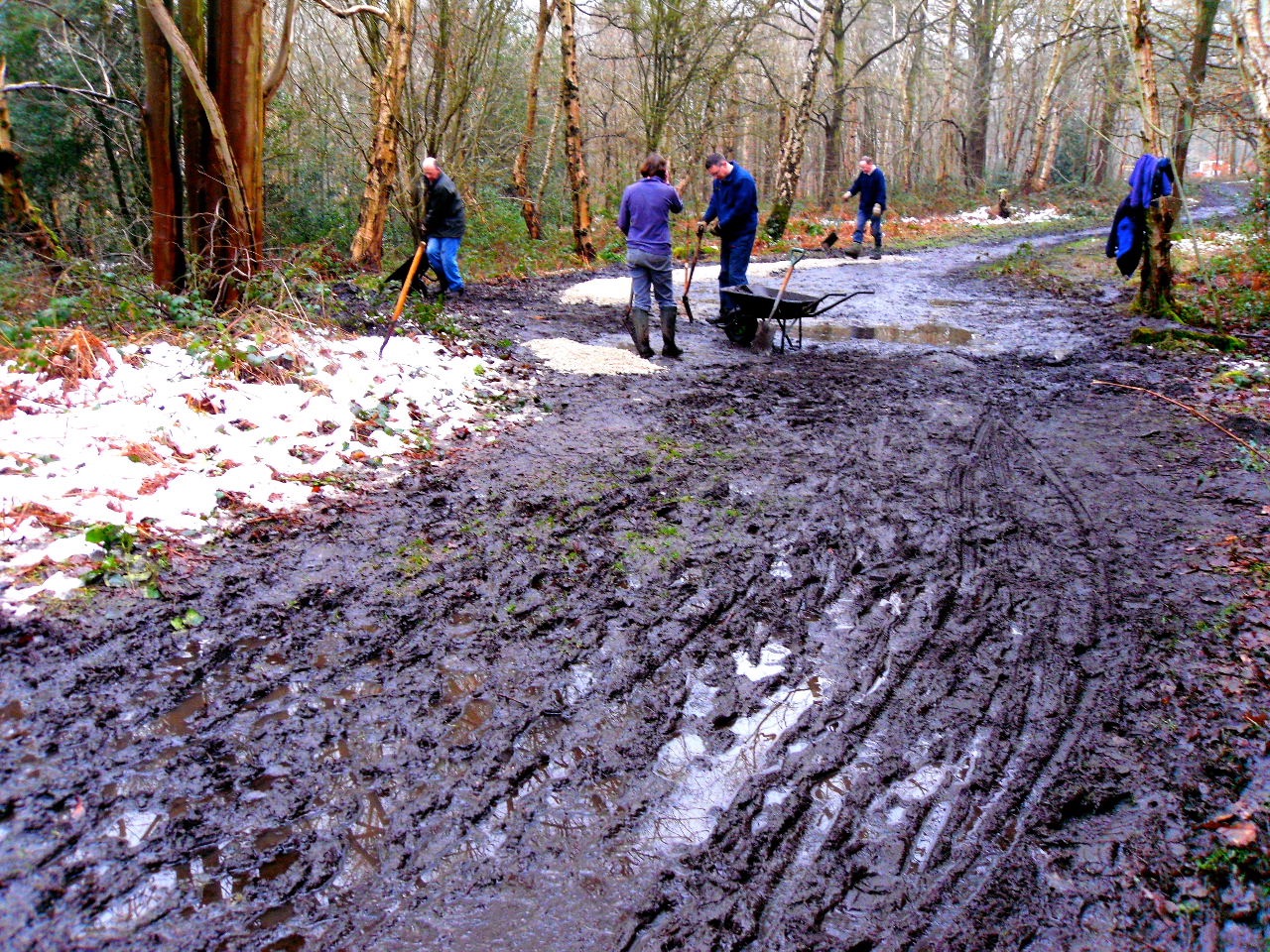
Friends of Adel Woods working on Crag Lane with Steve Joul on 20th February 2011
Until February 2011, Crag Lane near the picnic area used to turn into a quagmire every time it rained as can be seen in the photograph above. In February 2011 Steve Joul led a team of FOAW volunteers in placing a drainage pipe in the offending area and building up the path using hardcore provided by Leeds City Council.
The path is completely transformed as a result of that work, but the pipe needs to be unblocked a couple of times a year.
Using drainage rods to unblock the drainage pipe.
As one of our volunteers remarked: “I love work: I could watch someone doing it all day!”
Five happy Friends of Adel Woods
Friends of Adel Woods were formed in 2009 to help maintain Adel Woods and encourage people to enjoy them. We meet one morning a month to carry out various jobs, and we also put on educational events – this coming weekend we are putting on a Fungal Foray.
If you would like to take part in our activities, get in touch by leaving a comment on our website.
Looking southwards towards the Buck Stone on Thursday the 7th September 2023
A cool and Autumnal day. And also the day of the Meanwood Valley Trail Race organised by the Meanwood Valley Striders running club, so there were lots of runners in Adel Woods this morning.
Today we had two tasks: litterpicking and clearing scrub from around the Buck Stone.
The Buck Stone is a large outcrop of rock in the woods behind Buckstone Avenue. It has been recorded as a landmark on maps for over two hundred and fifty years and – you are ahead of me! – the Buckstone estate is named after it.
It has been a popular feature in the woods for many years, and members of FOAW can remember playing on it as children over fifty years ago!
Litterpicking
Unusually, we only had one litter picker, Sue, today.
She picked up three bags of rubbish, one of which was a bag of rubbish thrown into the bushes near the Buckstone Road entrance to the woods. She also found gas canisters and balloons in the Stairfoot Lane car park, and a disposable barbecue and box of raw bacon at Adel Crag!
The Buck Stone
Friends of Adel Woods first worked on the Buck Stone in March 2012 at the request of local residents. At that time, it was almost completely covered and hidden from view in the Summer by a large oak tree growing into the eastern end of the rock. We cut back most of the tree and cleared scrub under the guidance of our local ranger, Steve Joul, and restored the landmark to its former glory.
The Buck Stone “before and after” on the 30th March 2012
Since then, we have worked on the Buck Stone on 21 March 2015, 24th April 2016, and 8th April 2017. However, we have not worked on it since 2017 and this morning it was once more largely obscured from view by the oak tree, brambles, himalayan balsam and bracken. In fact, we had not seen such tall bracken and himalayan balsam – some plants were seven to eight feet high.
The southern face of the Buck Stone at 10.25 am this morning
The task looked daunting and the plan was to start from the Buck Stone and move outwards, to get the maximum bang for our Buck! But to begin we had to clear a way through to even reach the Buck Stone! And we also had to clear a space for a compost heap where we could put all the vegetation we removed. This in itself was a big job.
We started with a team of seven volunteers, but thankfully numbers gradually increased till there were twelve of us.
It was hard work, but as usual there was lots of interesting conversation and laughter – each of the Friends working on different parts of the project.
The northern face of the Buck Stone: 11.55 am on Saturday 16th September 2023
We finished at noon, and we achieved far more than we thought we could. Once more, the Buck Stone is a feature of Adel Woods and a place where people can sit, relax and dream, and young children can climb and play and use their imagination.
Thank you to all our volunteers. It is not just the Buck Stone that rocks. You rock too!
The southern face of the Buck Stone, noon on Saturday the 16th September
Friends of Adel Woods were formed in 2009 to help maintain Adel Woods and encourage people to enjoy them. We meet one morning a month to carry out various jobs, and we also put on educational events. If you would like to take part in our activities, get in touch by leaving a comment on our website.
Tonight David Preston, Parks and Countryside ranger with Leeds City Council, led an enthusiastic band of “bat detectorists” on a walk round Adel Woods: our mission to learn about bats. It was a clear, dry and mild evening so a good night for finding the object of our study.
We met at 7.15 in Old Leo’s car park where David (pictured in the orange hi-vis jacket) outlined the plan for the evening and gave an excellent introductory talk about bats, their importance ecologically and how to survey them, and shared some interesting facts about bats around the world. Perhaps one of the most surprising facts was that there are seventeen species of bat in the UK, several of which can be found in the suburbs of Leeds! David handed out paper “cut outs” showing the relative sizes of some of the UK species.
In preparation for this evening’s walk, yours truly (ie me!) had been out in the woods three evenings this week to find out when and where bats were likely to be found. The good news is that there were bats present in various locations – in Old Leo’s carpark; by the track leading down to the cricket pavilion; in the practice rugby pitch to the north of Crag Lane, and around the picnic area and Adel Crag. At this time of year they seemed to be appearing in flight at about 8.10 pm (sunset was at about 7.40 pm). At this time of year, bats are building up their fat supplies to prepare for their winter hibernation.
A pair of the twenty or so bat detectors brought by David
Whilst it is possible to see bats in flight at dusk, it is not possible – at least not for the non-specialist – to identify the particular species by sight. The way to detect the presence of bats, especially as it gets dark, and to identify which species is present, is by using a “bat detector”. And so David had brought twenty of so for us to use.
David explained that whilst bats have excellent eyesight, they find their way about and catch their insect prey using an echo-location system. As they fly, they send out high pitch sounds, and the echos from these sounds enable the bats to track and catch insect prey. The high pitch sounds are too high for human hearing and so the bat detector picks up the sounds and converts them into clicks which humans can hear. It also identifies the pitch of the sounds which helps you to know which species of bat is making them, and David handed out sheets which gave the frequency of the different bat clicks. For example, the noctule bat, the UK’s largest bat makes clicks at the frequency of 25kHz; the pipistrelle on the other hand, makes clicks at the frequency of 50kHz.
After a quick lesson on how to use the bat detectors, we made our way to have a look at some bat boxes which Friends of Adel Woods made and put up in the woods in January 2010 under the tutelage of Steve Joul, then a ranger with Leeds Parks and Countryside.
Steve Joul holding a bat box in January 2010 to show the slot in the bottom of the box used by bats to enter and leave the box
We put up eight bat boxes near Old Leo’s clubhouse, four on each of two trees. We put the boxes approximately twenty feet up, with the boxes on each tree facing roughly North, South, East and West so that the bats could choose the best for them. Bat boxes differ from tit nest boxes in that they don’t have a hole on the front of the box. Instead, the back of the box protrudes down below the box and bats land on this and then crawl into the box and come out again through a slot in the bottom.
The Echo Meter Touch Active Bat Detector
Whilst Friends of Adel Woods put up the boxes, it would be illegal for us to take them down and have a look inside. This was therefore a good opportunity for David to use his specialist Echo Meter Touch Active Bat Detector which fits on a smart phone, to see if there were any sounds of bats in the vicinity of the boxes. Unfortunately, it detected no activity near either set of boxes.
However, when doing our annual survey of the FOAW tit boxes, two years running we were surprised to find a noctule bat hibernating in one of them! David also recounted that when surveying dormice in North Yorkshire (which he is licensed to do) he has found bats roosting in dormouse nesting boxes; and he has even found a tit box containing a tit nest and eggs, with a dormouse sharing the box!
From the bat boxes we made our way towards the moor, past the cricket pitch, looking out for bats and listening for any noises coming from our bat detectors. The first clear sounds and sightings of bats came as we crossed the stream behind the cricket pavilion. Our detectors told us that the bats in the area were noctule (25kHz), pipistrelle (50kHz) and soprano pipistrelle (55kHz) bats.
From there we made our way up to Adel Moor, which we thought could be a good place to see and detect bats. However, we just picked up the odd sign of bat activity. So yours truly took the opportunity to explain the importance of the moor as a habitat for common lizards and green hairstreak butterflies, and to talk about the work which Friends of Adel Woods and the Parks and Countryside rangers have done to maintain the moor.
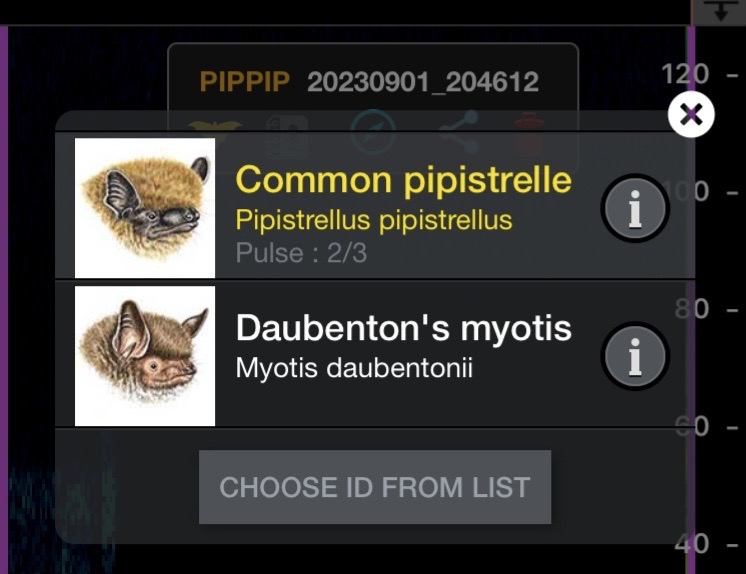
Part of the screen of David’s Echo Meter bat detector
From the moor we returned to Old Leo’s carpark via the cricket pavilion and made our way from there to the disused rugby pitch where there have been a number of bats earlier in the week. Again we detected bats but not as many as seen on earlier evenings – and the battery on David’s Echo Meter ran out!
However, when we were in the disused rugby pitch we heard tawny owls calling from opposite ends of the field.
By now it was 9.15 pm and time to finish. The preliminary results from David’s Echo Meter bat detector, subject to proper analysis, were that we saw and detected four species of bat:
noctule
pipistrelle
soprano pipistrelle
natterers bat
This is a print out from David’s Echo Meter. As can be seen, most bat activity was detected in the area in front of the cricket pavilion.
Thank you to David Preston for leading an interesting and enjoyable walk, and thanks to everyone who attended. It was a great evening.
I hope that you have found this blog post interesting. The next “educational” event organised by Friends of Adel Woods will be on the afternoon of Sunday the 8th October 2023, when Steve Joul will be leading a Fungal Foray.
Friends of Adel Woods were formed in 2009 to protect, enhance and maintain Adel Woods and to work with Leeds City Council and other groups and organisations to that end. We meet one weekend morning a month to carry out a variety of tasks in the woods. If you would like to join us, have a look at our website for upcoming events: we welcome everyone who would like to help us to look after the beautiful woods on our doorstep.
Friends of Adel Woods and Alwoodley 2030 volunteers working on the community orchard
This evening, Friends of Adel Woods had our first ever evening “work party” led by our secretary, Stephanie.
It was a joint event with Alwoodley 2030 who are a group set up about a year ago under the umbrella of Climate Action Leeds. The aim of Alwoodley 2030 is to “activate community-driven solutions to address the loss of biodiversity and nature and the climate emergency”. You can find out more at their very active Facebook page: Alwoodley 2030: Climate Action Hub.
Our task this evening was to clear bracken and brambles that have grown up around the community orchard in Adel Woods. We had a great turn out of FOAW and Alwoodley 2030 volunteers – fifteen in all – and in an hour and a half of hard work, they made a huge difference.
The orchard was planted in March 2021 by Leeds Parks and Countryside Ranger, Steve Joul, assisted by his son, as part of Leeds City Council’s woodland creation scheme. There are ten trees comprising a range of varieties of apple and pear trees.
The trees were planted as very young saplings. If they seem far apart in the photos, it is because, before planting them, Steve researched the space each would need to grow into a fully mature tree.
Spot the four trees in the photo!
If you would like to find out more about the planting of the trees and their varieties, have a look at our blog entry for the 18th March 2021 – the link is given below.
Can you spot four more four fruit trees in the photo?Some of the team of volunteers enjoying a sense of achievement for a good evening’s work!
Since the trees were cleared, Steve has put some labels on them. For more information about the orchard, here is a link to our blog post for the 18th March 2021
I hope you have enjoyed reading this blog post.
Friends of Adel Woods were set up in 2009 to protect, enhance and maintain Adel Woods and to work with other groups and organisations to that end. We welcome everyone would like to help us look after the beautiful woods on our doorstep.
The next Friends of Adel Woods “work party” is on Saturday the 16th September 2023, when we will be litterpicking and clearing scrub from around the Buck Stone. Have a look at our home page for more information.
Today we had a magnificent turnout of twelve volunteers to litterpick and to help Leeds City Council ranger, Rachel, work on the Orchid Meadow.
Three of our number chose to litterpick and ranged widely through the woods from Buckstone Road, where we met, to the pond, Crag Lane and the Stairfoot Lane carpark. They picked up up three bags of litter on the way.
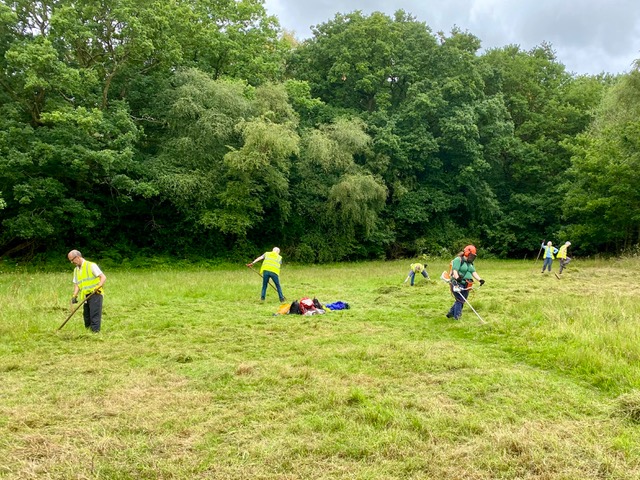
The rest of us set off to the Orchid Meadow with Rachel, armed with a brush cutter, scythes, rakes and tarpaulins.
The existence of the Orchid Meadow came to our attention in Summer 2014 when our treasurer Judith discovered lots of orchids flowering there. At that time there were lots of young trees growing in the meadow and it was surrounded by swathes of himalayan balsam. Since then we have done a lot of work on the meadow, under the leadership of Steve Joul, and it has blossomed into a wonderful wildflower meadow – as can be seen from the photograph above.
What you cannot see in the photograph are the many common spotted orchids concealed among the buttercups.
Here is a photograph of one of them.
Common spotted orchid, Adel Woods, 14th June 2023
Traditionally meadows were mown in mid to late Summer. The cuttings were then allowed to dry and removed after a few days to produce hay to feed livestock. This allowed flowering plants the chance to set seed, and the removal of the mowings reduced the nutrient levels in the soil and allowed flowers to compete with more vigorous grasses.
Much of Adel Woods was originally farmland, as evidenced by the many dry stone wall field boundaries – the farmhouse for Crag Farm used to stand in the area now used as a picnic area. Without regular mowing meadows will soon turn into scrubland and eventually woodland as shown in this photograph of the same field, taken in July 2016.
Steve Joul in the Orchid Meadow, Adel Woods, 16th July 2016
So over the last few years, as a ranger with Leeds City Council Steve Joul has mown the orchid meadow in late Summer – and last year as a private citizen he scythed the meadow and raked off the cuttings on his own!
Last week, Rachel cut about half of the meadow with a brush cutter last week, and our task today was to continue the mowing – Rachel with a brush cutter and three of us with scythes – and rake off the mowings.
Friends of Adel Woods working on the orchid meadow
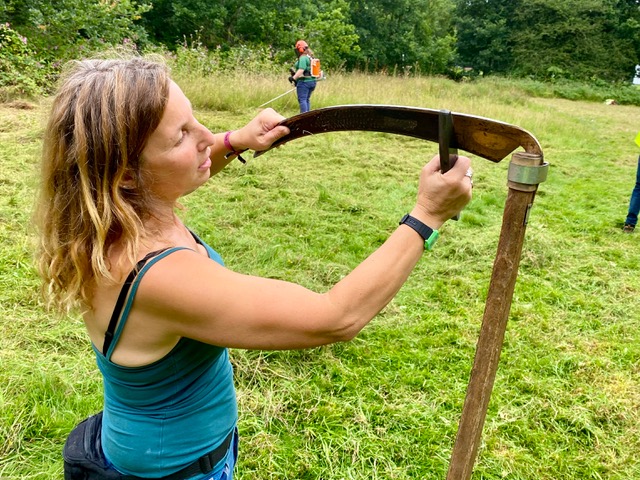
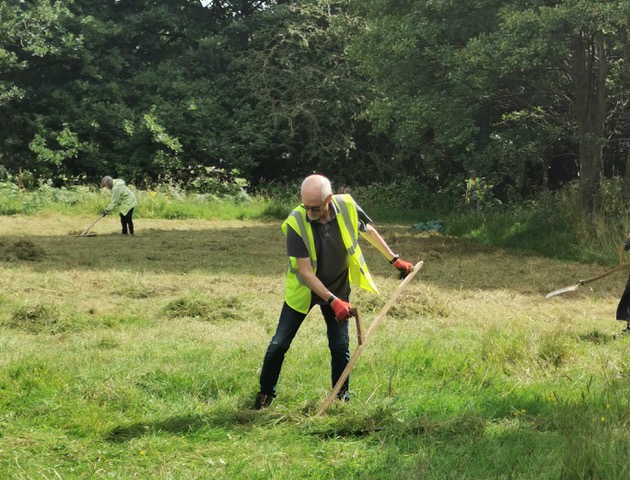
None of us had used a scythe before and Rachel showed us what to do. One essential part of using a scythe is to sharpen it with a whetstone every five minutes or so to keep it cutting well.
Friends of Adel Woods: sharpening a scythe with a whetstoneFriends of Adel Woods: scything the orchid meadow
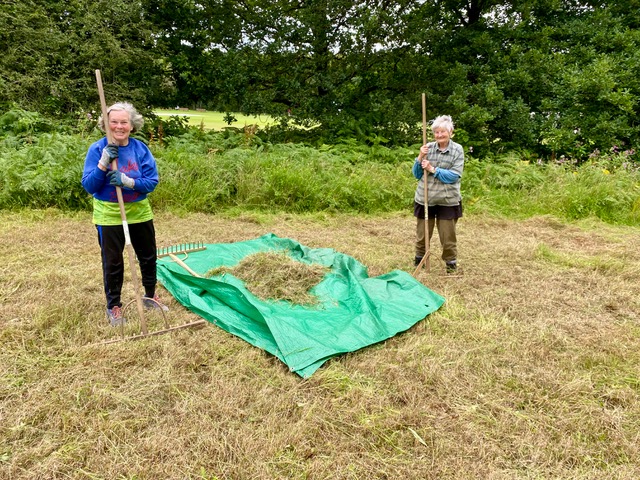
Due to the fact that we are a volunteer group, we are not able to leave the cuttings to dry, so the next step today was to rake up the cuttings and transport them to compost heaps in the adjacent woods.
Two happy workers raking up the mowingsTwo more happy workers putting the cuttings onto a tarpaulin for transfer to a compost heap.Feeling happy after a good morning’s work
Friends of Adel Woods are a friendly group and we are always looking for new members. If you would like to help look after our woods, get some fresh air and exercise in beautiful surroundings, and make new friends, please get in touch.
Our next work party is on Saturday the 16th September 2023 when we will be clearing scrub from around our local landmark, the Buck Stone.
Today was our final “Bracken Pulling Wednesday” on Adel Moor, and our fourth morning of working on the moor during July. Today we had an excellent team of six volunteers – and the next day a seventh who turned up a day late, but still did an excellent morning’s work on his own!
Over the years Friends of Adel Woods, the Leeds City Council Rangers and various other groups have done a lot of work on the moor to keep it in good shape. The difference that the work has made can be seen by comparing views below of the northern area of the moor with the south western area which has not received as much attention.
The north eastern area of Adel MoorThe south western section of the moor: a profusion of heather, bracken, brambles and saplings
Our aim during our four July events has been to reduce the amount of bracken to allow other plants such as heather, bilberry and gorse to thrive. Clearing saplings in the western section of the moor is a task for another day using tools like tree poppers and mattocks.
We focused today on clearing areas of bracken where heather or bilberry were still present under the canopy of bracken.
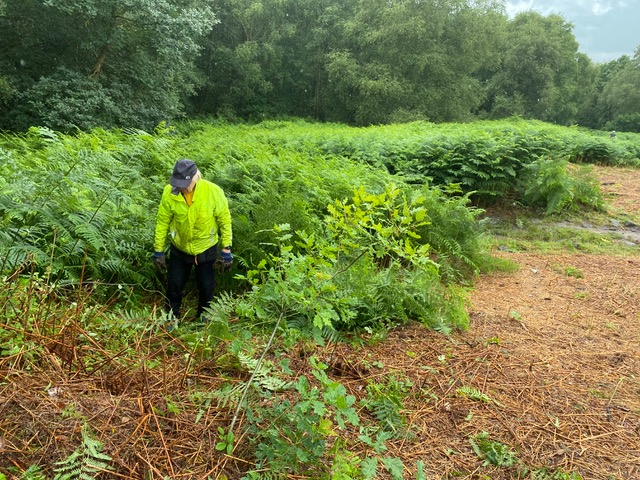
We started in the southern area of the moor where we expected (based on our work last Saturday) to find a lot of heather surviving under the bracken. However, we found that much of the ground under the bracken was bare. We therefore moved round to the south western area where we did find a lot of heather surviving under the bracken.
Getting stuck in!
However, it was very clear that a lot of work needs to be done in the south western and western areas of the moor to clear saplings. There are a lot of young oak trees and birch trees.
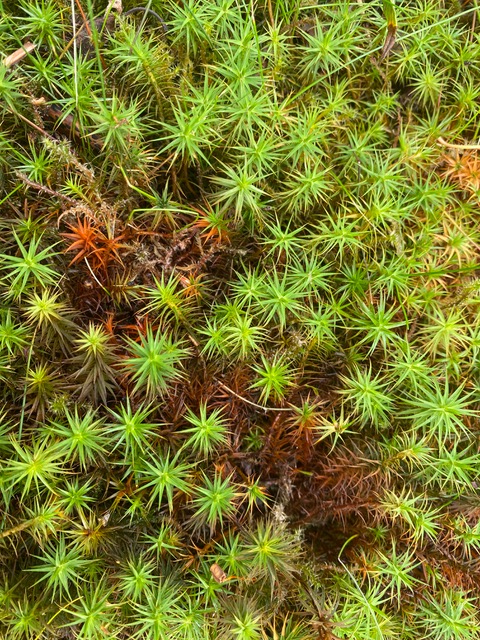
Rose Bay WillowherbJuniper Polytrichum Moss
There is a modest amount of rose bay willow herb on the moor. We cleared some of this. It was considered rare until about 150 years ago but it has spread dramatically over the last hundred years probably due to the corridors provided by railways. After the second world war it was called “bomb weed” due to its tendency to appear in bomb sites. It has a beautiful flower.
During our bracken pulling we revealed a beautiful patch of star shaped moss -see the photo above. A quick look on an iPhone app told us it was Juniper Polytrichum Moss.
Thank you to all who have participated in bracken pulling during July – including the Meanwood Valley Volunteer Rangers who worked on the moor last Wednesday with David Preston.
PS
Thank you to the person who found my New Zealand sun hat and hung it up on a tree. We found it on Friday and it is now safe and sound!
Our objectives this morning were litterpicking and continuing with our work on Adel Moor, reducing the amount of bracken, removing tree seedling and brambles.
Adel Moor
We had a small but select group of seven. One of us went off litterpicking along Crag Lane to the Stairfoot Lane car park and picked up just over a bag full of litter.
Clearing bracken on Adel Moor
The rest of us worked on Adel Moor. Today we were continuing with our work of reducing the amount of bracken on the moor, but also removing brambles and tree seedlings, saplings and rosebay willow herb.
The chair of Friends of Adel Woods assisting Judith with a tough bramble
We each found different things to do. Three of us focused on pulling bracken; one of us concentrated on clearing brambles and bracken from around the main clump of gorse; and two of us roamed over the moor, clearing up odd patches of bracken, rosebay willowherb and brambles among the heather.
One of the patches of bracken had a very healthy population of heather plants surviving beneath it – as can just about be seen in the before and after photographs below.
A patch of bracken before – at 10.43 am……and after at 11.57 amrevealing a healthy patch of heather
It was another enjoyable morning on the moor. We worked through a couple of heavy rain showers but as we finished the sun came out. Some of the heather was just coming into flower.









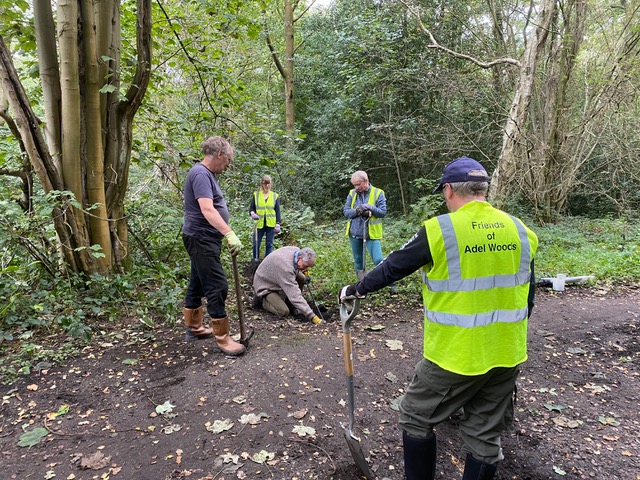
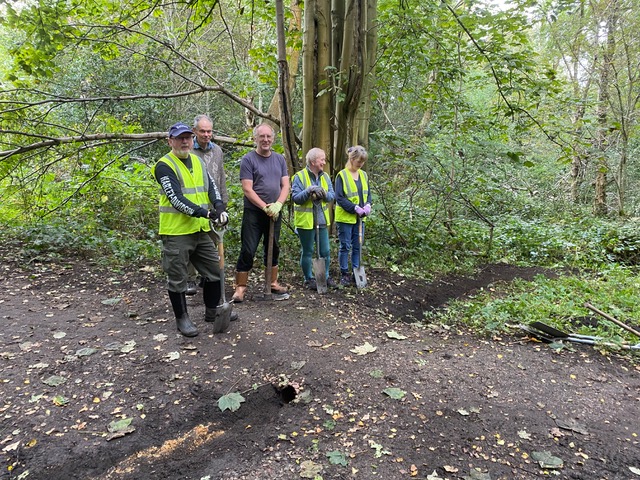



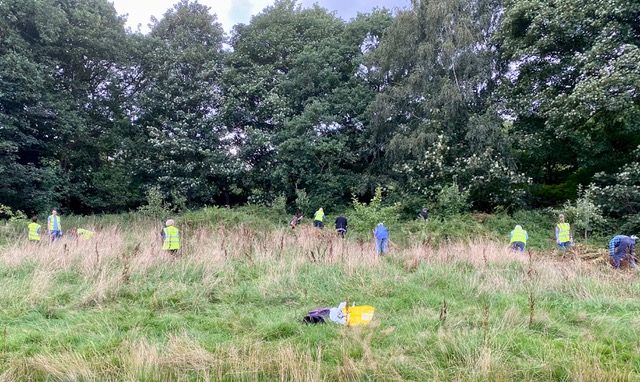









 Friends of Adel Woods
