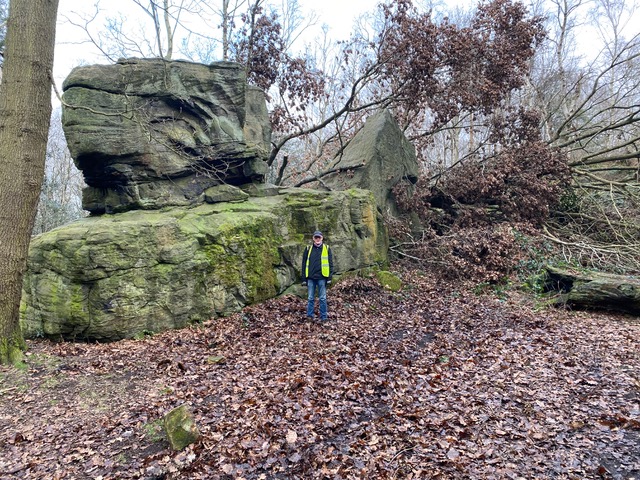
In March 2021, Steve Joul, then a ranger with Leeds City Council, planted an orchard of ten apple and pear trees to the north of the disused rugby pitch on Crag Lane. This was part of the Council’s Woodland Creation Scheme in response to climate change. Steve’s son helped to plant the trees and helped Steve to water them over their first Summer.
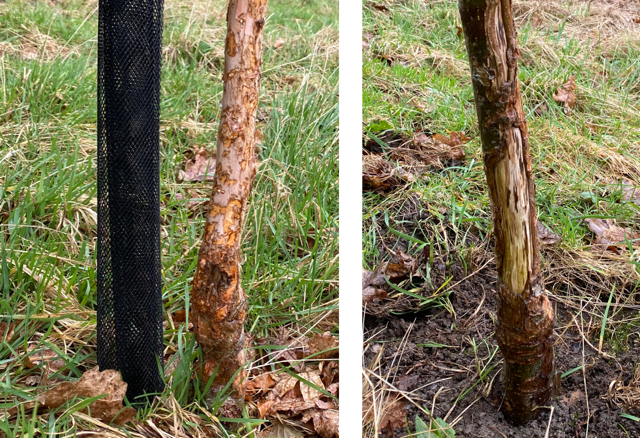
Four years on the trees are doing well but rabbits and deer are nibbling at the bark which, if not prevented, will kill the trees. All the trees are showing signs of damage.
Bark damage on two of the fruit trees – and to the left a tree guard
At Steve’s suggestion, Friends of Adel Woods applied to Alwoodley 2030 for a grant to purchase ten tree guards to protect the trees and we are very grateful that the request for a grant was approved. Over the last eighteen months, Alwoodley 2030 with the help of ranger David Preston have done work to look after the trees.
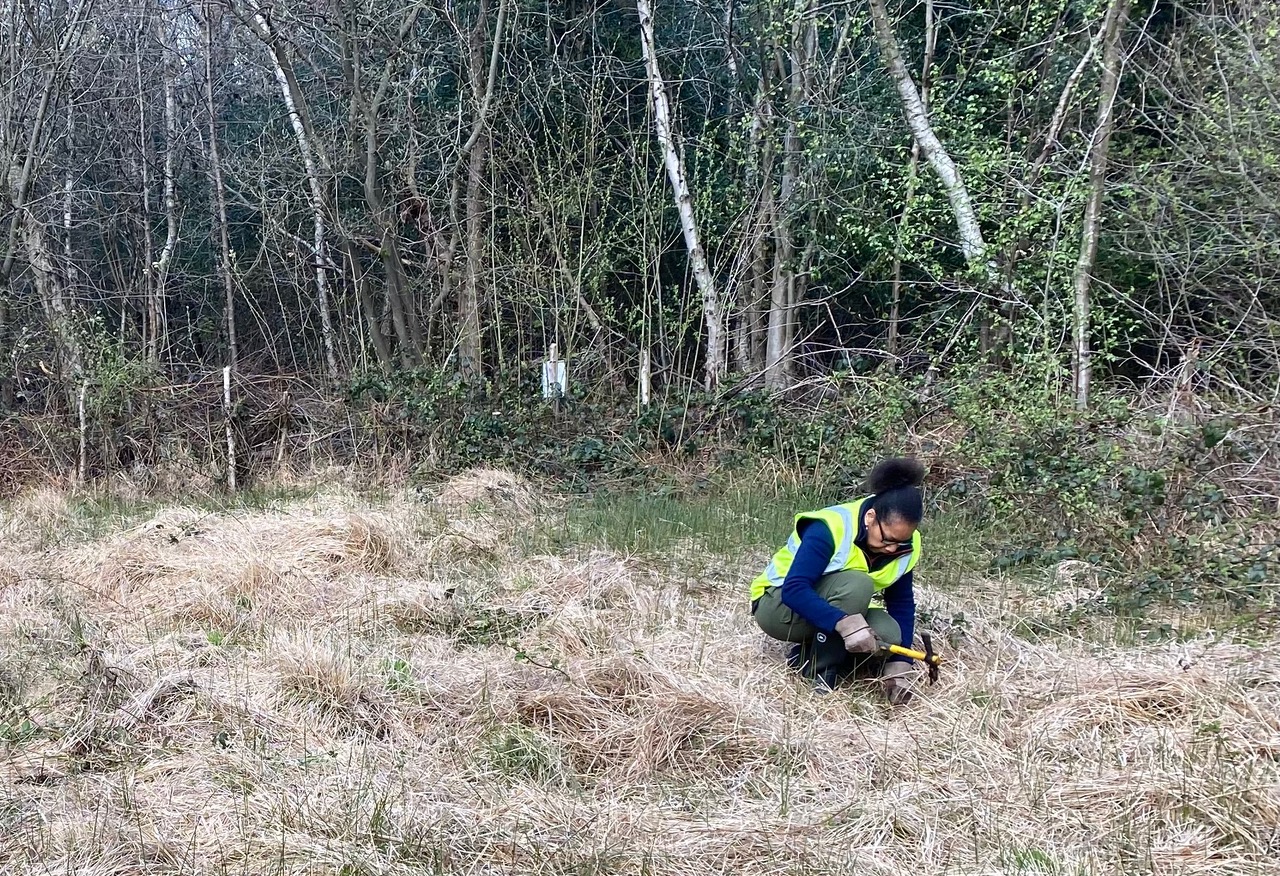
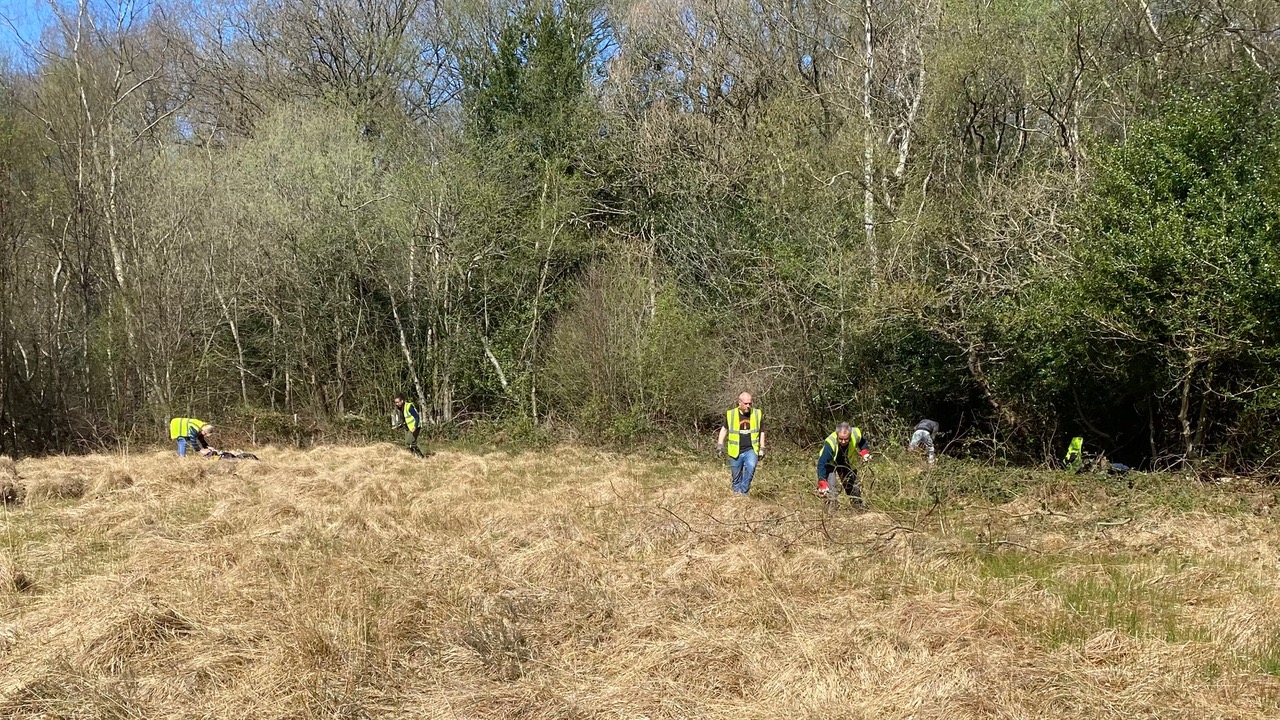
This morning, yours truly and Steve went out in somewhat wet, windy, and cold weather to put the new tree guards on the trees. The tree guards are plastic mesh which wraps around the trees and which we secured with ties You can see a tree guard ready for use in the left hand side of the photograph above. We successfully protected all ten trees, just in time for lunch. Interestingly, Steve pointed out two rabbit burrows, just a few yards from the trees!
You can find out more about the planting of the trees and their varieties in our blog entry for the 18th March 2021.
See if you can spot five of the newly protected trees!
About Friends of Adel Woods (according to Chat GPT)
Friends of Adel Woods is a community group dedicated to the conservation and enhancement of Adel Woods, a picturesque woodland in North Leeds, England. Established in July 2009, the group has been instrumental in maintaining the woods and fostering community engagement.
Formation and Early Activities
The group was founded with the aim of preserving the natural beauty of Adel Woods and promoting its enjoyment among local residents. Since its inception, Friends of Adel Woods has organized monthly meetings to carry out various conservation tasks, including:
Clearing paths to improve accessibility.
Installing bird and bat boxes to support local wildlife.
Removing litter and fly-tipping to maintain the woods’ cleanliness.
These efforts have significantly contributed to the upkeep and enhancement of the woodland area.
Educational Initiatives
Beyond conservation work, the group has organized numerous educational walks and talks, enriching the community’s understanding of the local environment and its history. These events have covered a range of topics, from local flora and fauna to the historical significance of the area.
Community Impact
Friends of Adel Woods has played a pivotal role in fostering a sense of community among local residents. By actively involving individuals in conservation efforts and educational activities, the group has strengthened the bond between people and their natural surroundings. Their ongoing dedication ensures that Adel Woods remains a cherished and well-preserved space for future generations.
Be part of Friends of Adel Woods!
If you would like to be part of FOAW, please come along to one of our monthly meetings or get in touch through this website – you should find a “comment” button below.
Despite it being a rather cold and damp morning, we had an amazing turn out of twelve Friends (including a toddler) and a spaniel!
Nine of us chose to do a litterpick and two of us to do some path clearing.
The litterpickers
The litterpickers split into two teams. One team picked up litter along Crag Lane, along the track to the cricket pavilion, and then along Buckstone Road and across the Village Green.
The other team focused on the Village Green, the area around the edge of the Village Green, and the playground area.
Between them they picked up nine bags of litter. A fantastic achievement.
Path clearing
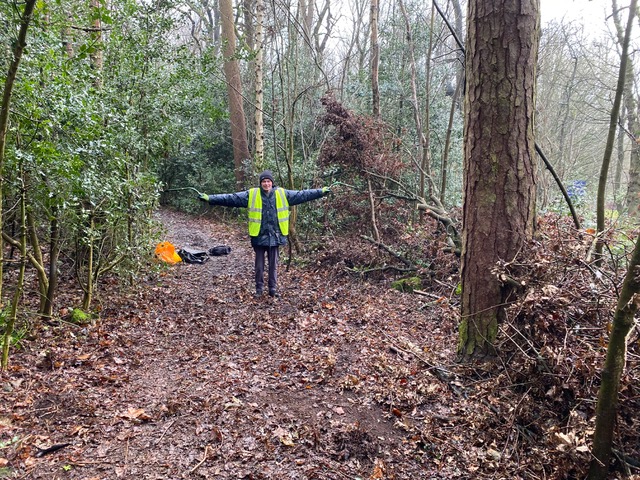
Before (looking down the path towards Crag Lane)…
We two path clearers made our way along Crag Lane and onto the “diagonal” path on the right, just before Old Leo’s carpark. A short way up this path, a tree had fallen and although part of it had been cleared from the path, it was still making the path very narrow.
….and after
Having cleared away the many branches, we made our way further up the path and trimmed back a holly bush which was growing over the path.
Before……and after
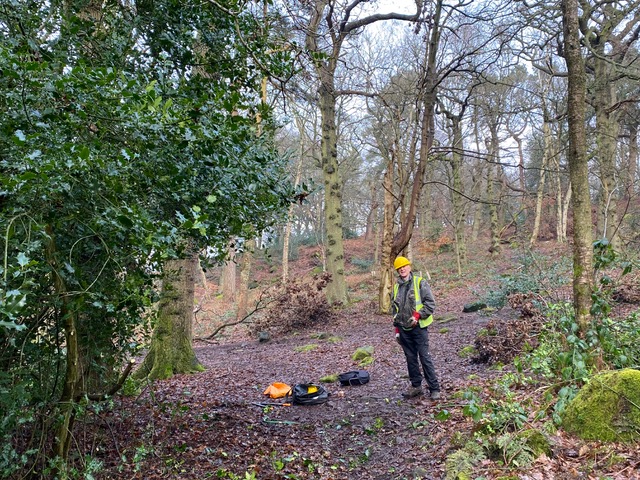
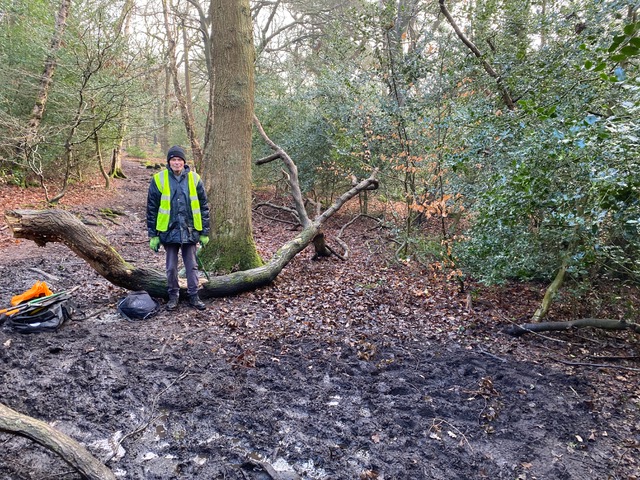
We then made our way westwards along the path towards the former rugby field and tackled another large tree which had fallen across the path.
Before….
The trunk of the tree was too big for us to tackle, but we were able to clear away many of the branches.
…and after
Finally, we made our way down to Crag Lane, and towards the picnic area. Part way along we cleared away the branches of another fallen tree.
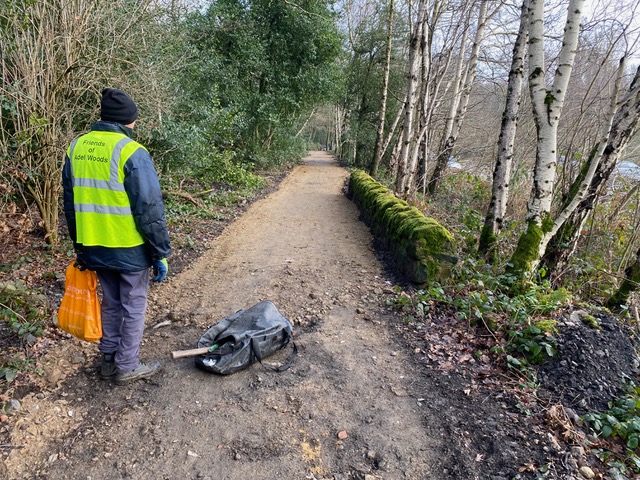
Whilst on Crag Lane we took the opportunity to have a look at some improvement work which Leeds City Council is carrying out to its surface.
Resurfacing work to Crag Lane, looking in the direction of the Stairfoot Lane carpark Resurfacing work to Crag Lane behind Old Leo’s
Come along to Friends of Adel Woods events!
We hope that you have enjoyed reading about our activities and would be delighted if you would like to join us.
Friends of Adel Woods were formed in 2009 to help maintain Adel Woods and encourage people to enjoy them. We meet one weekend morning a month to carry out various jobs or ”work parties”, and we also put on educational events such as bat walks, fungal forays and birdsong walks.
We are a very friendly group and welcome new members who want to help preserve our special woods, enjoy fresh air and exercise in the woods, and make new friends. If you would like to take part in our activities, keep an eye on our Home Page and come along to one of our work parties.
If you would like to join our email mailing list, please get in touch by leaving a comment on this website – you should be able to see a comment button at the bottom of this page.
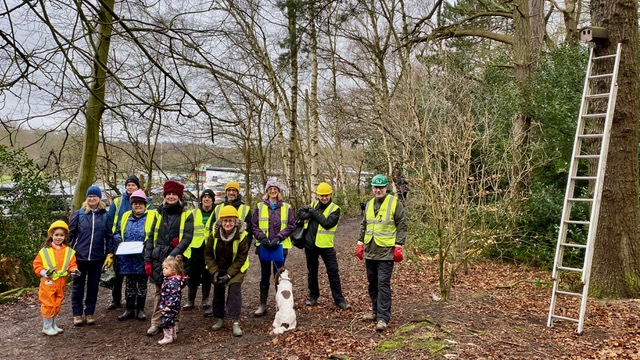
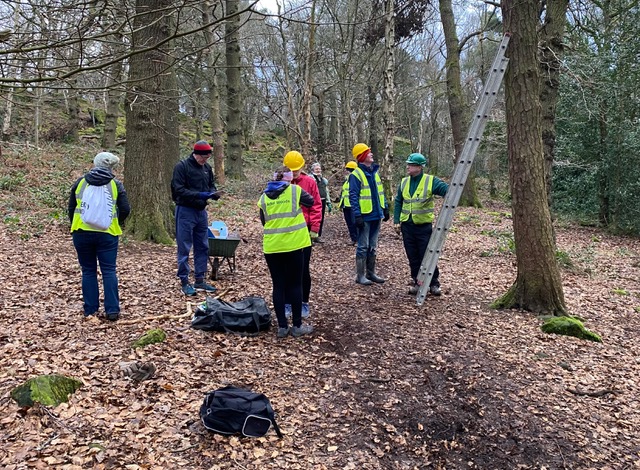
Last Sunday we started the process of surveying and cleaning the Friends of Adel Woods nest boxes and we completed about two thirds of them. Today, the weather was a bit warmer and thirteen of us set out on our nest box safari to survey and clean the remaining boxes.
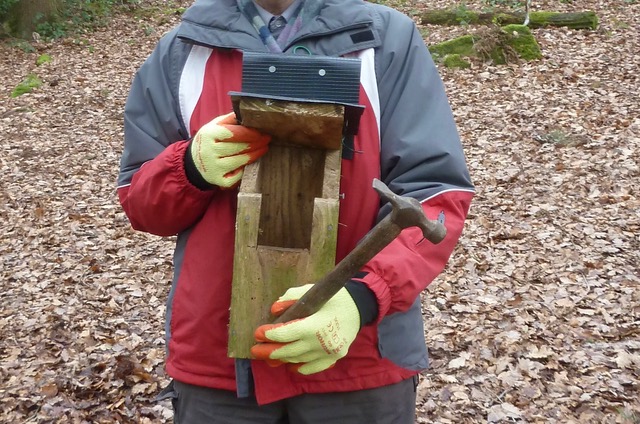
Our first port of call was to put back up our best nest box, the two hole Schwegler nest box on Crag Lane near Old Leo’s car park. We took this down last week because it needed a new nail to hold it up.
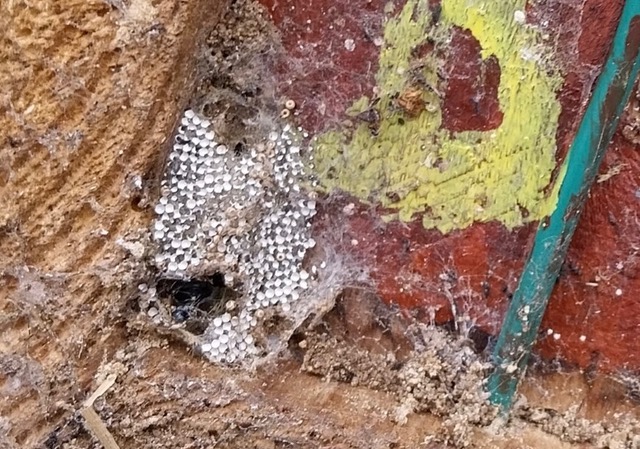
Having secured the nest box, we made our way down to the Slabbering Baby. When cleaning the nest box there, we noticed what looked like a piece of fabric on the underside of the box. It was not fabric, but the eggs of the vapourer moth – which I had never heard of before.
Vapourer moths are common throughout the UK. The female is virtually wingless, and spends her life attached to the cocoon from which she emerged, She attracts males by releasing pheromones – which is why they are call vapourer moths – and lays her eggs on what remains of her cocoon. When hatched, the very hairy caterpillars feed on a range of deciduous trees and shrubs. Gardeners know them as rusty tussock caterpillars and considered them a pest.
From the Slabbering Baby we made our way to nest box 29A by Nanny Beck. This nest box often provides a home to nuthatches, and we were very pleased to see that nuthatches used it last Spring. We can always tell in advance if nuthatches have used a nest box because they block up all cracks with mud. Intriguingly they make a nest out of chips of birch bark which look like a bowl of bran flakes!
A nuthatch nest photographed in our 2020 survey. Note the different coloured bits of mud used to block up gaps between the roof and the sides
We next surveyed nest boxes 42 and 35 – one of our new Schwegler tit boxes – and then made our way southwards down to the Seven Arches, cleaning our next boxes on the way.
Our nest boxes are not used by birds only for nesting. After the breeding season, they will use nest boxes for roosting – as evidenced by the droppings in the nest material.
Other creatures will also use the nest boxes. A couple of years running we found a noctule bat in one particular nest box – and we very quickly put the nest box back up without disturbing it! Another nest box was originally intended as a tree creeper box but last year, as in others, it provided a roosting place for squirrels.
Many of the nest boxes are used by clothes moths after the breeding season. The larvae of the moths eat into the wood and use it to create a thick fibrous and rubbery cocoon in which they spend the winter.
A tit box containing clothes moth larvae. Note the droppings in the bottom of the box, showing it was used for roosting after the nesting season.
We finished our surveying and cleaning at 2 pm. As usual, it was a very satisfying, if long, morning’s work.
Happy Friends at the end our survey
The results of our survey
We currently have forty two nest boxes: thirty seven tit boxes, four robin boxes and one starling/tree creeper box. In the course of our survey, we unfortunately overlooked one robin box and one tit box so we surveyed forty in total.
The tree creeper/starling box
Steve Joul with our tree creeper or starling box in February 2013
This box was originally intended as a box for tree creepers though we soon decided it might be better as a starling box. Treecreepers like to nest in the cracks behind the bark of trees. As can be seen from the photo, the box is very different from a tit box: it has a rectangular hole on the side, rather than a round hole on the front. It is also a lot deeper than a tit box, though this has not deterred tits from nesting in it! The hole you can see in the photograph was too big and in about 2013 we fixed a metal plate around the hole. Unfortunately, it is still too big and the box has been used several years by squirrels.
This year the box was used by a grey squirrel for roosting – evidenced by a layer of about 15 cm of dry leaf bedding.
The robin boxes
A robin box photographed in January 2019
Robins are well known for finding unusual nest sites – usually low down and well concealed: flower pots, old boots, kettles, toolboxes, farm machinery, hats and coat pockets! They will use nest boxes but rather than a round entrance hole they will only use open-fronted next boxes as shown in the photo above. However, they have not used any of our nest boxes since we put them up in 2009! There are lots of robins in Adel Woods, so they can obviously find lots of suitable nest sites on their own.
Of the three robin boxes we surveyed this year, one was used by a great tit family for nesting, one was used by a grey squirrel for roosting, and one was unused.
Tit boxes
Of the thirty six tit boxes we surveyed, two were unused. Of the thirty four used, one was used by a family of nuthatches, and thirty three by tits. We were not surveying how many nests were used by blue tits and how many by great tits, but we believe that six were used by blue tits, and four by great tits. This is based on hole size of the nest (if the nest hole is 25mm, only blue tits can get through) and size of eggs.
Sadly, not all of the tit nests will have been successful. Two nest boxes contained six skeletons each, one contained three, and one contained one. Eleven nests contained unhatched eggs. Nine of these nests contained one or two unhatched eggs, but two contained five each. It is possible that some of the young fledged from these nests, but it is also possible that the parents were predated and the nests were unsuccessful.
About Friends of Adel Woods
We hope that you have enjoyed reading about our activities and would be delighted if you would like to join us.
Friends of Adel Woods were formed in 2009 to help maintain Adel Woods and encourage people to enjoy them. We meet one weekend morning a month to carry out various jobs or ”work parties”, and we also put on educational events such as bat walks, fungal forays and birdsong walks.
We are a very friendly group and welcome new members who want to help preserve our special woods, enjoy fresh air and exercise in the woods, and make new friends. If you would like to take part in our activities, keep an eye on our Home Page and just come along to one of our work parties.
If you would like to join our email mailing list, please get in touch by leaving a comment on this website – you should be able to see a comment button at the bottom of this page.
A very, very chilly morning, but ten of us gathered at 9.45 am for the first morning of our annual nest box survey and cleaning session.
The morning
We took our usual route – along Crag Lane, taking the diagonal path into the plantation, cleaning all the nest boxes around the plantation and then heading south back to Crag Lane, and finishing at lunch time with box 53.
As in every previous survey, we found that most of the tit boxes had been used for nesting. The robin boxes had not been used by robins but one had been used by a family of great tits or blue tits – we can tell by the nesting material.
Blue tits and great tits both build their nests out of moss, grass, fur, feathers and man made materials – it is common to find in their nests orange, green or white material which seems to come from tennis balls!
As usual we found that the nest boxes were homes not only to tits but also to assorted insects – clothes moth larvae, and woodlice – and spiders.
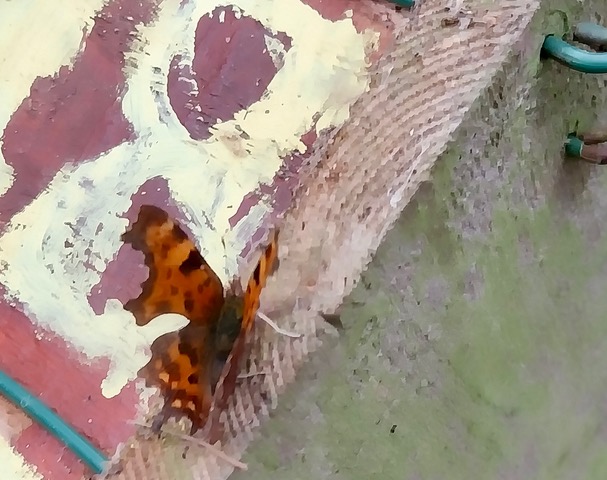
A hibernating comma butterfly in Adel Woods
We also had a new discovery. As your correspondent lifted one of the nest boxes down from the tree, he saw a leaf stuck to the bottom of it. Fortunately, he did not brush the leaf off the box because the leaf opened up to show a flash of orange and turned out to be a hibernating comma butterfly! The photograph above shows how well the butterfly was camouflaged as a leaf, and the photograph below shows its open wings. Fortunately, the butterfly returned to its state of hibernation and we were able to clean the nest box and replace it on the tree with the butterfly still in place.
The comma butterfly gets its name from the white “comma” shape on the underwing – which can be clearly seen in the photograph above.
The same hibernating butterfly, sleepily opening its wings
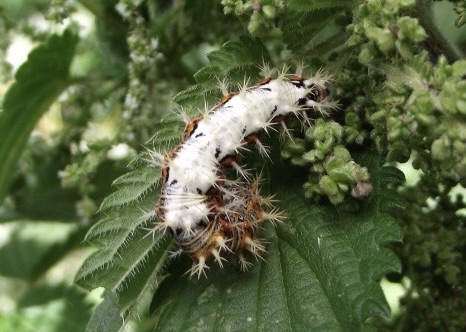
The caterpillar stage of the comma is spectacular as can be seen in the photograph below. We came across this one back in August 2013 during a FOAW task. The white stripe along its back makes it look like a bird dropping.
A caterpillar stage of a comma butterfly (polgonia c-album) photographed by Steve Joul on 13th
August 2013
After surveying and cleaning box 53, we took a lunch break from about 1.30 to 2.30 pm.
The afternoon session
Refreshed after lunch, we continued cleaning and surveying the nest boxes along Crag Lane to the picnic area and Adel Crag, and then made our way down the Meanwood Valley Trail, finishing at about 4.45 pm.
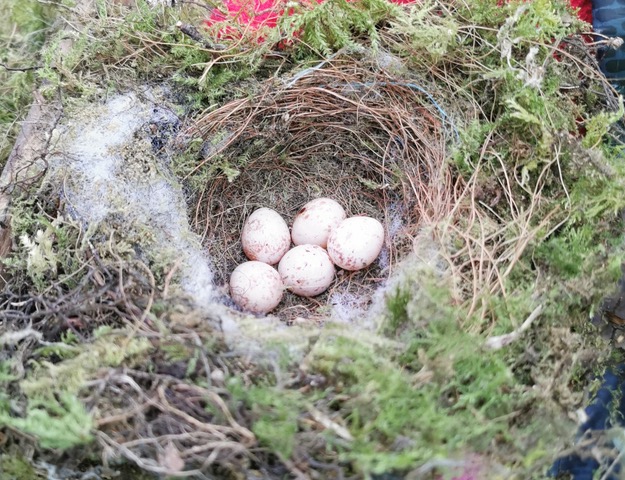
Blue tits lay typically eight to twelve eggs, but sometimes as many as sixteen, one per day! Great tits are larger than blue tits, but lay a clutch of seven to nine eggs. The eggs of both species are similar – creamy white with brown spots – but the great tit eggs are larger.
A tit nest in Adel Woods photographed in the afternoon. Note the moss, grass and grey manmade material
It is common to find one or two unhatched eggs in the nesting material which probably indicates that most of the eggs hatched and the chicks successfully fledged. Sometimes though, as in the photo above, we may find more, which may indicate that the female was predated before laying all her eggs. Sometimes we find skeletons in the nest, indicating that the parents were predated whilst raising their young.
Having made our way down the Meanwood Valley Trail almost as far as the pond, we decided to call it a day in the fading light.
About Friends of Adel Woods
We hope that you have enjoyed reading about our activities and would be delighted if you would like to join us.
Friends of Adel Woods were formed in 2009 to help maintain Adel Woods and encourage people to enjoy them. We meet one weekend morning a month to carry out various jobs or ”work parties”, and we also put on educational events such as bat walks, fungal forays and birdsong walks.
We are a very friendly group and welcome new members who want to help preserve our special woods, enjoy fresh air and exercise in the woods, and make new friends. If you would like to take part in our activities, keep an eye on our Home Page and just come along to one of our work parties.
If you would like to join our email mailing list, please get in touch by leaving a comment on this website – you should be able to see a comment button at the bottom of this page.
A fine morning and nine of us met in the Stairfoot Lane carpark at 10 am – four volunteers for litterpicking and five for clearing footpaths.
Some kindly soul had left half a dozen bags of compost – possibly from a cannabis farm – just over the fence from the carpark. Before we left we emptied the compost into the undergrowth and put the plastic bags in the carpark waste bin.
Litterpicking
Our litterpickers made their way along Crag Lane to Old Leo’s rugby club carpark. They found little litter on Crag Lane or around Adel Crag. However, there was plenty in the Stairfoot Lane carpark and around the rugby club and they picked up about two bags including lots of bags of dog faeces, many bottles and a filled disposable nappy.
A special mention goes to Rowan, our youngest volunteer this morning, who was very enthusiastic and very good at spotting difficult to see bits of glass!
Path clearing
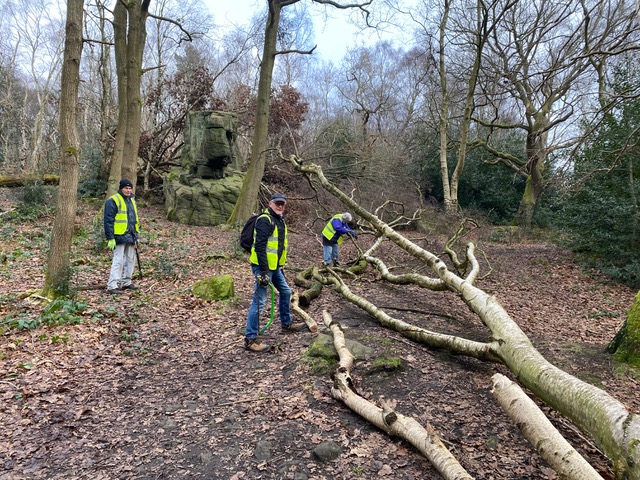
Our path clearers first of all tackled a birch tree which had fallen across the path from the Stairfoot Lane carpark up to the hospice woodland. We then pruned back some holly a little higher up the same path.
Clearing holly on the path up to the hospice woodland
Our next destination was Adel Crag where another silver birch had fallen over between Crag Lane and the Crag. We also took the opportunity to prune some of the scrub in that area.
Clearing a fallen birch tree in front of Adel Crag
In August Storm Lilian blew two very large oak trees over onto the Crag. The trees are far too big for Friends of Adel Woods to tackle, but we completed our morning’s work by clearing away some of the smaller branches to the side of the Crag.
Adel Crag at the end of our morning’s work
Finally, we cleared away a pallet which had been left by the Crag.
Join Friends of Adel Woods!
We hope that you have enjoyed reading about our activities and would be delighted if you would like to join us.
Friends of Adel Woods were formed in 2009 to help maintain Adel Woods and encourage people to enjoy them. We meet one weekend morning a month to carry out various jobs or ”work parties”, and we also put on educational events such as bat walks, fungal forays and birdsong walks.
We are a very friendly group and welcome new members who want to help preserve our special woods, enjoy fresh air and exercise in the woods, and make new friends. If you would like to take part in our activities, keep an eye on our Home Page and just come along to one of our work parties.
Over the last fifteen years we have picked up over four hundred bags of rubbish – which makes you wonder what the woods would look like today without the loving care our volunteers have given them.
In our first two litterpicks alone in July and August 2009 we picked up fifty three bags of litter plus many things which will not fit into a plastic bag – like a chair and a shopping trolley. You can find our reports here – July 2009 and August 2009.
If you would like to join our email mailing list, please get in touch by leaving a comment on this website – you should be able to see a comment button at the bottom of this page.
A Spring-like day and twelve volunteers turned out to pick up litter and to work with David Preston, our local ranger, on Adel Pond.
Adel Pond
Adel Pond is near the Slabbering Baby and was constructed originally as a water supply for a flax mill. Now it is an important breeding place for newts and frogs.
Adel Pond – it can be seen that nearly half of the pond is silted up
Water flows into it from a ditch on the northern edge but the pond silts up from the mud brought in from the ditch. Each Autumn since 2010 Friends of Adel Woods have dredged mud from the pond and the ditches which feed it in order to keep sufficient depth of water in the pond for newts and frogs to breed.
Dredging the pond
It’s not just mud that finds its way into the pond. Each year we fish out a surprising number of logs – which are presumably thrown into the pond by passers-by. We also find each year, in the mud where the water flows into the pond, pieces of broken china cups, saucers and plates which must have been thrown into the pond by picnickers or patrons of Verity’s tea rooms which used to be situated nearby.
Digging out mud where water flows into the pond Clearing the ditches feeding Adel Pond
This year there is another problem with the pond: the water level has dropped.
Dropping mud onto the outflow channel of the pone in the hope it might help to raise the water level
Water flows out of the pond from a channel on the South side of the pond. The level of the water is maintained by a barrier across the channel. Upon inspection today, it seems that water is leaking out from beneath the barrier. Today we tried a temporary fix by putting mud in the area of the leak. However, this is probably not going to work and we need to find a permanent fix in 2025.
Part of the pond dredging team after a hard morning’s work
Litterpicking
At 10 am we had one litter picker who picked up litter along Buck Stone Road, around the Village Green, the playground and the Village Green carpark, along Crag Lane, around Adel Crag and in the Stairfoot Lane carpark, picking up two bags of litter.
Later on another volunteer arrived and picked up litter in the vicinity of the cricket club.
Join Friends of Adel Woods!
We hope that you have enjoyed reading about our activities and would be delighted if you would like to join in our activities in 2025. Our next planned event is on Sunday the 12th January when we will be cleaning and surveying our nest boxes. The following Saturday we will be litterpicking and path clearing, and then on Sunday the 26th we will be completing our nest box survey and clean up.
Friends of Adel Woods were formed in 2009 to help maintain Adel Woods and encourage people to enjoy them. We meet one weekend morning a month to carry out various jobs or ”work parties”, and we also put on educational events such as bat walks, fungal forays and birdsong walks.
We are a very friendly group and welcome new members who want to help preserve our special woods, enjoy fresh air and exercise in the woods, and make new friends. If you would like to take part in our activities, just come along to one of our work parties or get in touch by leaving a comment on this website – you should be able to see a comment button at the bottom of this page.
Our plan today was to litter pick and to work with Leeds City Council ranger, David Preston, on Adel Pond. However, as Robert Burns so aptly wrote:
“The best laid schemes o’ Mice an’ Men Gang aft agley” [go awry].
Yesterday we woke up to find an inch of snow on the roads, the roofs and our gardens, with snow and sleet continuing to fall. Whilst the temperature rapidly rose to double figures during yesterday morning, the sleet turned to rain, and the snow disappeared by yesterday evening, Storm Bert brought further heavy rain overnight, with the forecast being for heavy rain which would continue until this afternoon.
Amid this weather, it was not surprising that David was not able to make it to Leeds due to flooding.
A decision was therefore made to change our plan to an hour or so’s litterpicking.
In the event, whilst Storm Bert caused havoc and mayhem elsewhere across the UK, in Alwoodley and Adel the rain had stopped by 10 am, and eight volunteers met up at the Slabbering Baby entrance to the woods – four old hands, and four newbies. It turned out to be a very pleasant morning.
We separated into two teams.
Two of our regulars set off and picked up litter from the banks of Nanny Beck (the stream running alongside Buck Stone Road), the recreation ground and the trees around it. They picked up two and a half bags of litter including a child’s wooden rattle.
The remaining six of us started by picking up litter from the path down to the Slabbering Baby – an unusual find being a fire extinguisher! We then made our way back to the cricket pavilion, taking a look at Adel Moor on the way.
Adel Moor in August 2024
From the cricket pavilion we picked up litter along the path up to Crag Lane, along Crag Lane, around Adel Crag, and in and around the Stairfoot Lane car park. Just outside the carpark we found four car number plates – no doubt discarded in the course of criminal activity.
From there we made our way back to Buck Stone Road, having collected five and a half bags of litter – making the total haul eight bags.
JOIN FRIENDS OF ADEL WOODS!
We hope that you have enjoyed reading about our activities and would be delighted if you would like to join us.
Friends of Adel Woods were formed in 2009 to help maintain Adel Woods and encourage people to enjoy them. We meet one weekend morning a month to carry out various jobs or ”work parties”, and we also put on educational events such as bat walks, fungal forays and birdsong walks.
We are a very friendly group and welcome new members who want to help preserve our special woods, enjoy fresh air and exercise in the woods, and make new friends. If you would like to take part in our activities, just come along to one of our work parties or get in touch by leaving a comment on this website – you should be able to see a comment button at the bottom of this page.
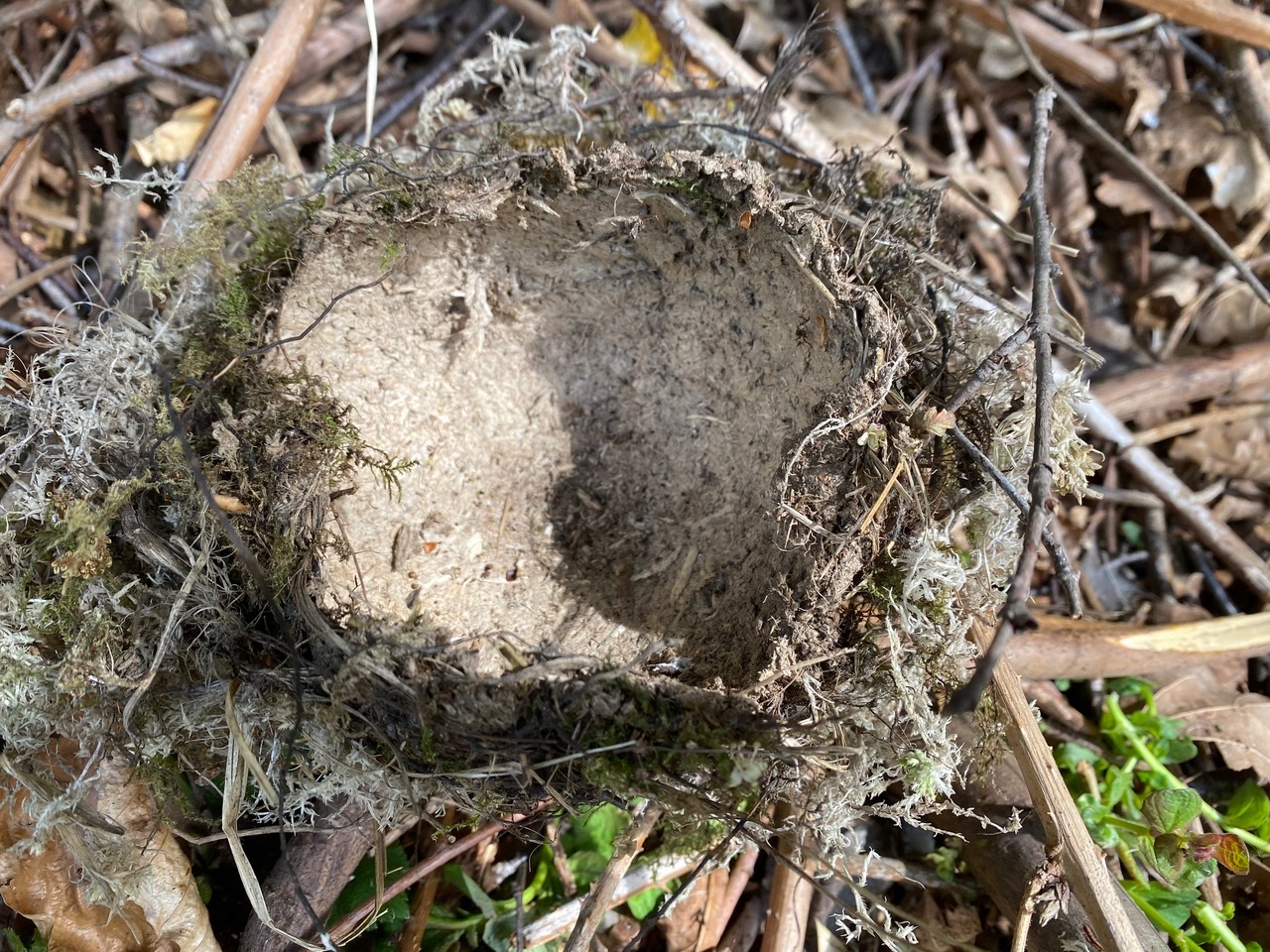
Our second Fungal Foray with Steve Joul this Autumn.
We met in Alwoodley Village Green carpark at 2 pm and Steve gave an introductory talk about Adel Woods and fungi before we moved on to the area just behind the cottage adjacent to the car park.
Having pointed out a sparrow hawk perched in a nearby tree, Steve explained that there are about 13,000 different species of fungi in the UK and new species are arriving in the UK through travel and trade.
Blushing Rosette (Abortiporus biennis)
Whilst there are many thousands of species in the UK, there are about two hundred common species which we are likely to find in Adel Woods. These days we identify or categorise species of fungi by their DNA rather than by their morphology (ie their shape and structure).They often have more than one name and so it is best to identify them by their Latin name, or by their recommended English names.
Many species are associated with particular species of trees – for example, you will see on many birch trees in Adel Woods, the birch polypore (fomitopsis betulina).
A small specimen of the common earth ball (Scleroderma citrinum)
The part of the fungus that we see is the fruiting body, while most of the organism is underground or within the dead wood of the tree. The part of the fungus within the soil or wood is called the mycelium, an interconnected network of thin threads called hyphae.
Ganoderma bracket (ganoderma sp.): the brown powder that looks like cocoa is made up of spores dropped from the brackets above.
The fruiting body produces millions of spores which, when spread, will grow into new individuals. Some species allow their spores to drop from the fruiting body into the air below: others (like the puff balls) forcibly eject spores allowing the spores to travel long distances.
Fungi may reproduce asexually or sexually. Sexual reproduction is complex: there may be more than six different sexes!
During the afternoon, we made our way from the cottage, through the Plantation on the north side of Crag Lane, and eventually reached the Stairfoot Lane car park. From there we made our way back along Crag Lane to King Lane.
As we made our way, adults and children enthusiastically searched for specimens which they brought to Steve to identify.
Steve examines a specimen of rooting shank found on Crag Lane near Old Leo’s clubhouse
In the course of the afternoon we found eighteen species of fungi, some of which appear in photographs below. Here is a complete list – the species in red being a new one for Adel Woods:
We hope that you have enjoyed reading about our activities and would be delighted if you would like to join us.
Friends of Adel Woods were formed in 2009 to help maintain Adel Woods and encourage people to enjoy them. We meet one weekend morning a month to carry out various jobs or ”work parties”, and we also put on educational events such as bat walks, fungal forays and birdsong walks.
We are a very friendly group and welcome new members who want to help preserve our special woods, enjoy fresh air and exercise in the woods, and make new friends. If you would like to take part in our activities, keep an eye on our Home Page and just come along to one of our work parties.
If you would like to join our email mailing list, please get in touch by leaving a comment on this website – you should be able to see a comment button at the bottom of this page.
Our next event is on Saturday the 14th December, when we will be litterpicking and working with David Preston, our local ranger, on Adel Pond.
A cool and damp day, but not enough to cool or dampen down the spirits of seven Friends of Adel Woods!
Today the plan was to litterpick and work with David Preston, Leeds City Council ranger, on Adel Bog.
We met up with David at the Slabbering Baby entrance to the woods in Buck Stone Road. Two of us chose to litterpick, while five of us chose to work with David on Adel Bog.
Our plucky litterpickers set off
The litter pickers made their way up to the village green, along Crag Lane to the Stairfoot Lane car park and then back along Crag Lane to the Slabbering Baby and back to Buck Stone Road. En route they collected two bags of litter.
Adel Bog looking westwards
The “bog team” transported tree poppers, mattocks, saws and loppers to Adel Bog where the plan was to remove saplings and brambles and create a “dead hedge” around the boundary of the bog.
The bog is a special habitat in Adel Woods. It is home to heath spotted orchids, bog asphodel , cotton grass, and other plants which are not found elsewhere in Adel Woods. Friends of Adel Woods have done a lot of work on the bog over the years to preserve it: if saplings and brambles are not removed, the bog will soon turn into woodland.
David standing in front of our new stretch of dead hedge
A dead hedge is what it says on the tin (or would do if it were in a tin!), a hedge but made with stakes, tree branches, uprooted saplings, brambles and the like. We started making a dead hedge last year and we were pleased to see that willow wands in the hedge had taken root to make the hedge even more effective.
Two friends of Adel Woods – with a tree popper (yellow device on the left)
The purpose of the dead hedge is to deter people from creating paths across the bog or picnicking there and to preserve this special spot in Adel Woods.
David with three happy members of our team, standing in front of the dead hedge
We removed many saplings with the use of our tree popper, and uprooted many brambles, all of which went into the construction of our dead hedge. Thank you David and team!
JOIN FRIENDS OF ADEL WOODS!
We hope that you have enjoyed reading about our activities and would be delighted if you would like to join us.
Friends of Adel Woods were formed in 2009 to help maintain Adel Woods and encourage people to enjoy them. We meet one weekend morning a month to carry out various jobs or ”work parties”, and we also put on educational events such as bat walks, fungal forays and birdsong walks.
We are a very friendly group and welcome new members who want to help preserve our special woods, enjoy fresh air and exercise in the woods, and make new friends. If you would like to take part in our activities, just come along to one of our work parties or get in touch by leaving a comment on this website – you should be able to see a comment button at the bottom of this page.
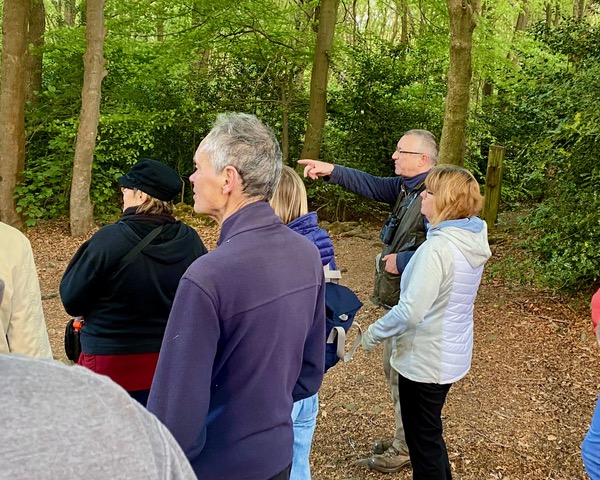
For further information, please have a look at our home page.
An overcast and damp day, but a good turn out of ten Friends met at 10 am in Buck Stone Road by the Slabbering Baby entrance to the woods. Our mission to pick up litter and remove fallen trees and encroaching brambles from paths.
The Litter Pickers
Rubbish found at Adel Crag
Three of our group chose to pick up litter and made their way up to Crag Lane and along Crag Lane to Adel Crag and Stairfoot Lane carpark.
The bulk of the litter was by Adel Crag where someone seemed to have held some sort of event, leaving a lot of rubbish behind – including wood and large lumps of foam from a bed or settee.
All in all, our valiant litterpickers picked up four full bags of rubbish plus large lumps of foam which wouldn’t fit in them. They were unable to remove the heavy wood. They also spotted a buried bag of rubbish by Stairfoot Lane car park but they were unable to unearth it.
The path clearers
Two of our number set off to Alwoodley Plantation (on the northern side of Crag Lane) with the intention of clearing holly which has grown across the paths there. However, they found that paths were also obstructed by trees and branches which had fallen across them during Storm Lilian on the 22nd August. They had a productive time, but there is still lots to do.
Clearing a fallen silver birch in Alwoodley Plantation
At the same time, yours truly and the remaining four path clearers made our way down past the Slabbering Baby to the bridge over Adel (or Meanwood) Beck. From there we followed the path by the side of the beck leading towards Stairfoot Lane.
Storm Lilian on the 22nd August had blown over a number of trees along this path. In addition, the path had been made narrow in various places by encroaching brambles.
Taking a breather after cutting back bramblesAnother fallen tree: before….…and after
We got about three quarters of the way to Stairfoot Cottage before it was time to finish and return to Buck Stone Road. Another great work party in Adel Woods!
Three happy Friends of Adel Woods
JOIN FRIENDS OF ADEL WOODS!
We hope that you have enjoyed reading about our activities and would be delighted if you would like to join us.
Friends of Adel Woods were formed in 2009 to help maintain Adel Woods and encourage people to enjoy them. We meet one weekend morning a month to carry out various jobs or ”work parties”, and we also put on educational events such as bat walks, fungal forays and birdsong walks.
We are a very friendly group and welcome new members who want to help preserve our special woods, enjoy fresh air and exercise in the woods, and make new friends. If you would like to take part in our activities, just come along to one of our work parties or get in touch by leaving a comment on this website – you should be able to see a comment button at the bottom of this page.
Our next events
Our next educational event is a Fungal Foray with our expert naturalist, Steve Joul, on Sunday 17th November 2024.
Our next work party is on Sunday the 24th November 2024 when we will be litterpicking and working with David Preston, our local countryside ranger, to dredge Adel Pond and clear the ditches feeding it.
For further information, please have a look at our home page.