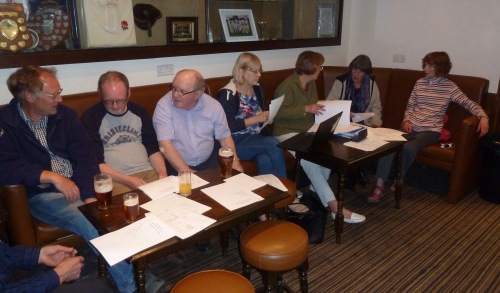
 Thank you to Old Leo’s Rugby Club for letting us hold our Annual General Meeting in their bar. Fifteen Friends of Adel Woods attended with apologies from a further three. Thank you to all.
The Chair reported on the year’s activities (see below), and the Treasurer reported on the financial position – which is very healthy.
The following were appointed officers and committee members unopposed:
Chair: Roger Gilbert Treasurer: Judith White
Secretary: Stephanie Clark Auditor: David Hall
Committee members: Robert Hall; David Hampshire; Brian Joice; David Smith
The constitution provides for ten committee members. Currently, FOAW’s committee has only seven members, so if you are interested in joining the committee, please contact the Chair.
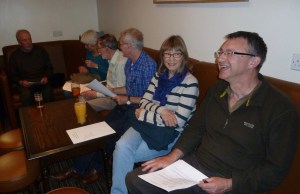
Steve Joul enjoys a joke
The meeting offered particular thanks to David Hall, who stood down as a member of the committee. David was a founder member of Friends of Adel Woods, and has made a great contribution as an active participant in our activities and as a committee member.
The meeting also gave a vote of thanks to Steve Joul for all the support he has given to the group over the last year (and indeed since the group was set up in 2009).
The Chair’s review of the year
We have had about eighteen events since our last AGM and it has been another varied, interesting and enjoyable year as recorded in our blog. Looking through the blog brings back happy memories.
We have two kinds of events: the tasks and the educational events. In both, we are incredibly lucky to be supported in what we do by Steve Joul, senior ranger with Leeds CC.
Educational/social events
There have been two of these this past year:
A visit to Alan and Diane Yarker’s small holding and survey of meadow plants on 2nd July – National Meadows Day
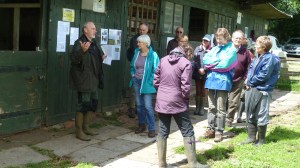 This was a great success. About 15 of us attended. Alan told us about running a smallholding and managing a meadow, and then we were free to look around. Steve and Alan took us on a tour of Alan and Diane’s meadow and Steve led some of us in carrying out a survey of a couple of quadrats – each of which contained about 20 species of plant.
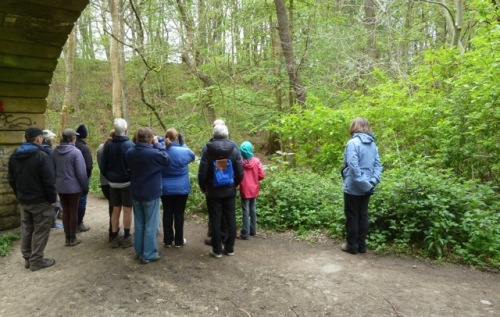
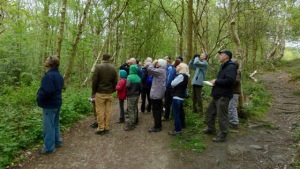 The second was a birdsong walk last Saturday, 6 May. About twenty three of us joined Steve Joul for a birdsong walk last Saturday. It was a fresh but dry morning and we saw and heard many birds.
Tasks
When I go through the range of tasks and activities we have undertaken over the last year, it is quite amazing. We cover a large area and it is clear that we could easily spend every day of every weekend doing something in the woods. Fortunately, we are not alone. There are other volunteer groups doing work in Adel Woods, and Leeds City Council bring in teams of employees from local companies to do team building work. For example, Steve Joul will be working with a team of volunteers in the woods tomorrow.
Litterpicking
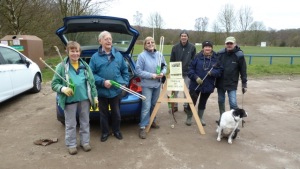 Firstly, there has been our regular litterpicking whose importance cannot be overstated. Litterpicking makes a huge difference to the woods. I haven’t kept a tally but we have picked up about 50 bags of litter over the year.
Adel Moor
We made Adel Moor a priority last year. In May we had a morning with Steve Joul pulling up saplings and brambles.
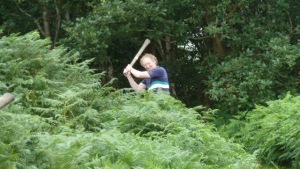
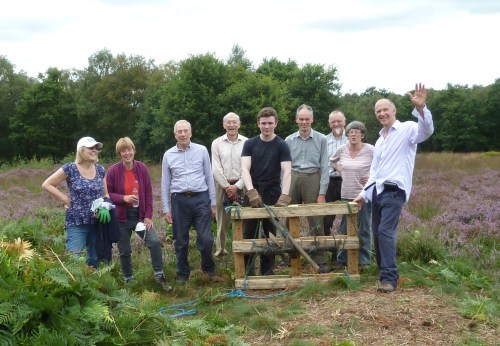
Andrew, in a testosterone fuelled moment
And in August and September we spent three mornings bracken bashing. These mornings were very enjoyable. The moor is a great place to work and on each occasion we were blessed with good weather. We tried out different ways of beating back the bracken. Some of us pulled it, some of us hit it with sticks, and some of us crushed the bracken with a deadly machine invented and designed by David.
Path improvements
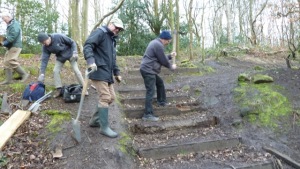 Path clearance has been another regular task. Over the last year Friends have worked on improving paths – clearing mud, cutting back branches and removing fallen trees – on three occasions. In March we repaired a couple of steps in the steps leading down from the Stairfoot Lane car park to the stream.
Adel Bog
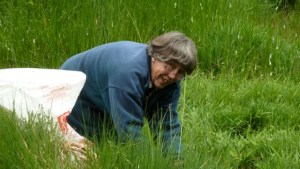
Working with a smile!
In 2011 BTCV cleared a lot of purple moor grass from Adel Bog, paid for in part by Leeds CC and the Parish Council. We have continued that work clearing a lot of encroaching vegetation such as brambles which were slowly turning the bog into dry land. Bog plants are returning. We worked on the bog on 19 June and it is our next event this month.
The bog is a great place to spend the morning in Spring and Summer: very secluded, full of beautiful plants, and often populated with many butterflies.
Nest boxes
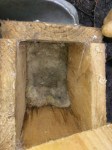
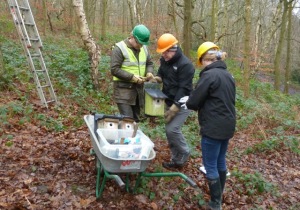 We had two days out in January surveying the nest boxes and the good news is that they were almost all used. You can feel pleased that there is a good chance that the great tits and blue tits you see in the woods or your garden – possibly the nuthatches too – were reared in a FOAW nestbox!
 The Buck Stone
Four years ago we did two days work on the Buck Stone and made it accessible to the public again. We have continued our work and on 8 April this year we spent a morning tidying it up.
The hospice woodland
We had one session working on the Hospice Woodland in the last year – clearing brambles from the trees.
Adel Pond
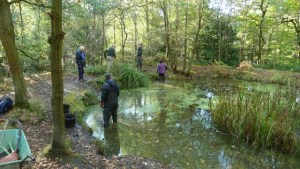
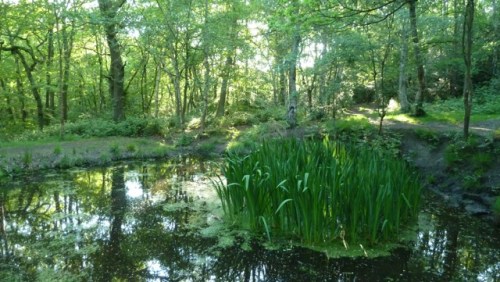
Adel Pond, 23 October 2016 – see the clump of flag irises to the right.
Adel Pond is one of our regular jobs now.
In October a team of volunteers helped Steve Joul clear silt out of the pond and clear the streams running into it. It is home to a healthy population of news and it is looking great at the moment.
The orchid meadow
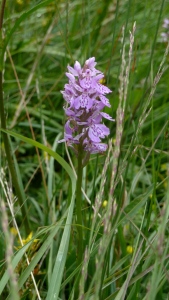
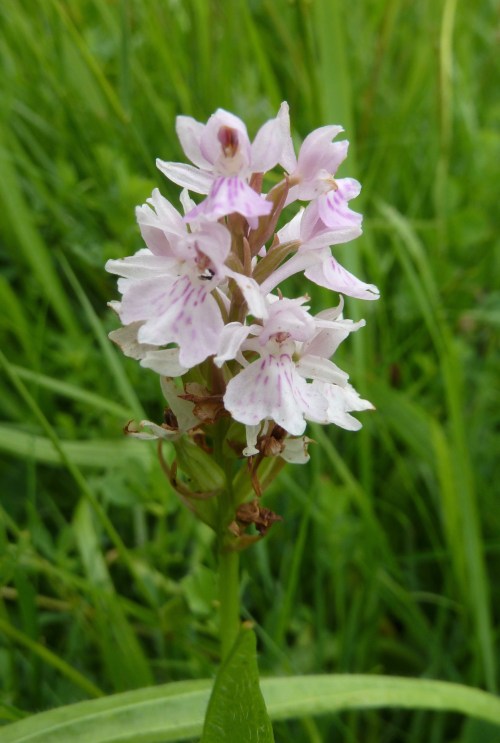 Two years ago we had a tremendous display of common spotted orchids in a field near the cricket pitch. However, the field is under threat from Himalayan Balsam and from encroaching trees. Last year we spent a morning with Steve Joul clearing Himalayan Balsam, trees and brambles. Steve counted the orchids and came to a figure of 2,690! We are working on this area again this Summer and Steve Joul will be carrying out work with a team of volunteers in August.
Christmas Garlands:
We had another session making Christmas garlands for sale to raise funds.
The Future
We have a draft program right up to December with an interesting and varied range of activities.
Our next event is Sunday 21 May when we will be litterpicking and working on Adel Bog with Steve Joul.
At the beginning of July, Alan Yarker and Diane Yarker are planning to have another open day at their small holding and all being well Steve will lead volunteers in carrying out a further survey of their meadow.
We are hoping to get the local scouts and guides involved in FOAW – possibly bracken bashing this Summer
We are planning to have at least one other event with Steve Joul this year – a moth survey and bat walk.
Thanks
So in summary, I would just like to end by thanking all the people we need to thank for supporting us over the last year.
First of all, I would like to thank Steve Joul for all the support – and tuition – he has given us over the year. If I know anything about conservation work, I have learned it from him.
I would like to thank Alwoodley Parish Council and our local city councillors for their financial support and encouragement.
I really must thank Tony and Old Leo’s for letting us use their facilities for making the Christmas garlands and have our AGM here. Please after the meeting, can you please drink as much as you can so that they’ll have us again!
I would like to thank our committee and officers for all their support and hard work over the year.
In particular, I would like to thank David Hall, who was one of our founder members, and a committee member since our founding in 2009, who has decided that the time has come to hang up his leather gloves. We are very grateful for all he has contributed both in the field and in the committee room since 2009.
And finally, I would like to thank all our wonderful Friends – whether here or absent – for the hard work you have all put in over the year. I hope that tonight’s summary has reminded you of some happy mornings or evenings and shown you that you have all made a fantastic improvement to the state of Adel Woods and to our local community.
Thank you!
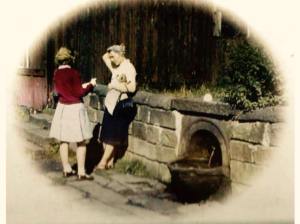
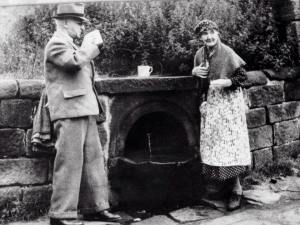 The Slabbering Baby is a drinking fountain in Adel Woods. Have a look at our blog entry for 24 May 2017 for information about its history and location. In recent years, it has fallen into disrepair, and the stream of water reduced to a feeble trickle, and many have dreamed that it can be restored. This picture shows the Slabbering Baby in its heyday – and the lady in the picture is believed to be Francis Verity of Verity’s Tea Rooms.
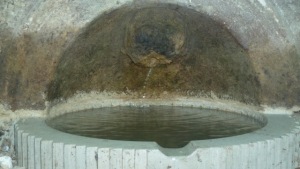 The new bowl has been carved by Teresa Dybisz, an apprentice stone mason with York Minster, and she has done a super job.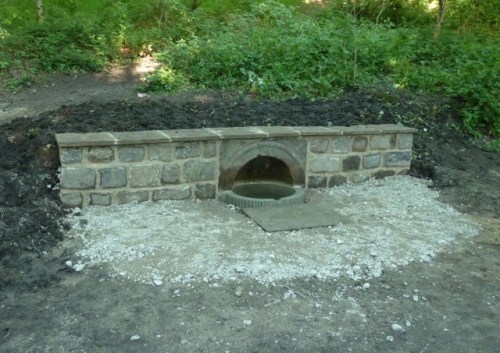
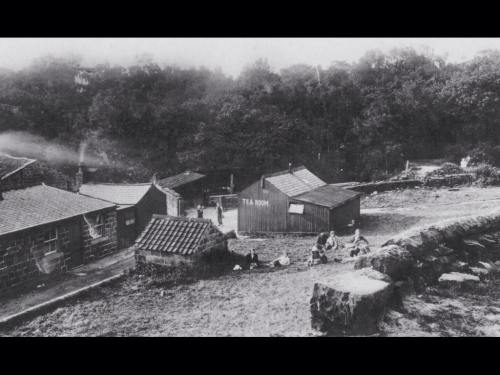 Did you know that until the late 1950’s there were tea rooms, known as “Verity’s Tea Rooms”, in Adel Woods? They were run by Francis Verity who arrived there in 1901, aged 30, and stayed there until she died in about 1953.
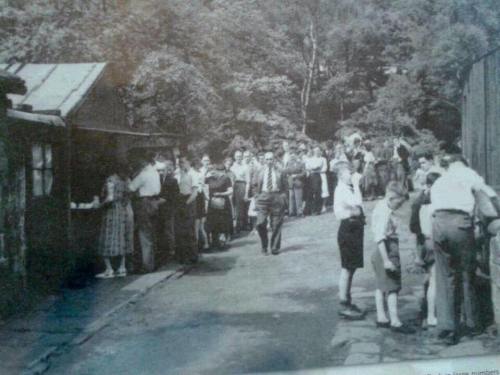 “She had a tragic life. Her husband, Ben, was a highly skilled stonemason but he died suddenly after falling off a roof he was mending. Her son, Benny, was a disabled child and she spent large amounts of time looking after him. Perhaps this led to the harsh expression on her stony face as many remember her as always seeming to be in a foul mood. In addition, when Mrs Verity took her cap off she had unusual lumps over her head. The children who visited the tea-shop were always scared of her….By the mid fifties the sheds had become very ramshackle. Children used to volunteer to help and their reward was ‘a free tray’. Mrs Verity used a motley collection of crockery, a lot of which was brown glazed. She sold Smith’s crisps with salt in the little blue bags and collected the tokens that came with them to get free pens. In addition she sold home-made scones and cakes but was a thrifty lady and told helpers who were buttering the scones to ‘just peel it off again’ so that the layer of butter remained extra thin.
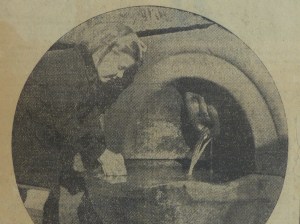 The only remaining vestige of the tea rooms is the Slabbering Baby, a water fountain fed by water off Adel Moor. The people on the right hand side of the picture above are queuing for drinking water from it. It was called the Slabbering Baby because the water streamed out of a carved face – as shown in this newspaper picture.
 You may have noticed that the Slabbering Baby disappeared in November last year. It has now returned with the addition of a new bowl, as shown in the picture below. The work is not yet complete.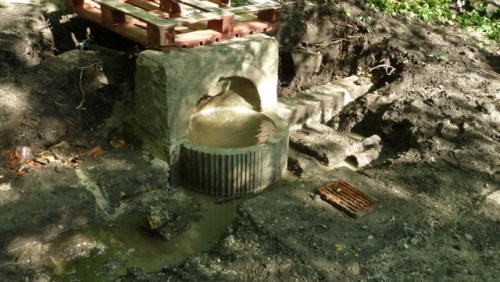
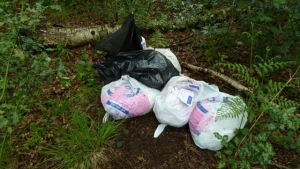 Disappointingly, on our way to the bog, we found that someone had dumped about seven bags of charity bags – for Children with Cancer and Candlelighters – in the middle of some holly bushes. Clearly, whoever put them there, wanted them not to be found because they were not flytipped on the outskirts of the woods: it clearly took a lot of effort to get them to where they were dumped. Needless to say, FOAW removed them and disposed of them.
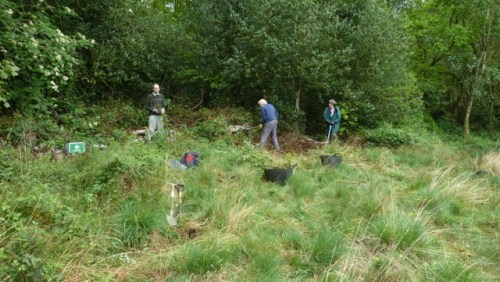 Moving on to more uplifting things, the bog looks different every time we visit it. Today, it was quite dry, particularly at the northern end. Over the years, we have removed thousands of saplings from the bog. Today, there seemed to be hundreds of new tree seedlings, and we removed very many of them. Fortunately, the pulled up very easily.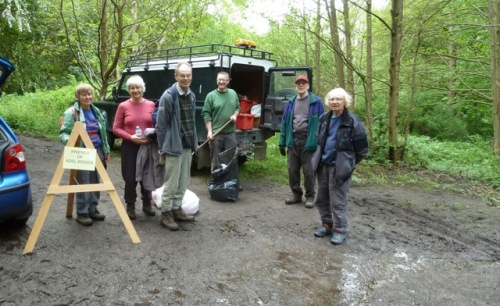


 While all the sawing was going on, Brian was carefully removing grass and weeds from the Buck Stone, others were digging up brambles and other plants from around the base, and yet other members of the team were clearing brambles from nearby paths and picking up litter. It is clear from the sweet wrappers we uncovered that the original ground level around the Buck Stone was at one time rather lower than it is now.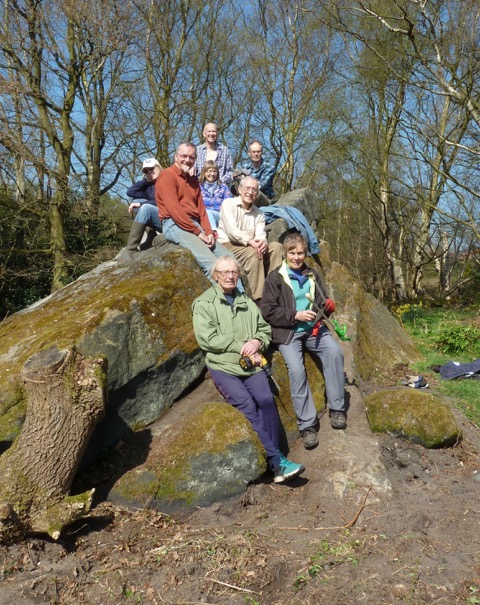

 where some of us set about clearing some flytipping. It is astonishing how the existence of a fence suggests to the human mind that if things are thrown over the fence, that somehow means that they are no longer a problem!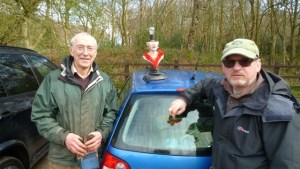
 Our task here was not to clear away all the brambles – they provide a wonderful habitat for small animals and for birds like whitethroats – but to remove them from trees, to widen footpaths and to clear them away from clumps of daffodils.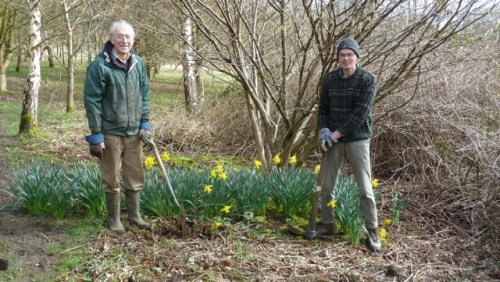
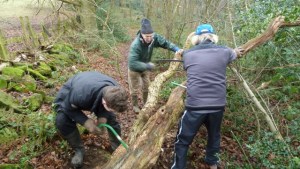
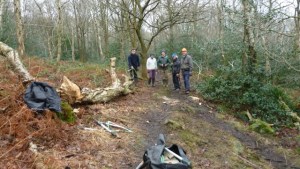
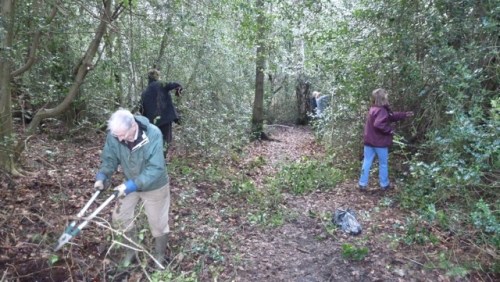 Thence to the picnic area, with the intention of working our way down the Meanwood Valley Trail. However, when we reached the picnic area our attention was caught by the path heading westward, just by the picnic table: it looked as if it was overgrown and difficult to walk. We set to enthusiastically and had soon cleared and widened the first 30 yards or so, removing a fallen tree trunk from the path, and many branches at high level in case horse riders use the path. Beyond 30 yards the path was clear.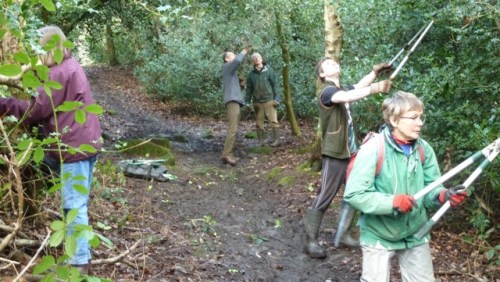



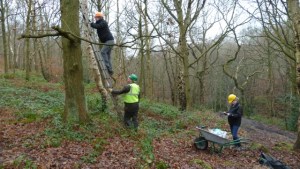 Yesterday we cleaned and surveyed eighteen nest boxes. Only thirteen left to do this morning! Fortunately, the remaining ones were all in a straight line down the Meanwood Valley Trail between the Slabbering Baby and the Seven Arches, which makes them much easier to find.
 Of the thirteen nest boxes, one was a robin box which could not be found. All the rest of the boxes (including a starling or treecreeper box) were used by tits.