Saturday, 3rd December 2016: preparing for Christmas

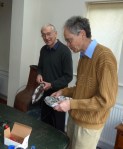
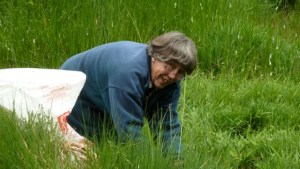
16-12-03-p1080967A group of happy Friends of Adel Woods met this morning to get ready for next Sunday’s Christmas Garland event – dismantling and recycling garlands returned from last year, and making more circular bases so that on the day we can just get down to some artistic creativity!

Much happy conversation, creativity and enjoyment – especially of mince pies!

16-12-03-p1080966

Saturday, 19 November 2016: Litterpicking and Path clearing

16-11-19-p1080952

It was rather wet and cold first thing this morning, but fortunately, the weather brightened up by 10 am for FOAW’s task.

Despite the cold and wet (and despite a number of apologies for other reasons) we had a turn out of five keen friends.  Barbara litter picked, while the rest of us headed up to the northern most part of the woods to clear paths.

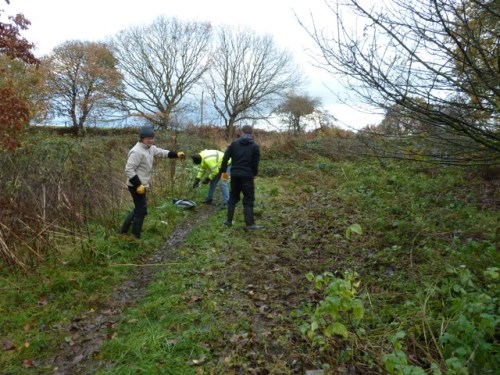
16-11-19-p1080954We started off at one of the paths leading down from Stairfoot Lane, removing nettles and brambles and, near the entrance from the road, cutting back some overhanging branches to make things easier for horse riders.

We then returned to the path leading at right angles from Crag Lane up towards the hospice woodland, adjacent to the rugby practice field.  There we cleared more nettles and brambles in addition to cutting back encroaching holly.

Two hours of hard work enabled us to make a significant improvement where we worked.

16-11-19-p1080958


Sunday, 23 October 2016: Adel Pond – Say not the struggle naught availeth…

Say not the struggle naught availeth, the labour and the wounds are vain, the enemy faints not nor faileth and as things have been they remain.  Arthur Hugh Clough

Friends of Adel Woods first formed in July 2009, and every Autumn since then we have spent a morning working with Steve Joul on Adel Pond.

Our first foray into the pond was on the 15th November 2009 when the pond was badly silted up and choked with Reed Sweet Grass, a non-native plant species which tends to crowd out the native plants.  Here are a couple of photographs taken that day:

2009-11-15-p1050499

Adel Pond, 15 November 2009

We can just see a few flag irises at the end of the wheelbarrow handle.  The rest of the vegetation in the pond is almost all reed sweet grass.

2009-11-15-p1050495

Adel Pond, 15 November 2009 – most of the vegetation is reed sweet grass

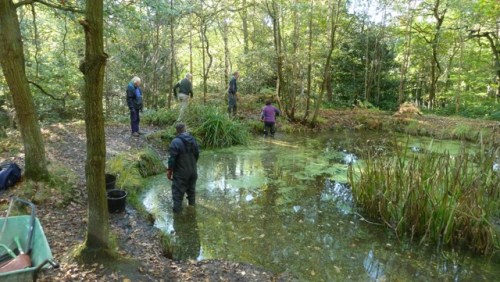
That first year, we removed most of the reed sweet grass, and each year since we have helped Steve manage the pond, digging out large amounts of silt which washes in from the surrounding woods, and an amazing number of sticks and logs which seem to appear out of nowhere each year.

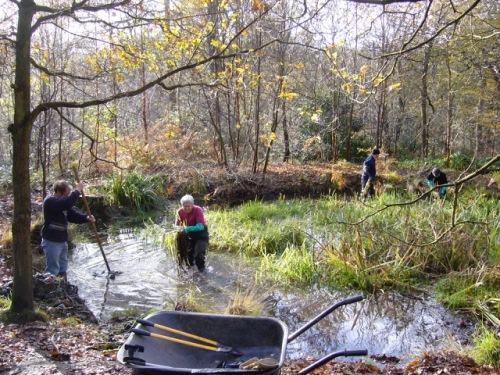
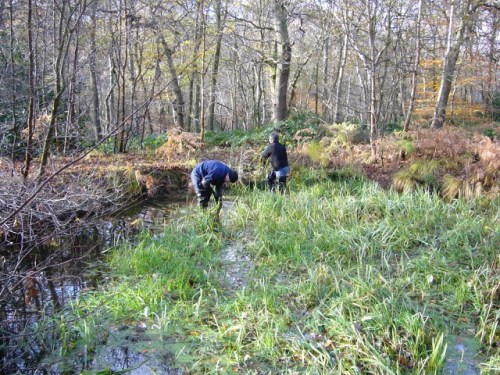
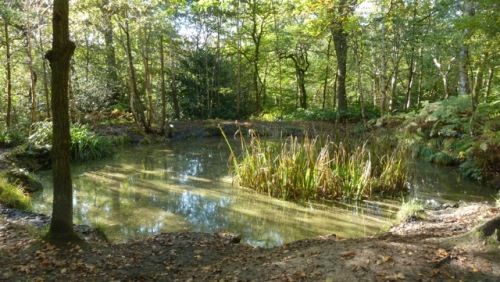
We had a good turn out of Friends today and enjoyed a successful if muddy morning of hard work – digging out silt, removing logs and cutting back some of the overhanging branches of trees.  Have a look at the photos taken today to see how the pond has improved.

The pond is an important habitat for palmate newts – as can be seen from our blog entry for the 5th May 2012 (click on the link) The newts headlines at 7.30 am on Saturday 5 May 2012.


Photos from 23 October 2016

2016-10-23-p1080852

Adel Pond, 23 October 2016 – see the clump of flag irises to the right.

2016-10-23-p1080853

Rob clearing the stream which feeds the pond.

2016-10-23-p1080856

Adel Pond, 23 October 2016

2016-10-23-p1080859

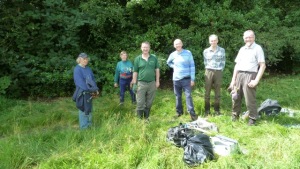
A smiling team, happily anticipating lunch!


Saturday, 24th September 2016: Pteridium Aquilinum bashing on Adel Moor: three strikes and you’re out

We had our third session of bracken bashing today, led by Steve Joul.  Your correspondent is unable to report because he was on holiday.

Here is a message from Steve in advance of the meet:

Just to clarify what I hope we can achieve, I intend to pull up bracken, put it into wheelbarrows and wheel it to our composting area. The more we get done the better for the future of Adel Moor.

Here’s a chant I just thought of that we can sing while we work.

“Here in Adel there’s not much moor,
So we’re pulling up the bracken so there’s not much more!”

Here is a report from our deputy bracken bashing correspondent:

We had about half a dozen turn up.
Steve wanted to remove the bracken that had been bashed in case it was smothering other plants.
We ended up moving wheelbarrow loads of previously bashed bracken to compost sites under the trees.
Also some bracken was pulled up where it was growing amongst some heather.
There were just two of us bashing bracken.

Unfortunately, the saplings appear to be thriving, so we should remove these when we can.

Whether any singing took place is not recorded.  Nor are there photographs of the events in question.

Saturday, 27th August 2016: bracken bashing reloaded

Following our successful session of bracken bashing on the 14th August, we decided to

p1080612

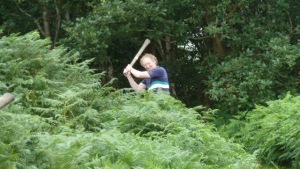
Andrew, in a testosterone fuelled moment

have another session to carry on the good work.

We had another good morning.  Unfortunately, your correspondent seems to have forgotten to take his camera and take any pictures, so we are having to rely on archive pictures.  The action packed photograph of Andrew was taken on the 14th August – he wasn’t there on the 27th.  However, the photograph contains a poetic truth!

p1080628The same three methods of “bashing” were used. David S had modified his bracken bashing machine by the addition of pieces of metal to act as blades.  These were a good idea, but the effectiveness of the machine was probably reduced because we put fewer mattocks on the pallet to provide weight.  Nevertheless, the machine provided much fun to its operators.

p1080625

Who is that good looking man, front left?


Sunday, 14 August 2016: bracken bashing on Adel Moor

16-11-14-p1080629

A view over Adel Moor – heather to the right and bracken to the left.

Pteridium Aquilinum, or the lowly bracken is one of the most successful plants on Earth and is found on all continents except Antarctica.  This is great if you like bracken but its success means that it out competes other plants which we want to see, reducing the variety of flora and fauna. Conservation groups in the UK devote time and effort in reducing the effect of bracken on the habitats they manage.

Bracken can be found throughout Adel Woods and in general we leave it to thrive.  However, it has colonised a large section of Adel Moor and, left alone, it will eventually completely suppress the heather and the other plants we want to see there.

Therefore, in conjunction with Steve Joul of Leeds CC, Friends of Adel Woods have decided to start a program to reduce the area of Adel Moor populated by bracken.
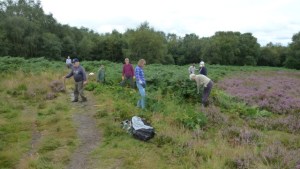
16-11-14-p1080611There are two basic methods of removing bracken: bashing it or poisoning it.  FOAW’s committee decided that in the first instance we would prefer to see what we can achieve by the organic or traditional method of bashing it.  This is going to involve two bashing sessions at least this year and two or three bashing sessions next year.  The aim of bashing the bracken is to weaken the plants until they die.

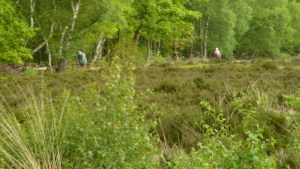
Today was our first ever bracken bashing session on the moor and we approached it in a spirit of scientific inquiry – to see how much we could achieve in two hours, and to see which form of bashing would be the most effective.
16-11-14-p1080617

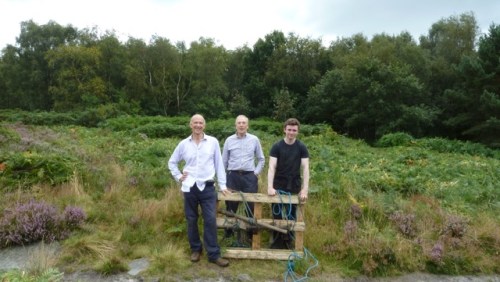
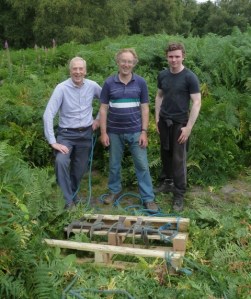
Three happy men and a pallet!

We had three different methods of bashing.  First, there was the traditional method of bashing the bracken with poles.  This was favoured by David H, Rob H and others.  The second method was pulling up the bracken with as much of the root as possible favoured by Judith and Steph.  The third method was to use a machine designed and made by our very own David S to squash the bracken.

Looking towards the East, the bashing area was to the left, the pulling area was to the right, and the area tackled by David, Andrew, James and your very own correspondent was in the middle.

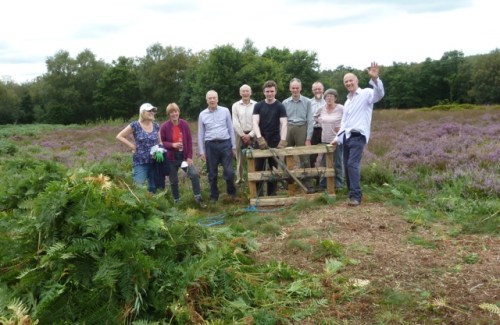
In two hours we bashed, pulled or squashed thousands of bracken plants over a large area. It was a very satisfying task and one which we all enjoyed.

The David’s machine entailed pulling a pallet over the bracken.  It soon became clear that it was simply going to slide over the top of the bracken without harming it.  Accordingly, Andrew, our resident engineer, designed an adaptation involving tying 5 mattock blades on top of the pallet in order to weight it down – an adaptation which worked very well.

One thing that came as a surprise was to discover how much heather was managing to cling on underneath the bracken.  However it was clear that if action was not taken, the surviving heather would have died out and the area of the bracken would have increased.

In summary, a very enjoyable and satisfying morning’s work.
16-11-14-p1080623


Saturday, 16 July 2016: the orchid meadow

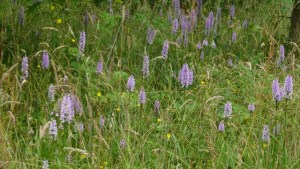
The orchid meadow

The orchid meadow

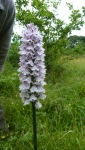
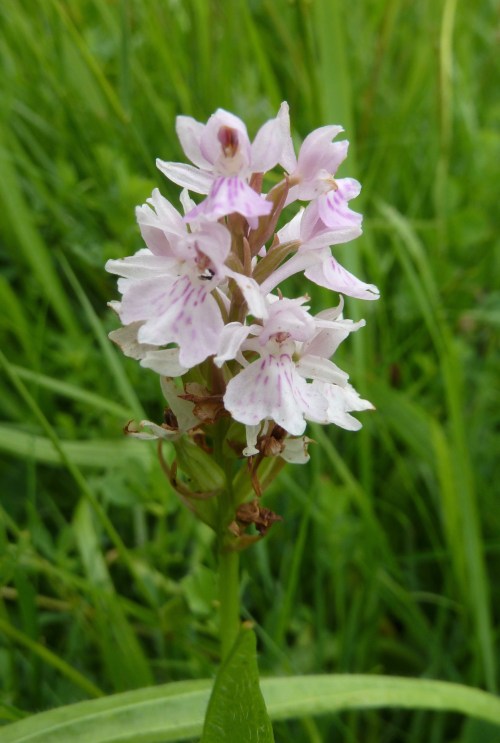
There is always something new to discover in Adel Woods, and two years ago our treasurer,  Judith, brought to our attention a secluded meadow with a beautiful display of common spotted orchids.


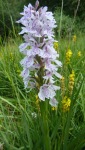
Common Spotted Orchid

Common Spotted Orchid

The meadow is a wonderfully tranquil oasis in the woods, under threat of two kinds of change – firstly the normal process of succession, whereby open grassland slowly changes into oak woodland; and secondly the invasion of Himalayan Balsam.

The meadow already has a range of small oak trees growing within its borders, and it is surrounded by thousands of specimens of Himalayan Balsam – many of which are just coming into flower and will send their seeds onto the meadow.

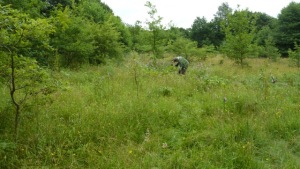
Removing trees

Removing trees

Our task today, under the guidance of Steve Joul, senior ranger with Leeds City Council, was therefore threefold.  Firstly, to find out how many common spotted orchids we have in the meadow.  Secondly, to remove some of the trees.  Thirdly, to remove as much of the Himalayan Balsam as possible from the immediate vicinity of the orchids.

The great thing is that there was an even more splendid display of orchids than the last couple of years.  Steve was keen to count them and came to a figure of 2,690! – a figure far higher than any of us expected.

As Steve counted the orchids, the rest of us cleared oak trees (about 5) and pulled up Himalayan Balsam plants.  Your correspondent estimates that between us we pulled up around 20,000, and we were able to clear the entire southwest boundary of the species.

16-07-16-P1080485

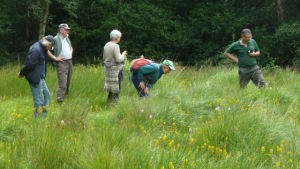
After working on the orchid meadow, we went to have a look at Adel Bog, another beautiful secluded spot in the woods.  Here we were treated to a wonderful display of heath spotted orchids, bog asphodel, tormentil and other plants.

Heath Spotted Orchid with yellow flowers of the Bog Asphodel in background

Heath Spotted Orchid with yellow flowers of the Bog Asphodel in background

Heath spotted orchids (dactylorhiza maculata) are very similar to common spotted orchids (dactylorhiza fuchsia).  Steve can tell you the difference!

Another wonderful morning in Adel Woods.

Inspecting the flora on Adel Bog

Inspecting the flora on Adel Bog

Saturday, 2 July 2016: National Meadows Day

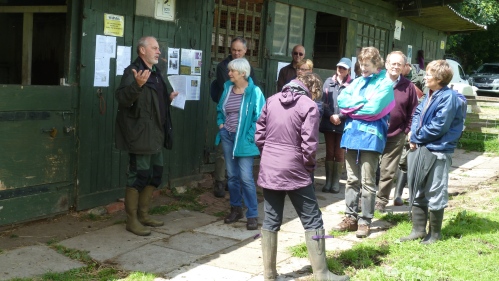
16-07-02-P1080405Thank you to Alan and Diane Yarker who welcomed Friends of Adel Woods to their smallholding today – to mark National Meadows Day.
Alan gave us an interesting talk about aspects of running a smallholding, and management of a meadow in the traditional way to encourage bio-diversity. In the course of his talk, Alan told us about a very interesting website “Tracks in Time” at http://tithemaps.leeds.gov.uk/TwinMaps.aspx?township=WYL333_334 which enables us to compare historic maps with modern day maps – it is very interesting to see how Alwoodley and Adel have changed over the years.

Unlike last year, when the temperature was very cold, and rain almost horizontal, the heavens confounded the gloomy weather forecast with a beautiful afternoon.

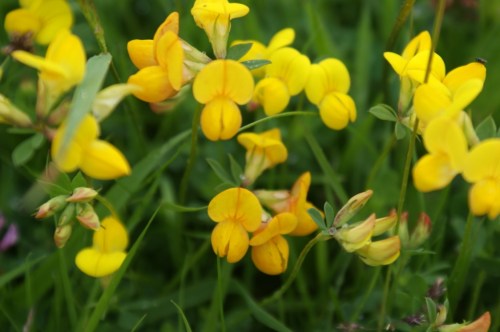
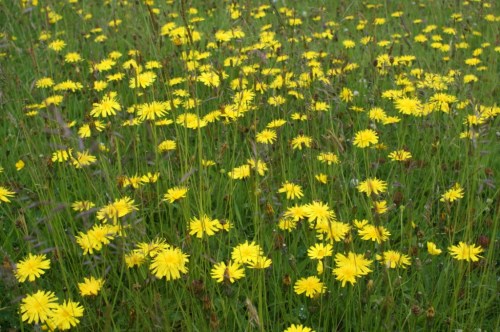
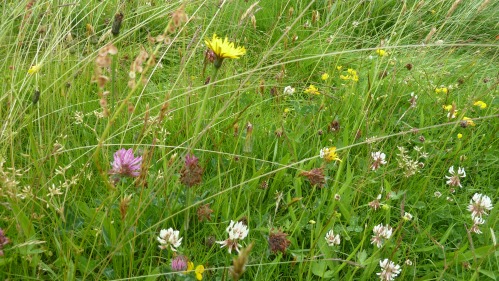
After the talk we were free to wonder around the smallholding and Steve and Alan took us on a tour of the meadow to have a first look at the wildflowers. What appeared from a distance to be a field of grass contained a treasure trove of wildflowers. Your correspondent is no expert, but can confidently tell you that among other plants in this picture you can see white clover, red clover, cats-ear, birdsfoot trefoil, mouse-ear, common sorrell, yorkshire fog and crested dogstail. There may well be some smooth hawksbeard and plantain too.

16-07-02-P1080406

One of the “stars” of the meadow is the population of common spotted orchids which have been increasing in recent years.

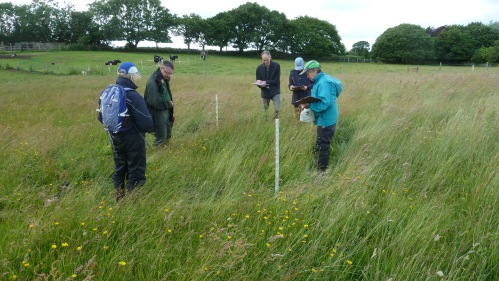
After a cup of tea and biscuits provided by Steve Joul, Steve led a group of us in an initial survey of the meadow. The first step is to choose an area of the meadow at random and stake out a quadrat – an area two metres by two metres. The next step is to note the range of flora we can see within the quadrat, and finally to estimate what percentage of the quadrat is taken up by each species of plant.

16-07-02-P1080434

Ideally we would have surveyed ten quadrats, but we had time for only two. However, each of our quadrats contained about twenty species of plant.

Having completed our survey of the quadrats, we quickly counted the common spotted orchids and were able to delight Alan with the news that there were at least 123!

16-07-02-P1080416

Common Spotted Orchid

SONY DSC

Birdsfoot Trefoil

SONY DSC

Cats Ear


Sunday, 19 June 2016: Adel Bog

Adel Bog - looking to the East

Adel Bog – looking to the East

Adel Bog is a wonderful haven of tranquillity in the middle of Adel Woods.

Working with a smile!

Working with a smile!

Over the last six years Friends of Adel Woods and other groups have done a lot of work to prevent it disappearing through the process of succession – the gradual change from bog to oak woodland – because the bog is a special habitat in the context of Adel Woods, home to a number of plants like the heath spotted orchid, bog asphodel, tormentil.

Clearing brambles

Clearing brambles

Today, an enthusiastic group of volunteers, under the guidance of Steve Joul, senior ranger with Leeds City Council, spent a happy couple of  hours removing tree seedlings and bramble from the bog.

Have a look at our blog entry for 16 July for some pictures of the flowers in the woods.

Adel Bog - looking to the West

Adel Bog – looking to the West

Saturday, 21 May 2016: Adel Moor

The weather forecast was dire – heavy rain all morning.  But it was dry at 10 am and six of us met with Steve Joul at the Slabbering Baby entrance to the woods to work on Adel Moor.

Adel Moor: 21 May 2016

Adel Moor: 21 May 2016

In fact it turned out to be a perfect morning for working on the moor – warm, with a pleasant breeze, and a lightly overcast sky with sunny intervals. In addition to the bird song, we heard cattle lowing from the direction of Adel, confirming the impression that we were in the middle of the countryside.

A successful tussle with a tree root!

A successful tussle with a tree root!

Adel Moor was looking fantastic this morning, with abundant heather and bilberry plants, and two clumps of gorse in full flower.

Our task this morning was to remove saplings and brambles from the moor and between us we removed several hundred seedlings and saplings and one mature tree.

We planned to do some bracken bashing today because bracken has taken over several hundred square yards of the moor, suppressing all other plant life, but it had only just started to appear.  So we will have to bash the bracken (the traditional way of controlling bracken is to bash it)  later in the season.

Thanks to Steve and everyone who came for a very enjoyable morning’s work.

16-05-21-P1080259