
This was the second day of our annual nest box survey. To find out more, have a look at our blog post for day one, the 24th January, and our blog post of the 28th January summarising what we found.
Sunday morning
Another dire weather forecast for today and at 8 am it was raining hard. After exchanges of messages, it was agreed that we would meet as agreed at 9.45 and make a decision whether to go ahead at that time.
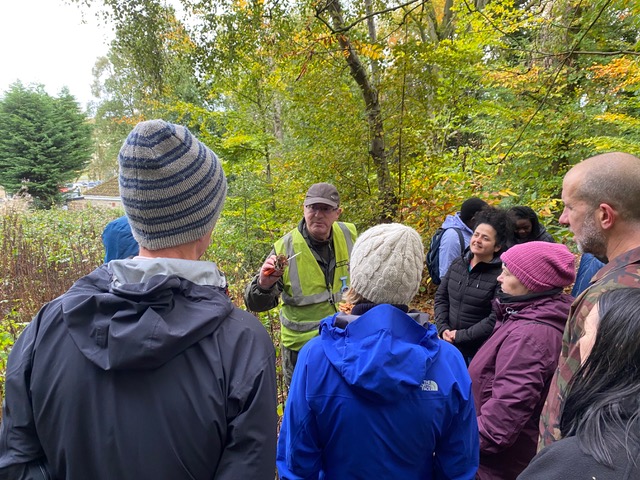
By 10 am six of us including Steve Joul and yours truly had gathered, and as the rain was becoming intermittent we set off into the woods at 10.30 am.
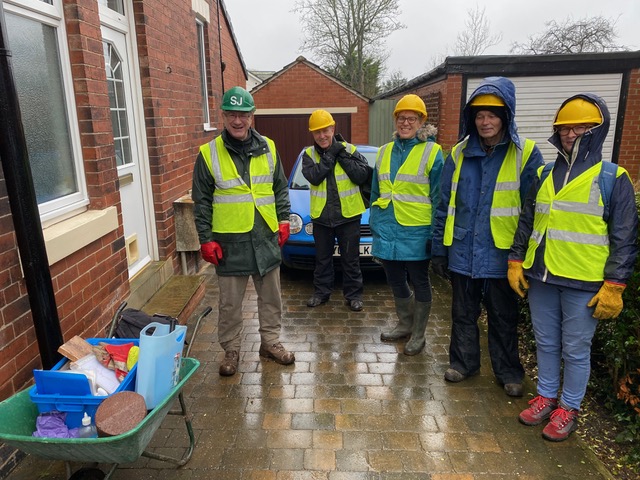
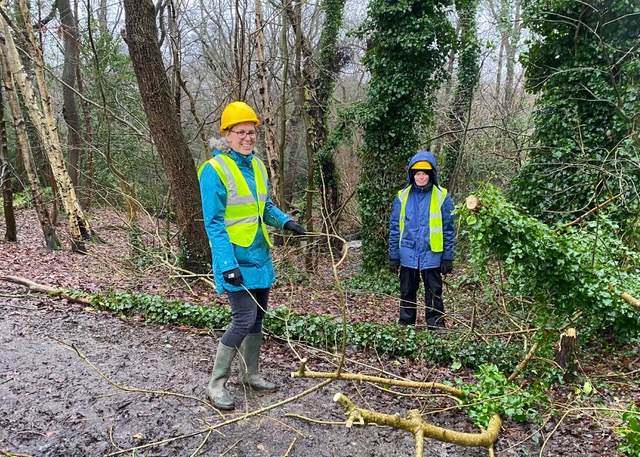
Our starting point today was nest box 42 just by Adel Pond, and so we made our way there along Crag Lane and then down to the Cricket Pavilion. On the path down to the Slabbering Baby we paused to remove a small tree which had fallen across the path overnight.
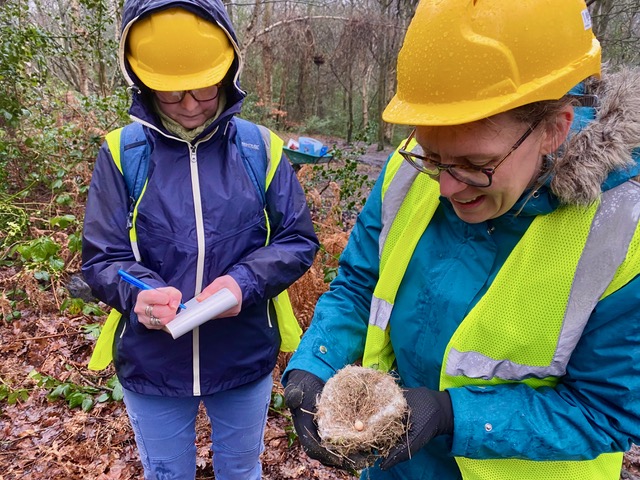
When we surveyed box 42, we found it contained a tit nest and one unhatched egg.
It is quite hard to say whether any particular nest box was used by great tits or by blue tits as their nests are made with similar materials and are very similar in appearance. The best indicators are the size of the entrance hole to the nest, and the size of any eggs left in the nest.
Our nest boxes have varying hole sizes: 25mm, 28mm and 32 mm. Blue tits are smaller than great tits and can get in through a 25mm hole while great tits can’t, so if the nest box has a 25mm hole, we can say it was used by blue tits. The larger holes are suitable for both blue tits and great tits.
Both blue tit eggs and great tit eggs are creamy coloured with brown speckles. However, they differ slightly in size. Different authorities give different sizes, but the Woodland Trust says that blue tit eggs are 1.6 x 1.2 cm in size, while great tit eggs are 1.8 x1.4 cm in size. It is difficult to measure these sizes accurately and there is of course variation between eggs of the same species.
We surveyed a further five nest boxes going down the Meanwood Valley Trail before lunch, leaving ten for the afternoon.
Sunday afternoon
The weather was much better in the afternoon and we managed to survey all the remaining nest boxes, save for one which we could not find.
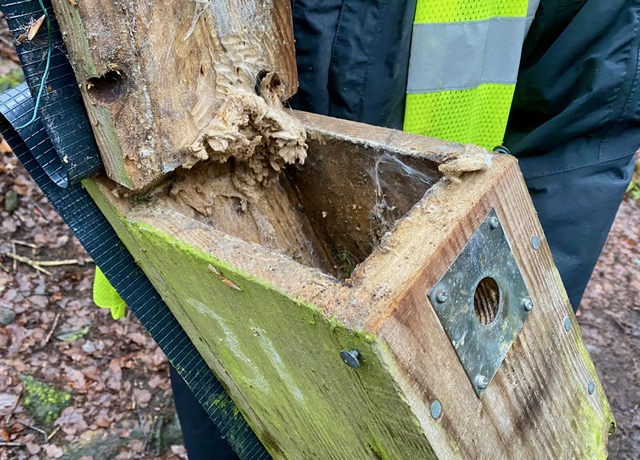
Our most exciting find of the afternoon was in box 31. It was quite difficult to open the lid, and when we opened it we found that the problem was caused by a mass of fibrous material holding the lid shut. Steve immediately identified this as the cocoons of the wax moth. If you look at the photograph above you can see that the moth larvae have used the wood of the box to make the cocoons.
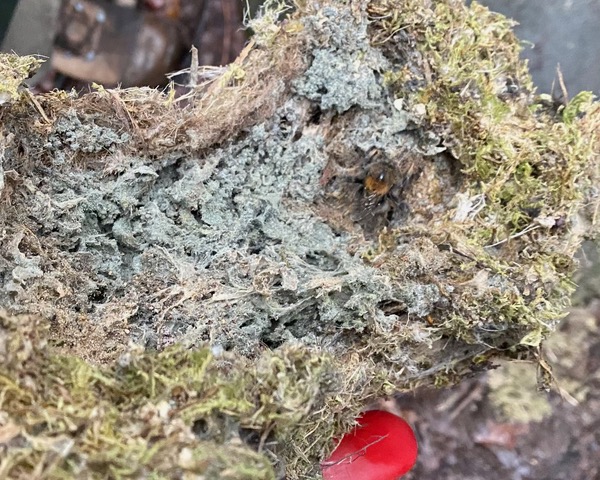
Steve prophetically said that there would be a bee’s nest because wax moth larvae eat the wax of bees nests, and sure enough, as we opened the nesting material, we found the remains of a bumblebee nest. It is the blue-green material in the centre of the photograph above.
As we examined the material further we discovered a very sleepy hibernating queen tree bumblebee. We identified her by the ginger brown top to her thorax and white tail. We disturbed her as little as possible, closed the nest material up, and carefully placed all the material in the dry hollow of a tree.
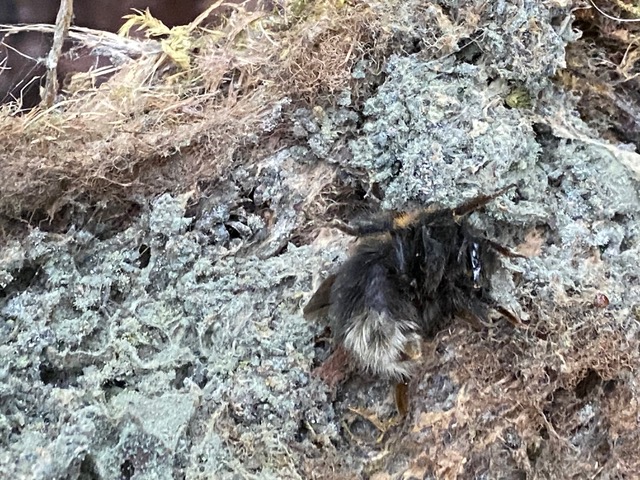
The nest box tells quite a story. Firstly, a pair of blue tits or great tits nested and raised their brood. Then a queen bumblebee moved in and built a nest and produced a colony of bees. Next the wax moths moved in and consumed the wax, honey and pollen in the beehive – moths do not eat the bee larvae or adult bees. Finally, a queen tree bumblebee born into the bee colony hibernated in the nest box.
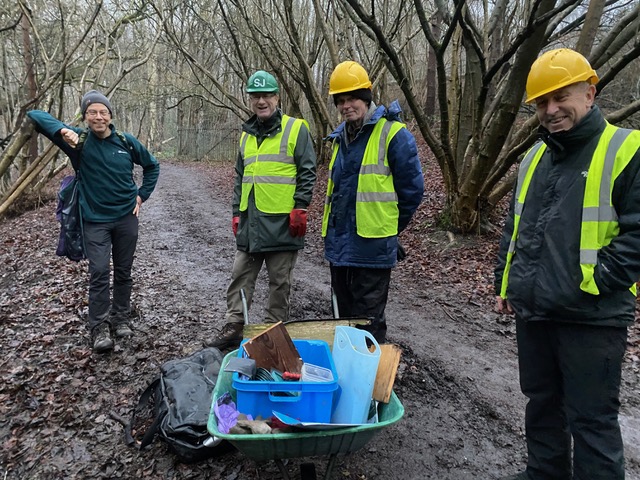
We finally completed this afternoon’s survey at about 4.15.
To find out how many of our nest boxes provided a home to our local population of blue tits and great tits, have a look at our blog entry for Wednesday the 28th January.
Join Friends of Adel Woods
We hope that you have enjoyed reading about our activities and would be delighted if you would like to join us.
Friends of Adel Woods were formed in 2009 to help maintain Adel Woods and encourage people to enjoy them. We meet one weekend morning a month to carry out various jobs or ”work parties”, and we also put on educational events such as bat walks, fungal forays and birdsong walks.
We are a very friendly group and welcome new members who want to help preserve our special woods, enjoy fresh air and exercise in the woods, and make new friends.
If you would like to take part in our activities, keep an eye on our Home Page.
You don’t need to book to come along to one of our work “parties”: just come along on the day.
If you would like to join our email mailing list, please get in touch by leaving a comment on this website – you should be able to see a comment box at the bottom of this page.
 Friends of Adel Woods
Pingback: Wednesday the 28th January 2026: nest box survey results | Friends of Adel Woods