Monthly Archives: January 2026

Wednesday the 28th January 2026: nest box survey results

This is the final part of a trilogy! To get most out of it, please have a look at our blog entries for Saturday the 24th January and Sunday the 25th January 2026.

Completing the survey

On Saturday and Sunday, we were unable to find three of our nest boxes. On Monday and Tuesday yours truly had a quick look and found them easily – we must have been tired at the weekend.

One was a robin box and it was unused.

The other two were tit boxes and a ladder was needed to survey them, so Steve Joul and yours truly went out today to have a look.
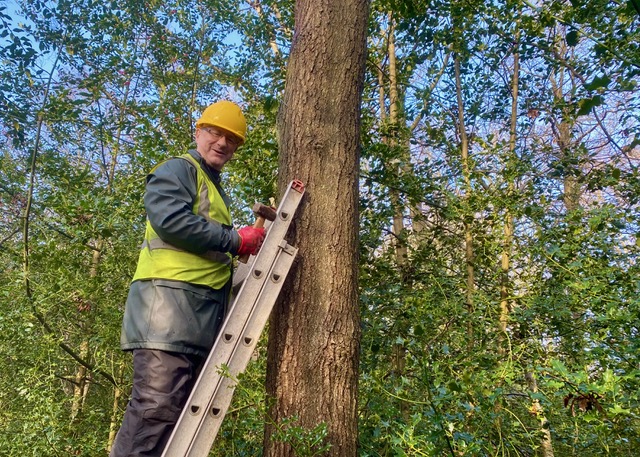
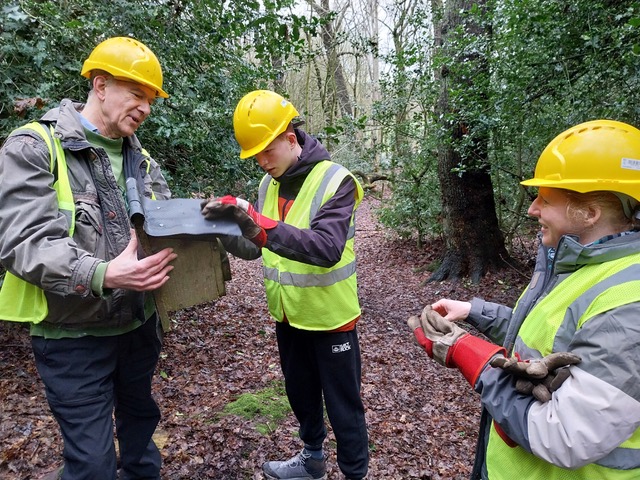
Friends of Adel Woods: surveying nest boxes on Wednesday the 28th January 2026
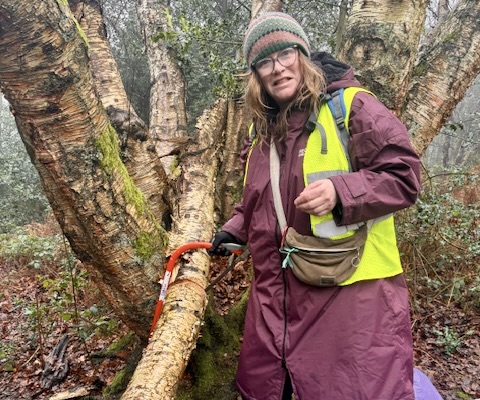
Surveying nest box 32

One of the nest boxes contained a tit nest. The other contained a small amount of nesting material but no nest. Because this nest box was a lot smaller than other nest boxes, and it has never been used for nesting, we replaced it with a larger refurbished nest box.
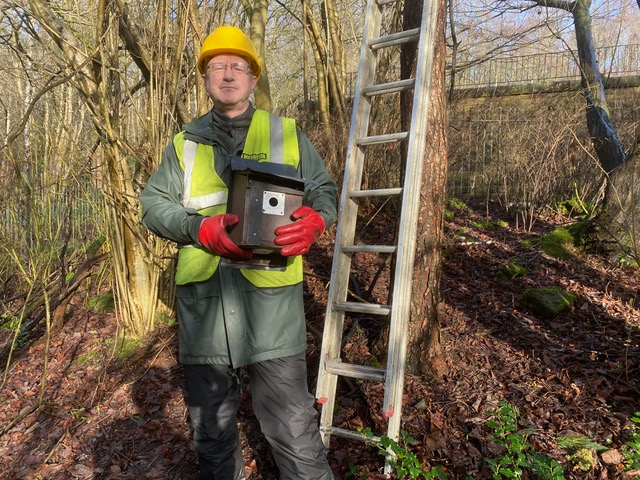
Friends of Adel Woods surveying nest boxes in January 2026
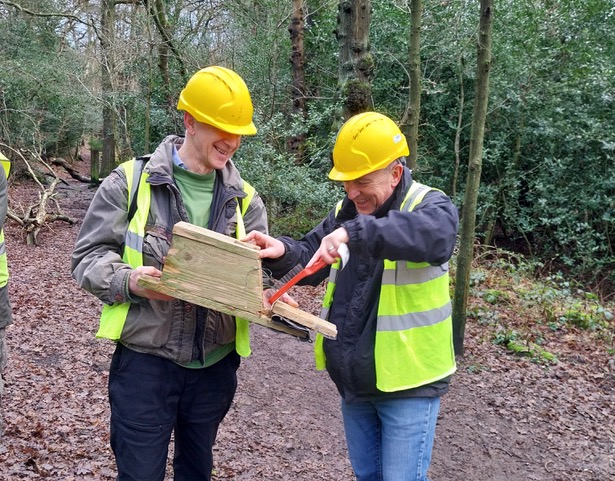
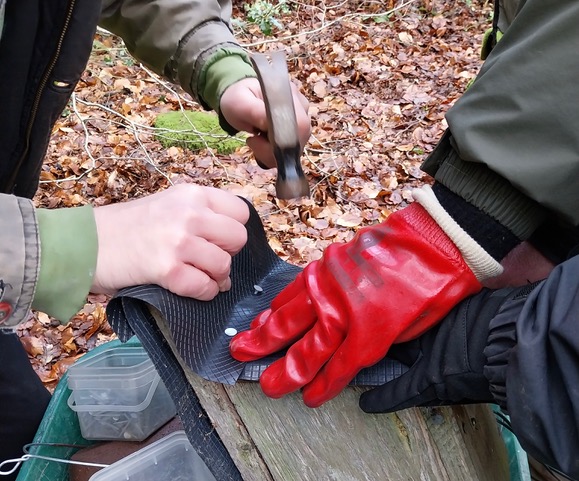
Preparing to put our replacement nest box on the tree!

And to Conclude: a Summary of our January 2026 Nest Box Survey

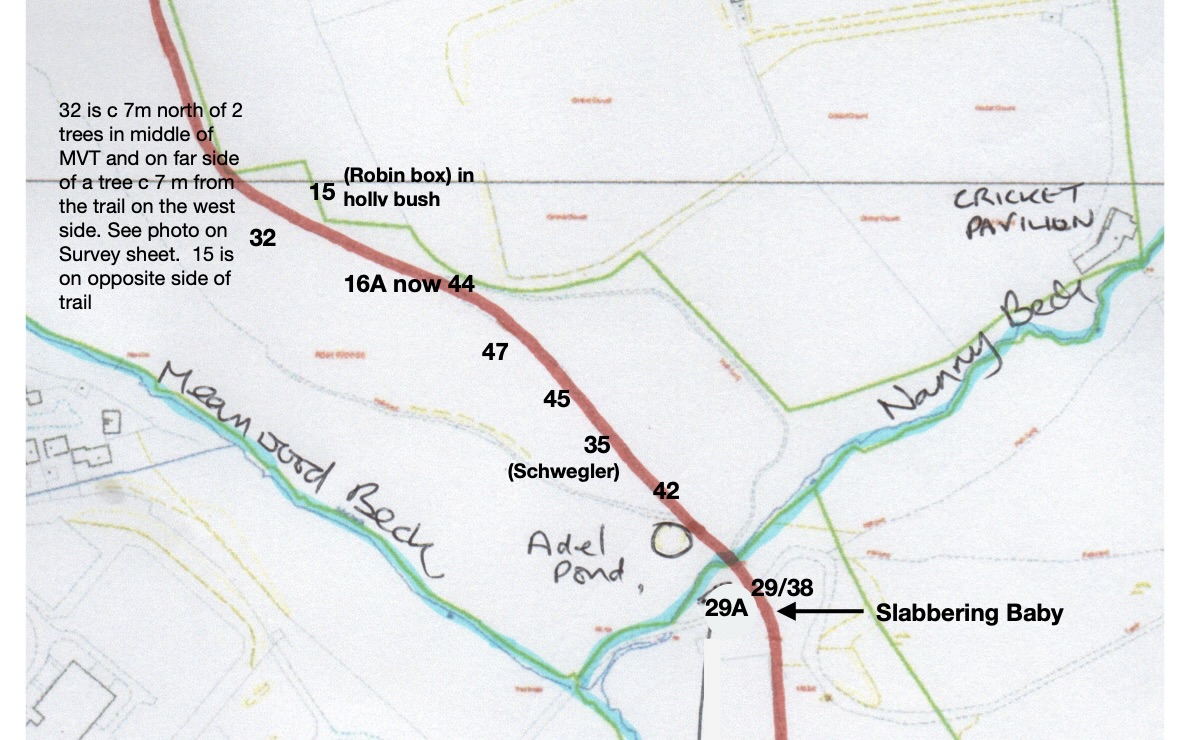
Friends of Adel Woods currently have 41 nest boxes in Adel Woods – in Alwoodley Crags plantation, along Crag Lane and along the Meanwood Valley Trail between Adel Crag and the Seven Arches aqueduct.

Of the 41 nest boxes, 36 are tit boxes, 4 are robin boxes and one was intended to be a treecreeper nest box (more about that below!).

The tit boxes

We have a record of what we found in 26 of the 27 tit boxes – in the excitement we forgot to write down what we found in one of them!

Of the 26, 17 contained successful nests. 4 contained unfinished nests. 7 were used for roosting (indicated by droppings) of which 4 did not contain nests or nesting material.

So, in summary, 25 of the 26 tit nests were used – 17 for nesting, 4 for attempted nesting, and 4 for roosting only.

As in previous years we found that the nests were built using moss, grass and straw, and many nests contained man-made fuzzy material like the surface of tennis balls. The man-made material was of varying colours – white, red, orange, green and yellow.

Five of the nests contained 1 unhatched egg which indicates that on the whole all of the nests were very successful. In previous years we have found nests with a number of unhatched eggs, and sometimes a number of skeletons of chicks.
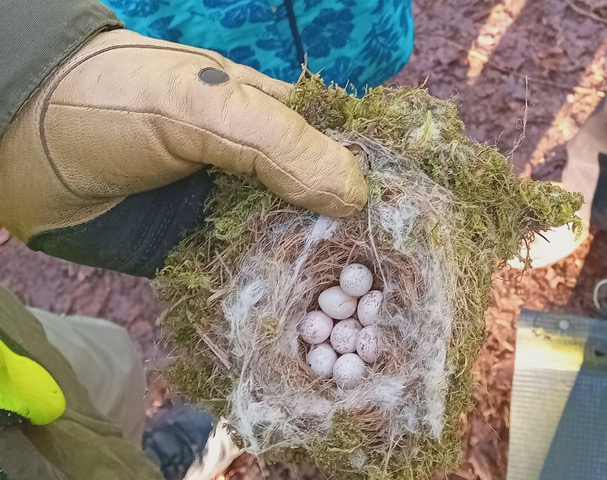
Friends of Adel Woods and a photograph of a tit nest with unhatched eggs in January 2024
A typical tit nest photographed in January 2024 – unusually containing a clutch of 8 unhatched eggs

In previous years, we have often found that one or two of the nest boxes are used by nuthatches, but this year there were no nuthatch nests. Their nests are easy to spot from the outside because nuthatches seal up all holes and cracks in the nest box with mud. The nest itself is very different from a tit nest: the nesting material consists solely of bark chips so that the nest looks like a bowl of bran flakes!

Friends of Adel Wood and a nuthatch nest photographed in the January 2019 survey
A nuthatch nest photographed in our January 2019 survey

Some of the nest boxes provided homes for other creatures. Many contained spiders of varying species. Some of the nest boxes also provided a home for woodlice and slugs

Several of the nest boxes contained larvae of clothes moths.

One nest box contained a tit nest, a tree bumblebee nest and wax moth cocoons: see our blog for Sunday 25th January for more details.

The robin boxes
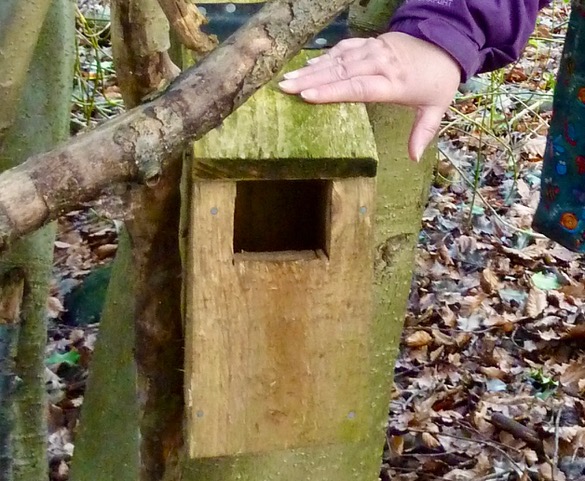
Friends of Adel Woods and a robin box in Adel Woods
One of the Friends of Adel Woods robin boxes

Robins usually nest close to the ground and like an open nest. For this reason, robin boxes have an open front as shown in the photograph. They will not nest in tit boxes, but have been known to nest in old kettles, lanterns, flower pots, car bonnets, boots, post boxes and even clothes pockets.

Of the 4 robin boxes, 3 were completely unused and 1 contained some nesting material but no nest. In previous years, tits have occasionally nested in a robin box and so it is likely that the nesting material was put there by tits – it certainly looked like typical tit nesting material.

One of the robin boxes contained a population of springtails which was a first for yours truly.

The treecreeper nest box

Friends of Adel Woods and a treecreeper nest box in Adel Woods
The treecreeper nest box in Adel Woods

We put up the treecreeper nest box in January 2015. As you can see from the photograph it is very deep, and rather than having a round hole in the front, it has a slit in the right hand side as treecreepers like to nest in the cracks behind loose bark.

We have never had treecreepers nest in the box. One year we had a successful tit nest. More often we have found that squirrels have used the box for nesting and filled the box with small leaves. One year we found a mummified squirrel in the box!

This year we found a large amount of mossy material in the box but no nest.

About Friends of Adel Woods

We hope that you have enjoyed reading about our activities and would be delighted if you would like to join us.

Friends of Adel Woods were formed in 2009 to help maintain Adel Woods and encourage people to enjoy them. We meet one weekend morning a month to carry out various jobs or ”work parties”, and we also put on educational events such as bat walksfungal forays and birdsong walks.

We are a very friendly group and welcome new members who want to help preserve our special woods, enjoy fresh air and exercise in the woods, and make new friends. 

If you would like to take part in our activities, keep an eye on our Home Page.  You don’t need to book to come along to one of our work “parties”: just come along! 

If you would like to join our email mailing list, please get in touch by leaving a comment on this website – you should be able to see a comment box at the bottom of this page.

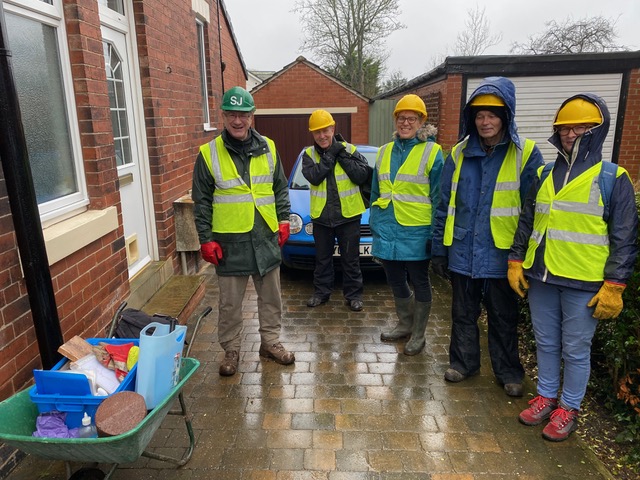
Friends of Adel Woods working with ranger Joe Craig-Jackson in August 2025
Working with ranger Joe Craig-Jackson on the orchid meadow

Sunday the 25th January 2026: nest box survey and cleaning (part 2)

This was the second day of our annual nest box survey. To find out more, have a look at our blog post for day one, the 24th January, and our blog post of the 28th January summarising what we found.

Sunday morning

Another dire weather forecast for today and at 8 am it was raining hard. After exchanges of messages, it was agreed that we would meet as agreed at 9.45 and make a decision whether to go ahead at that time.

By 10 am six of us including Steve Joul and yours truly had gathered, and as the rain was becoming intermittent we set off into the woods at 10.30 am.

Friends of Adel Woods preparing to survey nest boxes on the 25th January 2026

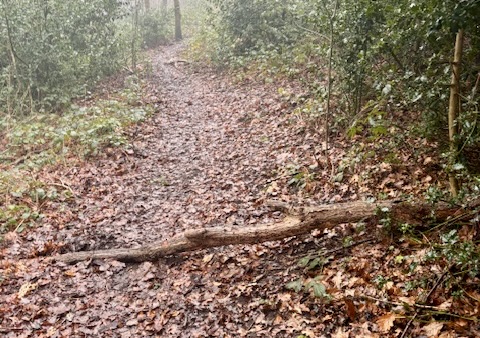
Our starting point today was nest box 42 just by Adel Pond, and so we made our way there along Crag Lane and then down to the Cricket Pavilion. On the path down to the Slabbering Baby we paused to remove a small tree which had fallen across the path overnight.

Finishing off the job – the tree was a lot bigger than shown!

When we surveyed box 42, we found it contained a tit nest and one unhatched egg.

It is quite hard to say whether any particular nest box was used by great tits or by blue tits as their nests are made with similar materials and are very similar in appearance. The best indicators are the size of the entrance hole to the nest, and the size of any eggs left in the nest.

Our nest boxes have varying hole sizes: 25mm, 28mm and 32 mm. Blue tits are smaller than great tits and can get in through a 25mm hole while great tits can’t, so if the nest box has a 25mm hole, we can say it was used by blue tits. The larger holes are suitable for both blue tits and great tits.

Both blue tit eggs and great tit eggs are creamy coloured with brown speckles. However, they differ slightly in size. Different authorities give different sizes, but the Woodland Trust says that blue tit eggs are 1.6 x 1.2 cm in size, while great tit eggs are 1.8 x1.4 cm in size. It is difficult to measure these sizes accurately and there is of course variation between eggs of the same species.

Friends of Adel Woods preparing to survey nest boxes on the 25th January 2026
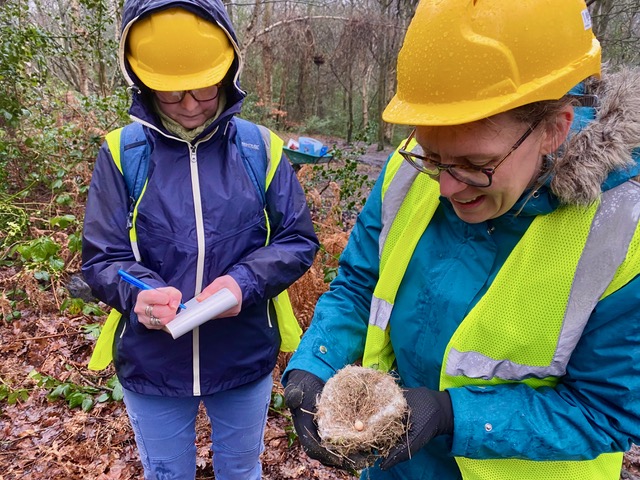
Examining a tit nest with lots of man made fibres and containing one unhatched egg

We surveyed a further five nest boxes going down the Meanwood Valley Trail before lunch, leaving ten for the afternoon.

Friends of Adel Woods survey nest boxes on the 25th January 2026
Weather beaten at lunchtime, but unbowed!

Sunday afternoon

The weather was much better in the afternoon and we managed to survey all the remaining nest boxes, save for one which we could not find.

Friends of Adel Woods and a next box containing cocoons of wax moths
Nest box 31 with a fibrous mass of wax moth cocoons on and around the lid

Our most exciting find of the afternoon was in box 31. It was quite difficult to open the lid, and when we opened it we found that the problem was caused by a mass of fibrous material holding the lid shut. Steve immediately identified this as the cocoons of the wax moth. If you look at the photograph above you can see that the moth larvae have used the wood of the box to make the cocoons.

Friends of Adel Woods surveying nest boxes on 25th January 2026. A nest box containing a tree bumblebee nest.
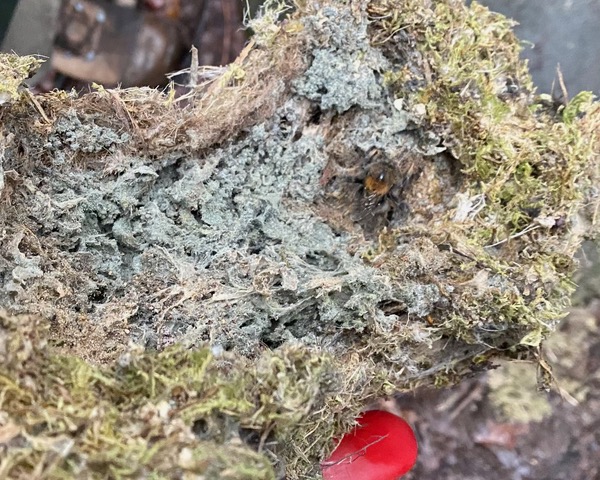
The remains of a tree bumblebee nest, and hibernating queen, amidst the remains of a tit nest

Steve prophetically said that there would be a bee’s nest because wax moth larvae eat the wax of bees nests, and sure enough, as we opened the nesting material, we found the remains of a bumblebee nest. It is the blue-green material in the centre of the photograph above.

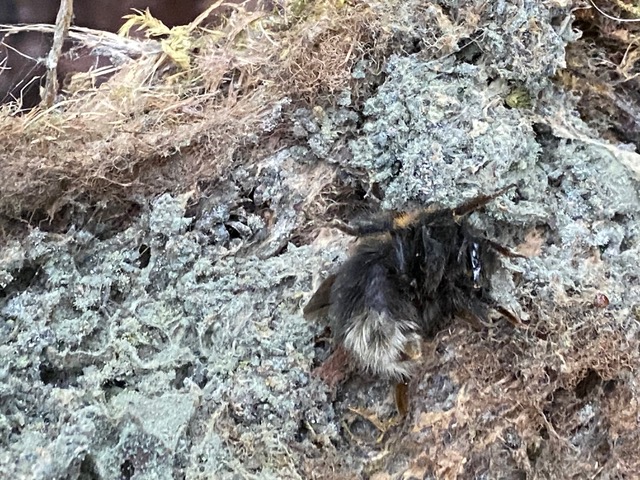
As we examined the material further we discovered a very sleepy hibernating queen tree bumblebee. We identified her by the ginger brown top to her thorax and white tail. We disturbed her as little as possible, closed the nest material up, and carefully placed all the material in the dry hollow of a tree.

Friends of Adel Woods and a photograph of a queen tree bumblebee in a nest box.
The hibernating tree bumblebee queen

The nest box tells quite a story. Firstly, a pair of blue tits or great tits nested and raised their brood. Then a queen bumblebee moved in and built a nest and produced a colony of bees. Next the wax moths moved in and consumed the wax, honey and pollen in the beehive – moths do not eat the bee larvae or adult bees. Finally, a queen tree bumblebee born into the bee colony hibernated in the nest box.

Friends of Adel Woods surveying nest boxes on Sunday the 25th January 2026
Three of our team and a member of FOAW who stopped by to give us some encouragement

We finally completed this afternoon’s survey at about 4.15.

To find out how many of our nest boxes provided a home to our local population of blue tits and great tits, have a look at our blog entry for Wednesday the 28th January.

Join Friends of Adel Woods

We hope that you have enjoyed reading about our activities and would be delighted if you would like to join us.

Friends of Adel Woods were formed in 2009 to help maintain Adel Woods and encourage people to enjoy them. We meet one weekend morning a month to carry out various jobs or ”work parties”, and we also put on educational events such as bat walks, fungal forays and birdsong walks.

We are a very friendly group and welcome new members who want to help preserve our special woods, enjoy fresh air and exercise in the woods, and make new friends. 

If you would like to take part in our activities, keep an eye on our Home Page

You don’t need to book to come along to one of our work “parties”: just come along on the day.

If you would like to join our email mailing list, please get in touch by leaving a comment on this website – you should be able to see a comment box at the bottom of this page.
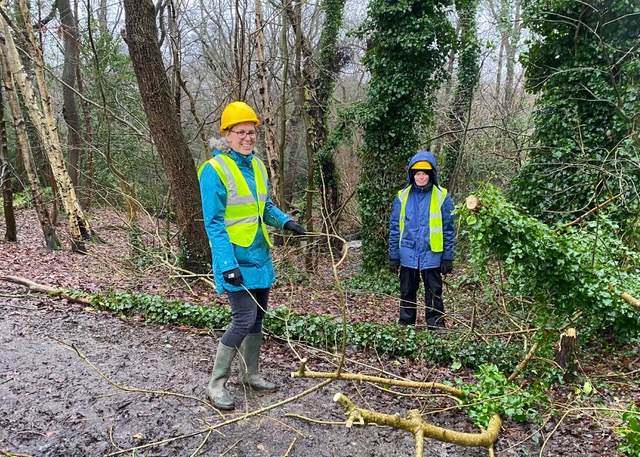
A fungal foray with Steve Joul on the 26th October 2025

Saturday the 24th January 2026: the Annual Nestbox spring clean and survey (part 1).

Friends of Adel Wods surveying nest boxes on the 24th January 2024
What will be in this box?

As you walk along Crag Lane, wander through Alwoodley Crag Plantation (the area north of Crag Lane between King Lane and the rugby club), or hike along the Meanwood Valley Trail between the picnic area and Seven Arches, you will see an assortment of nest boxes.

These were put up by Friends of Adel Woods under Steve Joul’s tutelage from 2010 onwards. In all we have put up forty one and in each year since 2011 (except for 2021) we have surveyed them, cleaned them out, and repaired them where necessary.

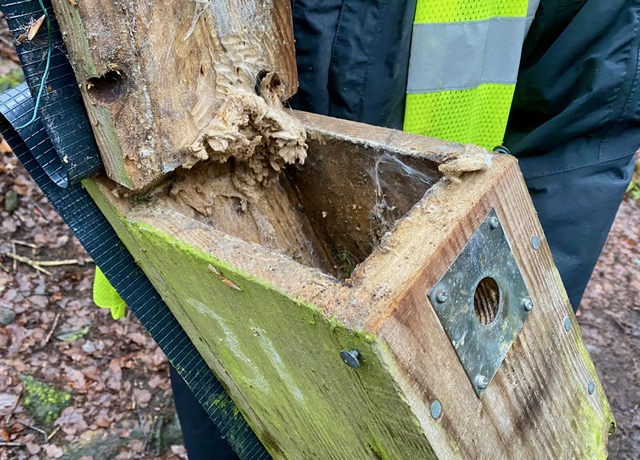
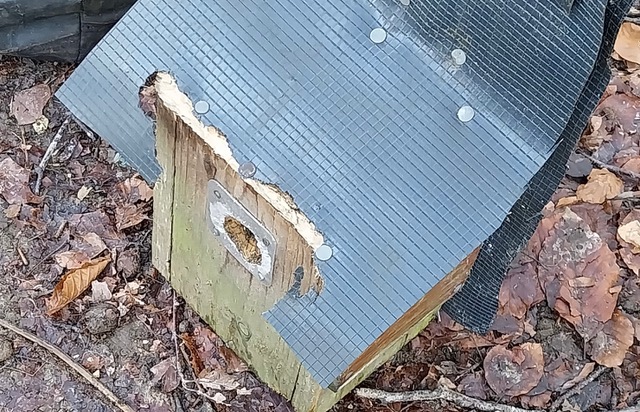
One of our nest boxes damaged by squirrels or woodpeckers: part of the wooden roof has gone and the metal plate protecting the hole is very badly damaged

We clean them out because tits and nuthatches (the birds which are most likely to use our nest boxes) don’t re-use old nests. We know this because we were not able to survey the nest boxes in 2021 due to Covid, and when we surveyed them in 2022 (ie to see how the birds had fared in the 2020 and 21 breeding seasons) we found new nests had been built on top of the previous year’s nests!

Whilst the birds can clearly get by if the nest boxes are not cleaned out, we often find that the old nests are full of mites or fleas, or that the old nesting material is very wet and rotten. Frequently, the nest box may contain bird droppings. It is therefore a good idea to give the birds a fresh start each nesting season.

By the way, if we find droppings in the nest box, it is a sign that the nest box has been used for roosting by adult birds outside the nesting season. Birds do not defecate in the nest during the breeding season. In fact, the parents take away the chicks droppings.

Today was the first day of our 2026 survey.

Saturday morning

The weather forecast for this weekend was pretty dire. Nevertheless, we had an excellent turnout of six “Friends” and we set off into the woods with our ladders and equipment at about 10.15 am.

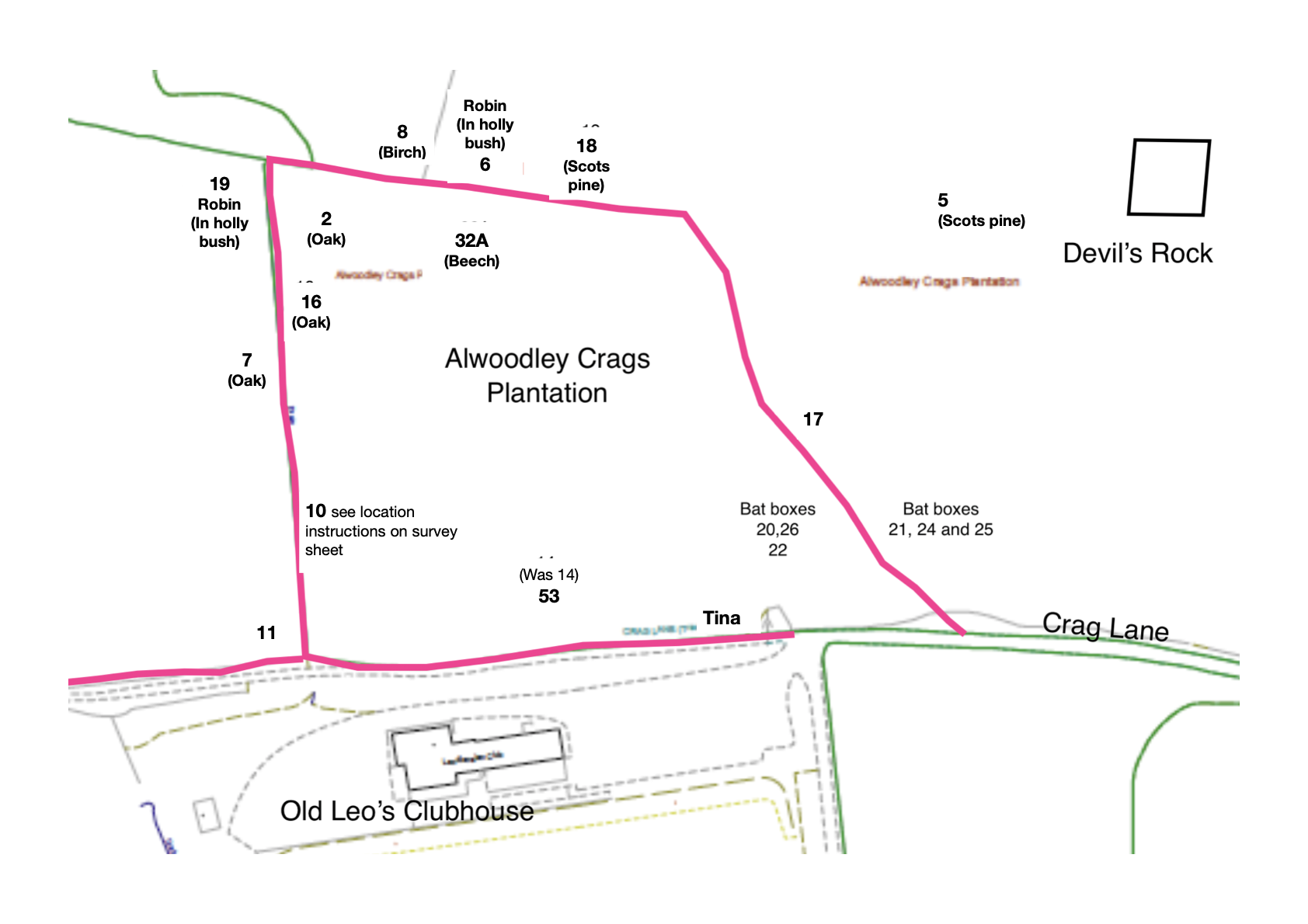
This morning we surveyed, cleaned and refurbished the nest boxes in Alwoodley Crags Plantation, starting with nest boxes 17 and 5, and finishing at 12.30 pm

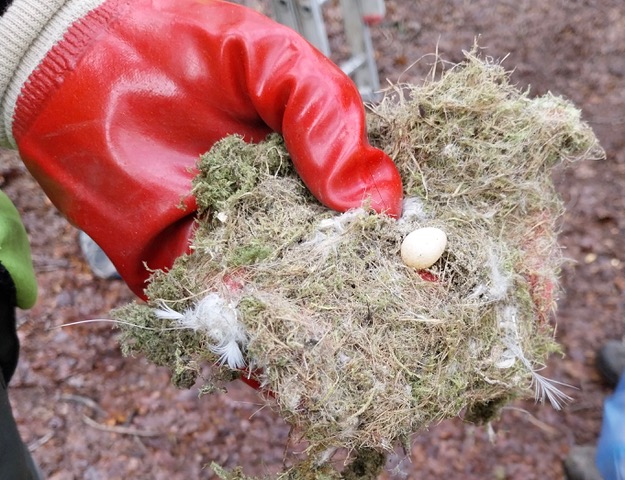
A typical tit nest taken from one of the boxes this morning

Most of the tit boxes had been used. but neither of the two robin boxes had been used – presumably because our local robins can find plenty of natural nesting sites.

Great tits and blue tits make very similar nests from moss, grass, dog hair, and man made fibres which seem to come from tennis balls. You can see white and red fibres in the photograph above. In other nests we found yellow, green and even blue man-made fibres.

It is not unusual to find an unhatched egg in the nest. Bearing in mind that great tits lay a clutch of seven to nine eggs on average (according to the BTO), it is likely that all the other eggs hatched and the chicks fledged.

Friends of Adel Woods cleaning nest boxes on the 24th January 2024
Cleaning out one of our tit boxes

Other things we might find in our nest boxes are clothes moth larvae, wax moth larvae, other insects, spiders and slugs.

Friends of Adel Wods surveying nest boxes on the 24th January 2024
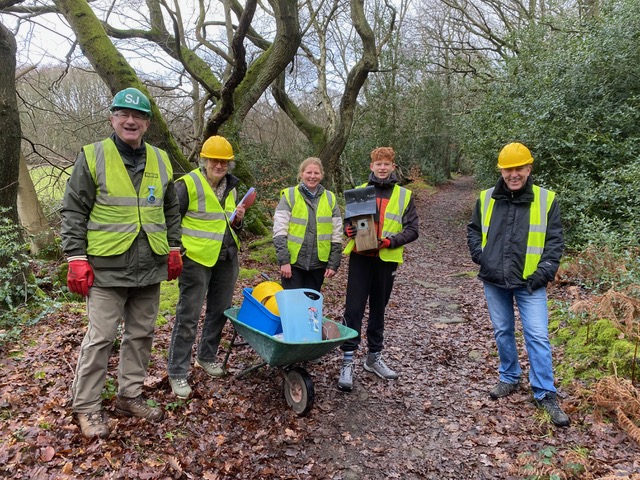
The end of an enjoyable and interesting morning

As can be seen from the photographs, despite the forecast of rain all day we had a perfect morning for surveying our nest boxes

Saturday afternoon

In the afternoon, we had a team of four and we completed surveying the nest boxes along Crag Lane, and then made our way down the Meanwood Valley Trail from the picnic area to Adel Pond.

We finished work at about 4.15 pm by which time we had made our way down to, and surveyed, nest box 35.

Friends of Adel Woods repairing a next box in Adel Woods on the 24th January 2026
Repairing damp proof protection to a nest box.

Please read our blog for details of the second day of our survey on Sunday the 25th January. A full report on our survey results will be included in a third blog post for the 28th January 2026.

About Friends of Adel Woods

We hope that you have enjoyed reading about our activities and would be delighted if you would like to join us.

Friends of Adel Woods were formed in 2009 to help maintain Adel Woods and encourage people to enjoy them. We meet one weekend morning a month to carry out various jobs or ”work parties”, and we also put on educational events such as bat walks, fungal forays and birdsong walks.

We are a very friendly group and welcome new members who want to help preserve our special woods, enjoy fresh air and exercise in the woods, and make new friends. 

If you would like to take part in our activities, keep an eye on our Home Page

You don’t need to book to come along to one of our work “parties”: just come along.

If you would like to join our email mailing list, please get in touch by leaving a comment on this website – you should be able to see a comment box at the bottom of this page.
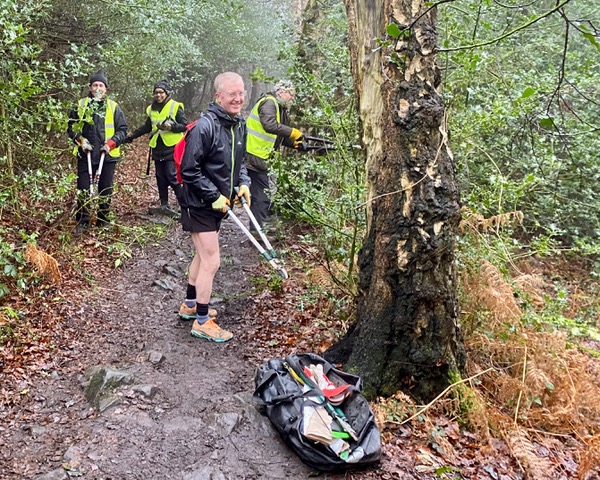
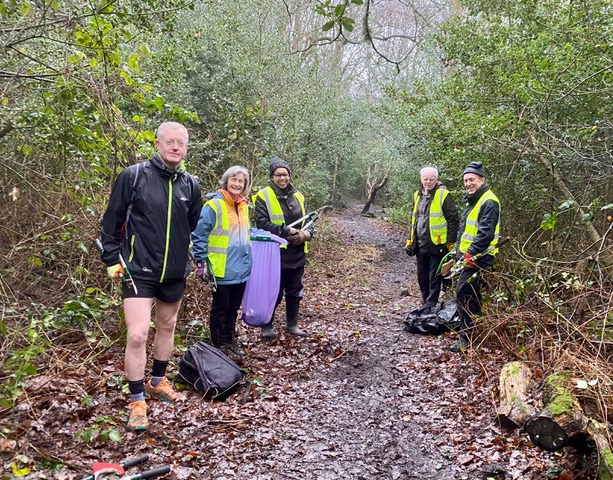
Saturday, 17th January 2026: litterpicking and cutting back holly on the Meanwood Valley Trail

Despite a misty and damp day and an unpromising weather forecast, eleven of us met by the Cricket Pavilion, bright-eyed and bushy-tailed, for this morning’s work party.

Five of us chose to litterpick, and six to clear holly on the Meanwood Valley Trail.

Litterpicking

Our litterpickers picked up about five bags of rubbish between them. They ranged widely through the woods: around the rugby club, along Crag Lane, through the plantation woodland and the Stairfoot Lane carpark. They collected the usual stuff: sweet/crisp wrappers, bottles, poo bags and broken glass and found a car battery which had been dumped near Stairfoot Lane.

One of our litterpickers brought a saw so that she could clear some fallen logs on three paths in the northern part of the woods.

Path clearing on the Meanwood Valley Trail

Friends of Adel Woods clearing holly on the Meanwood Valley Trail on the 17th January 2026

We path clearers made our way down from the Cricket Pavilion to the pond, and and from there proceeded up the Meanwood Valley Trail as far as the picnic area, trimming back holly on our way.

Friends of Adel Woods clearing holly on the Meanwood Valley Trail on the 17th January 2026

By the way, we left our off-clippings in the woodland on either side of the trail in accordance with guidance from Leeds City Council. However, someone has moved clippings into the centre of the trail – possibly to provide a surface on top of the mud. It wasn’t us!

About Friends of Adel Woods

We hope that you have enjoyed reading about our activities and would be delighted if you would like to join us.

Friends of Adel Woods were formed in 2009 to help maintain Adel Woods and encourage people to enjoy them. We meet one weekend morning a month to carry out various jobs or ”work parties”, and we also put on educational events such as bat walksfungal forays and birdsong walks.

We are a very friendly group and welcome new members who want to help preserve our special woods, enjoy fresh air and exercise in the woods, and make new friends. 

If you would like to take part in our activities, keep an eye on our Home Page

You don’t need to book to come along to one of our work “parties”: just come along! 

If you would like to join our email mailing list, please get in touch by leaving a comment on this website – you should be able to see a comment button at the bottom of this page.