Monthly Archives: January 2025

Sunday, 26th January 2025: nest box surveying and cleaning – part 2

Friends of Adel Wood nest box survey on the 26th January 2025 in Adel Woods

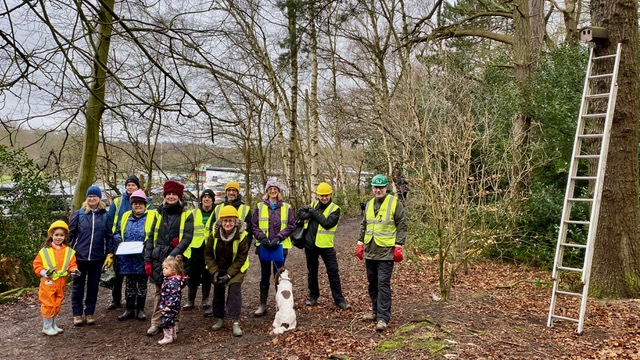
Last Sunday we started the process of surveying and cleaning the Friends of Adel Woods nest boxes and we completed about two thirds of them. Today, the weather was a bit warmer and thirteen of us set out on our nest box safari to survey and clean the remaining boxes.

Friends of Adel Woods surveying nest boxes on the 26th January 2025

Our first port of call was to put back up our best nest box, the two hole Schwegler nest box on Crag Lane near Old Leo’s car park. We took this down last week because it needed a new nail to hold it up.

Friends of Adel Woods: map of nest boxes in Adel Woods

Having secured the nest box, we made our way down to the Slabbering Baby. When cleaning the nest box there, we noticed what looked like a piece of fabric on the underside of the box. It was not fabric, but the eggs of the vapourer moth – which I had never heard of before.
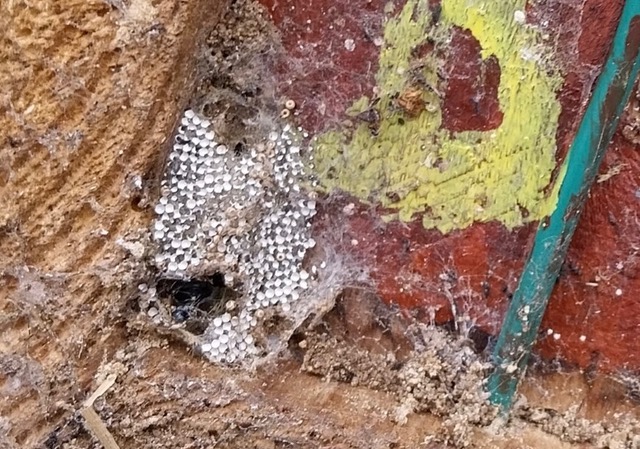
Friends of Adel Woods nest box survey and eggs of vapourer moth on base of a nest box

Vapourer moths are common throughout the UK. The female is virtually wingless, and spends her life attached to the cocoon from which she emerged, She attracts males by releasing pheromones – which is why they are call vapourer moths – and lays her eggs on what remains of her cocoon. When hatched, the very hairy caterpillars feed on a range of deciduous trees and shrubs. Gardeners know them as rusty tussock caterpillars and considered them a pest.

From the Slabbering Baby we made our way to nest box 29A by Nanny Beck. This nest box often provides a home to nuthatches, and we were very pleased to see that nuthatches used it last Spring. We can always tell in advance if nuthatches have used a nest box because they block up all cracks with mud. Intriguingly they make a nest out of chips of birch bark which look like a bowl of bran flakes!

Friends of Adel Woods and a photograph of a nuthatch nest in a tit box in 2020
A nuthatch nest photographed in our 2020 survey. Note the different coloured bits of mud used to block up gaps between the roof and the sides

We next surveyed nest boxes 42 and 35 – one of our new Schwegler tit boxes – and then made our way southwards down to the Seven Arches, cleaning our next boxes on the way.

Friends of Adel Woods nest box survey in 2025 and a schwegler tit box

Our nest boxes are not used by birds only for nesting. After the breeding season, they will use nest boxes for roosting – as evidenced by the droppings in the nest material.

Other creatures will also use the nest boxes. A couple of years running we found a noctule bat in one particular nest box – and we very quickly put the nest box back up without disturbing it! Another nest box was originally intended as a tree creeper box but last year, as in others, it provided a roosting place for squirrels.

Many of the nest boxes are used by clothes moths after the breeding season. The larvae of the moths eat into the wood and use it to create a thick fibrous and rubbery cocoon in which they spend the winter.

Friends of Adel Woods nest box survey in 2025: a at it box showing clothes moth larvae
A tit box containing clothes moth larvae. Note the droppings in the bottom of the box, showing it was used for roosting after the nesting season.

We finished our surveying and cleaning at 2 pm. As usual, it was a very satisfying, if long, morning’s work.

Friends of Adel Woods at the conclusion of the nest box Survey on the 26th January 2025
Happy Friends at the end our survey

The results of our survey

We currently have forty two nest boxes: thirty seven tit boxes, four robin boxes and one starling/tree creeper box. In the course of our survey, we unfortunately overlooked one robin box and one tit box so we surveyed forty in total.

The tree creeper/starling box

Friends of Adel Woods
Steve Joul with our tree creeper or starling box in February 2013

This box was originally intended as a box for tree creepers though we soon decided it might be better as a starling box. Treecreepers like to nest in the cracks behind the bark of trees. As can be seen from the photo, the box is very different from a tit box: it has a rectangular hole on the side, rather than a round hole on the front. It is also a lot deeper than a tit box, though this has not deterred tits from nesting in it! The hole you can see in the photograph was too big and in about 2013 we fixed a metal plate around the hole. Unfortunately, it is still too big and the box has been used several years by squirrels.

This year the box was used by a grey squirrel for roosting – evidenced by a layer of about 15 cm of dry leaf bedding.

The robin boxes
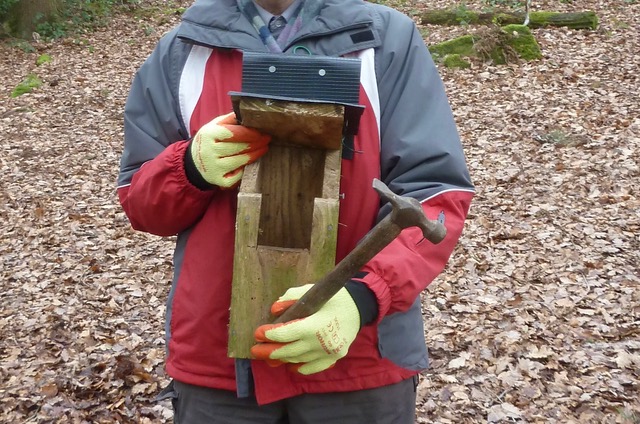
Friends of Adel Woods and a robin nest box
A robin box photographed in January 2019

Robins are well known for finding unusual nest sites – usually low down and well concealed: flower pots, old boots, kettles, toolboxes, farm machinery, hats and coat pockets! They will use nest boxes but rather than a round entrance hole they will only use open-fronted next boxes as shown in the photo above. However, they have not used any of our nest boxes since we put them up in 2009! There are lots of robins in Adel Woods, so they can obviously find lots of suitable nest sites on their own.

Of the three robin boxes we surveyed this year, one was used by a great tit family for nesting, one was used by a grey squirrel for roosting, and one was unused.

Tit boxes

Of the thirty six tit boxes we surveyed, two were unused. Of the thirty four used, one was used by a family of nuthatches, and thirty three by tits. We were not surveying how many nests were used by blue tits and how many by great tits, but we believe that six were used by blue tits, and four by great tits. This is based on hole size of the nest (if the nest hole is 25mm, only blue tits can get through) and size of eggs.

Sadly, not all of the tit nests will have been successful. Two nest boxes contained six skeletons each, one contained three, and one contained one. Eleven nests contained unhatched eggs. Nine of these nests contained one or two unhatched eggs, but two contained five each. It is possible that some of the young fledged from these nests, but it is also possible that the parents were predated and the nests were unsuccessful.

About Friends of Adel Woods

We hope that you have enjoyed reading about our activities and would be delighted if you would like to join us.

Friends of Adel Woods were formed in 2009 to help maintain Adel Woods and encourage people to enjoy them. We meet one weekend morning a month to carry out various jobs or ”work parties”, and we also put on educational events such as bat walks, fungal forays and birdsong walks.

We are a very friendly group and welcome new members who want to help preserve our special woods, enjoy fresh air and exercise in the woods, and make new friends. If you would like to take part in our activities, keep an eye on our Home Page and just come along to one of our work parties.

If you would like to join our email mailing list, please get in touch by leaving a comment on this website – you should be able to see a comment button at the bottom of this page.

Sunday 19th January 2025: surveying and cleaning nest boxes – discoveries and insights

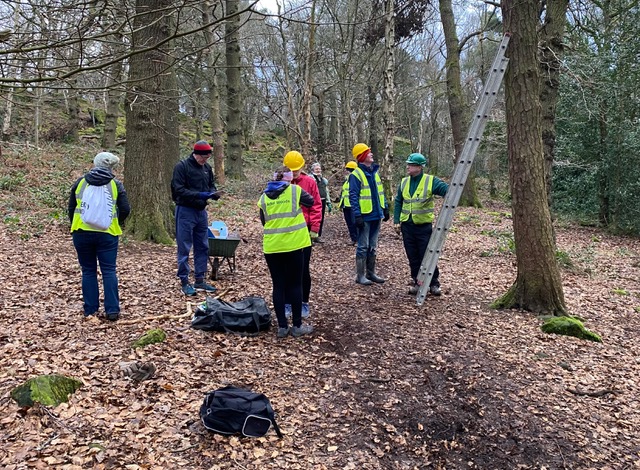
A very, very chilly morning, but ten of us gathered at 9.45 am for the first morning of our annual nest box survey and cleaning session.

The morning

We took our usual route – along Crag Lane, taking the diagonal path into the plantation, cleaning all the nest boxes around the plantation and then heading south back to Crag Lane, and finishing at lunch time with box 53.

As in every previous survey, we found that most of the tit boxes had been used for nesting. The robin boxes had not been used by robins but one had been used by a family of great tits or blue tits – we can tell by the nesting material.

Friends of Adel Woods surveying and cleaning nest boxes on 19th January 2025

Blue tits and great tits both build their nests out of moss, grass, fur, feathers and man made materials – it is common to find in their nests orange, green or white material which seems to come from tennis balls!

As usual we found that the nest boxes were homes not only to tits but also to assorted insects – clothes moth larvae, and woodlice – and spiders.

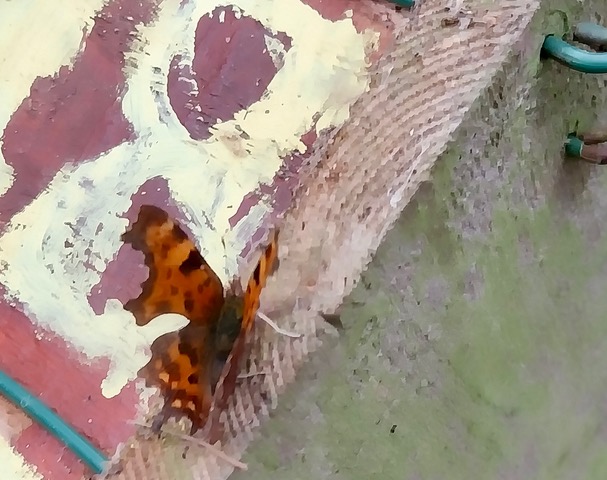
Friends of Adel Woods cleaning nest boxes. A hibernating comma butterfly in Adelj Woods
A hibernating comma butterfly in Adel Woods

We also had a new discovery. As your correspondent lifted one of the nest boxes down from the tree, he saw a leaf stuck to the bottom of it. Fortunately, he did not brush the leaf off the box because the leaf opened up to show a flash of orange and turned out to be a hibernating comma butterfly! The photograph above shows how well the butterfly was camouflaged as a leaf, and the photograph below shows its open wings. Fortunately, the butterfly returned to its state of hibernation and we were able to clean the nest box and replace it on the tree with the butterfly still in place.

The comma butterfly gets its name from the white “comma” shape on the underwing – which can be clearly seen in the photograph above.

A hibernating comma butterfly in Adel Woods
The same hibernating butterfly, sleepily opening its wings

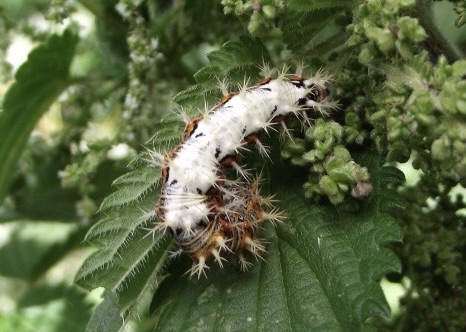
The caterpillar stage of the comma is spectacular as can be seen in the photograph below. We came across this one back in August 2013 during a FOAW task. The white stripe along its back makes it look like a bird dropping.

The caterpillar stage of a comma butterfly photographed in Adel Woods by Friends of Adel Woods in August 2013
A caterpillar stage of a comma butterfly (polgonia c-album) photographed by Steve Joul on 13th 
August 2013

After surveying and cleaning box 53, we took a lunch break from about 1.30 to 2.30 pm.

The afternoon session

Refreshed after lunch, we continued cleaning and surveying the nest boxes along Crag Lane to the picnic area and Adel Crag, and then made our way down the Meanwood Valley Trail, finishing at about 4.45 pm.

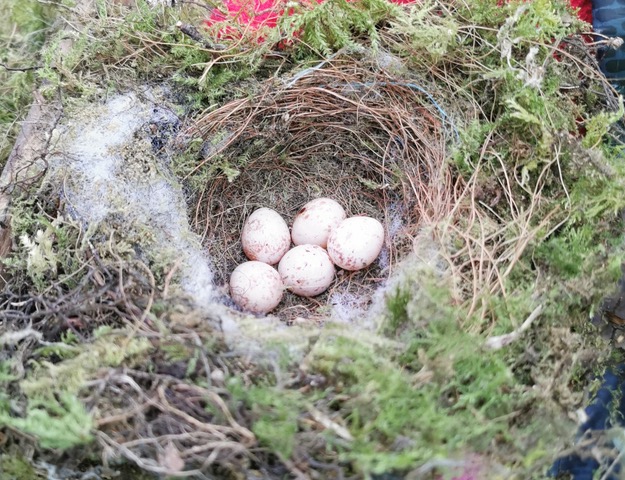
Blue tits lay typically eight to twelve eggs, but sometimes as many as sixteen, one per day! Great tits are larger than blue tits, but lay a clutch of seven to nine eggs. The eggs of both species are similar – creamy white with brown spots – but the great tit eggs are larger.

a tit nest in Adel Woods: Friends of Adel Woods
A tit nest in Adel Woods photographed in the afternoon. Note the moss, grass and grey manmade material

It is common to find one or two unhatched eggs in the nesting material which probably indicates that most of the eggs hatched and the chicks successfully fledged. Sometimes though, as in the photo above, we may find more, which may indicate that the female was predated before laying all her eggs. Sometimes we find skeletons in the nest, indicating that the parents were predated whilst raising their young.

Having made our way down the Meanwood Valley Trail almost as far as the pond, we decided to call it a day in the fading light.

About Friends of Adel Woods

We hope that you have enjoyed reading about our activities and would be delighted if you would like to join us.

Friends of Adel Woods were formed in 2009 to help maintain Adel Woods and encourage people to enjoy them. We meet one weekend morning a month to carry out various jobs or ”work parties”, and we also put on educational events such as bat walks, fungal forays and birdsong walks.

We are a very friendly group and welcome new members who want to help preserve our special woods, enjoy fresh air and exercise in the woods, and make new friends. If you would like to take part in our activities, keep an eye on our Home Page and just come along to one of our work parties.

If you would like to join our email mailing list, please get in touch by leaving a comment on this website – you should be able to see a comment button at the bottom of this page.

Saturday, 18th January 2025: Litter picking and path clearing

A fine morning and nine of us met in the Stairfoot Lane carpark at 10 am – four volunteers for litterpicking and five for clearing footpaths.

Friends of Adel Woods  and six bags of compost dumped in the Stairfoot Lane carpark

Some kindly soul had left half a dozen bags of compost – possibly from a cannabis farm – just over the fence from the carpark. Before we left we emptied the compost into the undergrowth and put the plastic bags in the carpark waste bin.

Litterpicking

Our litterpickers made their way along Crag Lane to Old Leo’s rugby club carpark. They found little litter on Crag Lane or around Adel Crag. However, there was plenty in the Stairfoot Lane carpark and around the rugby club and they picked up about two bags including lots of bags of dog faeces, many bottles and a filled disposable nappy.

A special mention goes to Rowan, our youngest volunteer this morning, who was very enthusiastic and very good at spotting difficult to see bits of glass!

Path clearing

Our path clearers first of all tackled a birch tree which had fallen across the path from the Stairfoot Lane carpark up to the hospice woodland. We then pruned back some holly a little higher up the same path.

Friends of Adel Woods pruning holly on the path from the Stairfoot Lane carpark up to the hospice woodland
Clearing holly on the path up to the hospice woodland

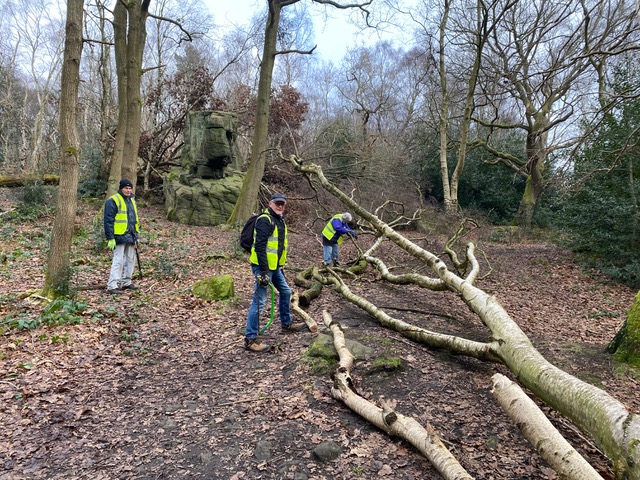
Our next destination was Adel Crag where another silver birch had fallen over between Crag Lane and the Crag. We also took the opportunity to prune some of the scrub in that area.

Friends of Adel Woods clearing a fallen birch tree in front of Adel Crag in January 2025
Clearing a fallen birch tree in front of Adel Crag

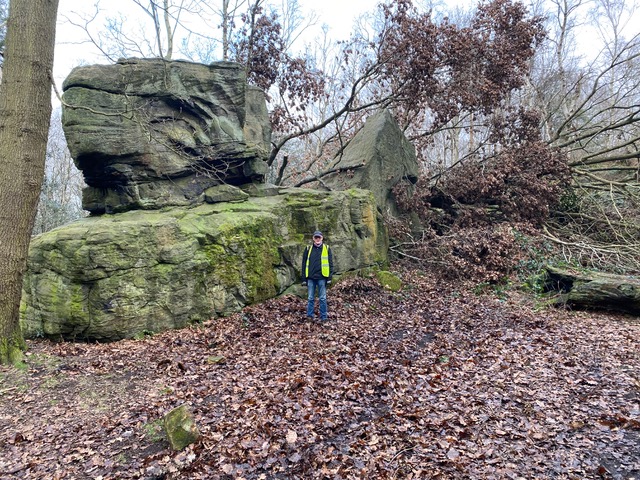
In August Storm Lilian blew two very large oak trees over onto the Crag. The trees are far too big for Friends of Adel Woods to tackle, but we completed our morning’s work by clearing away some of the smaller branches to the side of the Crag.

Friends of Adel Woods at Adel Crag
Adel Crag at the end of our morning’s work

Finally, we cleared away a pallet which had been left by the Crag.

Join Friends of Adel Woods!

We hope that you have enjoyed reading about our activities and would be delighted if you would like to join us.

Friends of Adel Woods were formed in 2009 to help maintain Adel Woods and encourage people to enjoy them. We meet one weekend morning a month to carry out various jobs or ”work parties”, and we also put on educational events such as bat walks, fungal forays and birdsong walks.

We are a very friendly group and welcome new members who want to help preserve our special woods, enjoy fresh air and exercise in the woods, and make new friends. If you would like to take part in our activities, keep an eye on our Home Page and just come along to one of our work parties.

Over the last fifteen years we have picked up over four hundred bags of rubbish – which makes you wonder what the woods would look like today without the loving care our volunteers have given them.

In our first two litterpicks alone in July and August 2009 we picked up fifty three bags of litter plus many things which will not fit into a plastic bag – like a chair and a shopping trolley. You can find our reports here – July 2009 and August 2009.

If you would like to join our email mailing list, please get in touch by leaving a comment on this website – you should be able to see a comment button at the bottom of this page.
Friends of Adel Woods: litterpicking in Adel Woods in July 2009
Our very first litterpick in July 2009