

A fine evening for a bat walk led by our local council ranger, David Preston, ably supported by fellow ranger Toby Amos from Gotts Park in Armley. We had thirty five attendees – twenty six adults and nine children.
We met in Alwoodley Village Green car park at 7.15 pm and, after introductions, David distributed bat detectors and information about the seventeen species of bats which breed in the United Kingdom.
Bats come out at dusk and fly around silently (to the human ear) at great speed. Unless you are a real bat expert, the only way to identify bat species is by using a bat detector.

Bat detectors pick up very high pitched sounds made by bats in flight and convert them to a pitch which humans can hear. Different species of bat make sounds of a specific pitch so that it is possible using a detector to identify the type of bat you can see whizzing through the air above you.

Armed with our bat detectors, we made our way along Crag Lane to Old Leo’s Rugby Club’s car park. Here David gave us some tuition on how to use the bat detectors.

Bats are able to see, but do not have very good night vision, so they use send out regular high pitched shouting sounds which we can’t hear and use the echos that come back from the objects around them to navigate their way through the trees and around their local area, and hunt for insects while flying. This is a process called echo-location and it is the high pitched shouting sounds which bat detectors pick up. There are various types of bat detector and we were using ones which you can adjust to different frequencies to identify bats in the vicinity.

From Old Leo’s we made our way into the woods to look at some bat boxes put up by Friends of Adel Woods In January 2010. While having a look at the bat boxes, we got our first clicks from some of the bat detectors, but we were unable to spot any bats flying around.
Bats don’t build a nest but find somewhere they can roost or raise their young in holes in trees, caves or buildings – or in tailor-made bat boxes. Bat boxes are different from nest boxes for tits and sparrows in that they don’t have a hole in the front. Instead, there is a thin slot in the bottom of the box and bats land below and crawl up into the box through the slot.
Having said the above, bats will sometimes roost in bird nest boxes. A few years ago, when Friends of Adel Woods were cleaning and surveying our nest boxes, we were amazed to find a noctule bat hibernating in one of them. We were even more surprised the following year to find a noctule bat – presumably the same one – hibernating in the same nest box. On each occasion we immediately closed the box and put it back up causing as little disturbance to the bat as possible.

From the bat boxes we made our way along Crag Lane to the picnic area where we got our first clear clicks from the bat detectors and sightings of bats in flight. It is always an exciting moment to hear the bat detectors start to click away and spot a bat flitting to and fro as it hunts for insects around the canopy of the trees. A pipistrelle bat will eat 3,000 tiny insects in a single night and it is awe-inspiring that it catches these insects using only sound echos to identify where they are, their size and shape, and their direction of travel.

From the picnic area we made our way to Adel Crag, where we saw and “heard” more bats.
An interesting fact about Adel Crag, is that the sculptor Henry Moor said that the landscapes which most influenced his work were the slag heaps of Castleford and Adel Rock. Today the Crag’s magnificence was partly obscured by a huge oak tree which had fallen over it, blown over by the recent Storm Lilian.
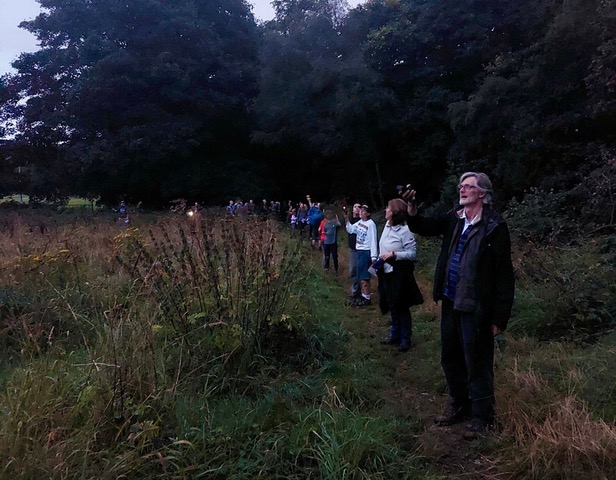
From the Crag we made our way back to the picnic area, along Crag Lane and around the disused rugby pitch, where we spotted more bats. Finally, we went down to the cricket pavilion before returning to the Village Green car park at about 9.10 pm.
On our journey through the woods we detected four different species of bats: pipistrelle; soprano pipistrelle; Nathusius’s pipistrelle; and noctule, our largest species. Nathusius’s pipistrelle is a surprise: the Bat Conservation Trust say that Nathusius’s pipistrelle is a rare bat in the UK though its numbers have increased in recent years.
All in all it was a very enjoyable and exciting evening, and we are grateful to David Preston and Leeds City Council for making it possible – and grateful to all our enthusiastic participants.
ABOUT FRIENDS OF ADEL WOODS
Friends of Adel Woods were formed in 2009 to help maintain Adel Woods and encourage people to enjoy them. We meet one weekend morning a month to carry out various jobs or ”work parties”, and we also put on educational events. We are a very friendly group and welcome new members who want to help preserve our special woods, enjoy fresh air and exercise in the woods and make new friends. If you would like to take part in our activities, just come along to one of our work parties or get in touch by leaving a comment on this website – you should be able to see a comment button at the bottom of this page.
Our next events
Have a look at our Home Page for details of our next work party
Our next educational event will be on Sunday the 29th September 2024 from 2 pm to 4 pm when local naturalist Steve Joul will be leading a fungal foray. Please note, this is not an event for collecting mushrooms to eat, but an opportunity to learn about the many species of fungi to be found in Adel Woods.
 Friends of Adel Woods