
Time again to get the ladders out, get out in the woods, and clean and survey the Friends of Adel Woods nest boxes! We have put up forty three since 2010 and surveying them is always an interesting and sociable activity.
Despite a dire weather forecast for today, the weather started off quite reasonably and got better and sunnier throughout the morning. Eight of us turned out for this morning’s start on the job, and five of us returned for the afternoon shift.
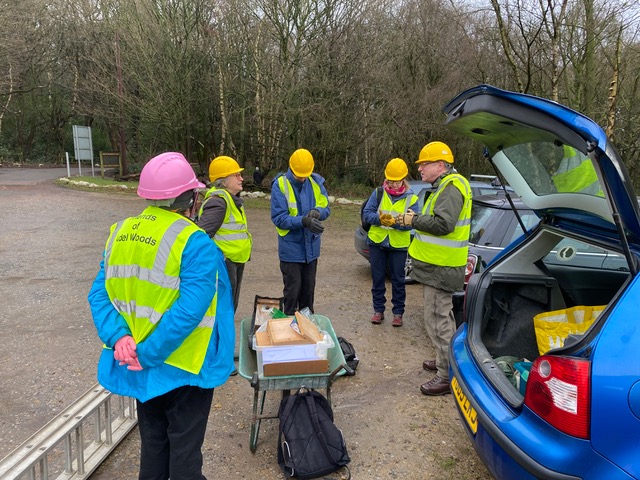
We met in Old Leo’s car park at 10 am and, led by Steve Joul our wildlife adviser, we set off into Alwoodley plantation.

Our first job was to put up a new bat box which we had been given by two of our Friends.
We put up seven bat boxes in 2010 to provide shelter for bats to roost in over the Summer months, and hopefully hibernate in over the Winter.
We are not allowed to have a look inside the bat boxes, but one fell off the tree a couple of years ago and this was a good opportunity to replace it.
If you look at the photo, you will see that bat boxes are very different from tit boxes: there is no entrance hole on the front! Bats enter the box by landing on the wood protruding downwards beneath the box and then crawling up into the box through a slit in the bottom. So you can see that bats powers to negotiate the environment by echo-location are truly astonishing.
You can also see that there are bat boxes on the left and right hand side of the tree. This is because bats are sensitive to temperature, and we put the boxes on different sides of the tree so that they can choose the one that suits them best.
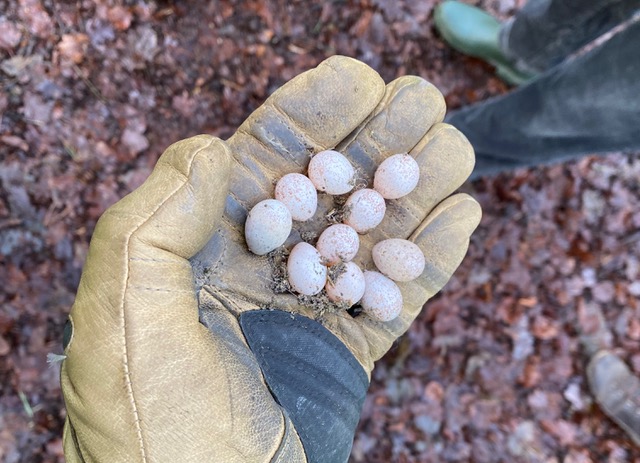
Having put up the bat box we headed further into Alwoodley Plantation, our first stop being nest box 5 on a Scots pine near the Devil’s Rock. This contained a nest but there were ten unhatched eggs of various sizes. We measured them and came to the conclusion that they were probably great tit eggs. We’ll never know what happened, but presumably the parents were taken by predators. As you can see the eggs are very small, and it is a source of wonder that in a matter of weeks great tits (or blue tits) can develop into fully adult birds from such small beginnings.


There is always plenty to do on the nest box surveys: Steve carries the ladder; one of us pushes the wheelbarrow loaded with all the tools which are needed to clean and, if necessary repair, the boxes; one of us (usually Steve or yours truly) climbs the ladder to bring the nest boxes down to the ground. We then take it in turns to open the box, and clean it before returning it to the tree. One of us makes a note of what we find, and one of us scouts around to find the next nest box: sometimes it can be very hard to find them and occasionally we don’t!
At about 12.50, having surveyed sixteen nest boxes, we decided it was time for a lunch break and we headed back to yours truly’s home to eat our sandwiches, and have a cup of tea and a piece of cake.
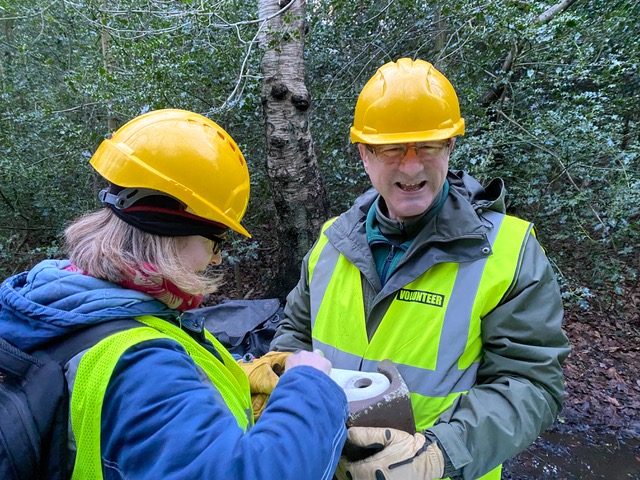
Duly replenished, we were back in the woods by 2.30, when we surveyed two nest boxes on Crag Lane, and then made our way down the Meanwood Valley trail from the picnic area down to Adel Pond – surveying another seven nest boxes until dusk arrived and it started to rain and hail!

In summary, today we surveyed twenty five nest boxes. Twenty one of these were tit boxes and four were robin boxes.
Of the twenty one tit boxes, all had been used for nesting except for one which had fallen off the tree. We cannot say that all of the nests were successful. Some clearly were as the nest looked used and was empty. Some had one or two eggs left in the nest and the assumption is that the other ten or so eggs hatched and the youngsters fledged. As reported above, the first nest box we surveyed contained ten unhatched eggs. Another nest box contained the macabre remains of eleven chicks. Presumably their parents were predated.
Turning to the robin boxes, the RSPB website says this about robin nesting habits:
“Most nests are located on or near the ground in hollows, nooks and crannies, climbing plants, hedgebanks, tree roots, piles of logs and any other situations which provide a fully concealed cavity.
“If a nestbox is provided to attract robins, it needs to be open-fronted, and placed in a hidden location in a climber or other such vegetation. Robins are famous for nesting in all kinds of unlikely locations, including sheds, kettles, boots, hanging baskets, coat pockets, under car bonnets, in farm machinery, even on boats in daily use.“
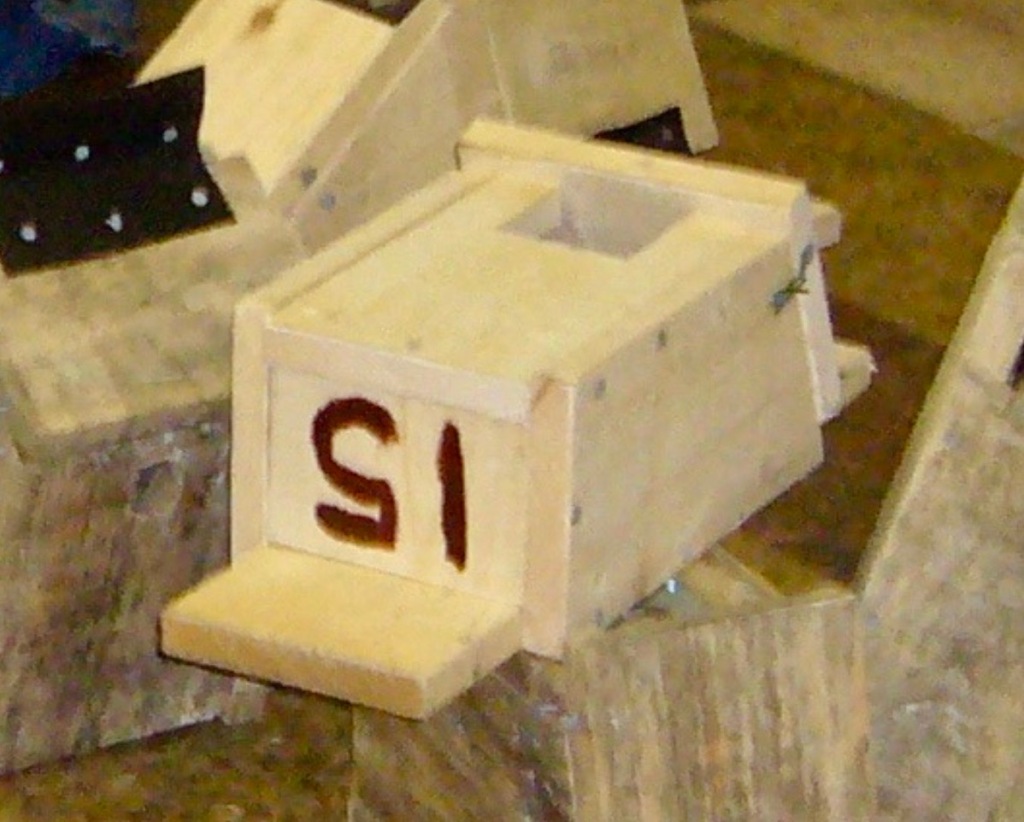
Robin nest boxes differ from tit boxes in that they have a large entrance – as shown in this photo taken when nest box 15 was made.
Clearly a nest box like this is very easy for a predator, such as a squirrel, to enter, so when we put them up in January 2010 we placed them on tree trunks a couple of feet off the ground in the middle of holly bushes. Two unintended consequences of this are (a) that they are very painful to reach to survey and (b) we have never been able to find one of the robin boxes which we put up!
None of the robin boxes have been used by robins for nesting. Occasionally, over the years they have been used by tits for nesting.
This year, two of the robin boxes contained a mass of oak leaves showing that they had been used by squirrels for roosting.
It was a very satisfying and enjoyable day, but yours truly was glad to get home and have a hot bath!


 Friends of Adel Woods
Very interesting, I didn’t know about all the different types of nest boxes for different birds and bats