
This morning, a small crack team, which you could call “the orchid squad”, completed the raking of the grass mowings from the orchid meadow. This was a job which FOAW began on Sunday 22nd August. Despite light drizzle in the early morning, it was a pleasant dry day.

Why mow and rake the orchid meadow?
By mowing and raking the meadow, we maintain a wide variety of wild flowers which are the fabric which supports much of our wildlife.
Whilst the orchid meadow is not mown for hay, we are following the traditional management cycle of hay meadows to promote the abundance of wildflowers, particularly the population of common spotted orchids.
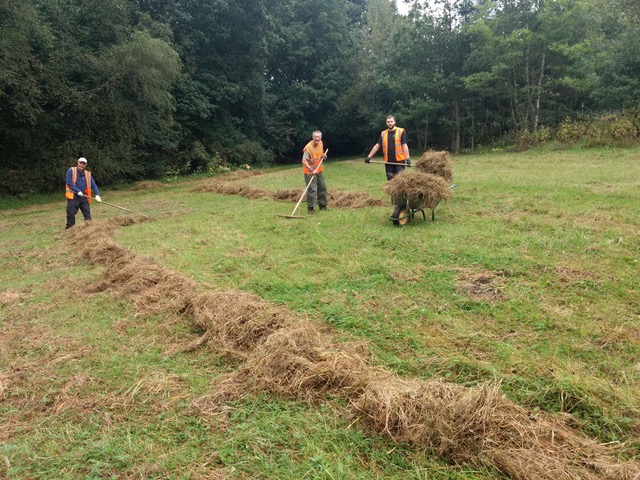
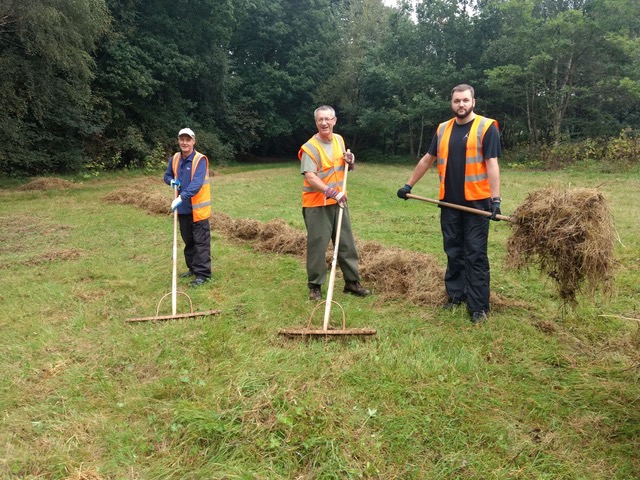
The annual management of a hay meadow begins in March when the livestock is excluded from the meadow. Then, through the spring and early summer, various species of wildflowers will bloom in succession. The wildflowers all depend on the ability to set seed to create new generations of plants.
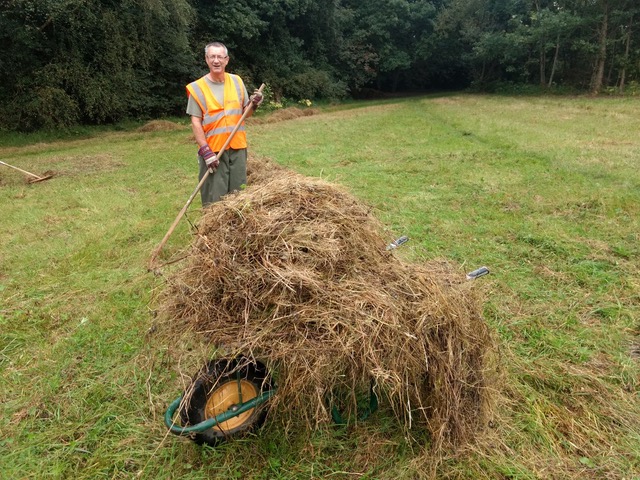

Hay is usually cut in July to September, depending on the type of wildflowers present and the weather. Changing the time of year, rather than cutting at the same time each year is beneficial for a hay meadow. So is leaving unmown strips along the edges of fields.
If hay is being made, the mowings are laid in rows to dry and then turned at least once a day to dry the crop. This also may shake out any wildflower seed which may remain in the flower heads. When the hay is dry, after three to five days, it is bailed and taken away for storage.
A few weeks after haymaking, livestock may be let onto the meadow for grazing and the cycle eventually begins again. Friends of Adel Woods don’t have any livestock unfortunately!
For more information about haymaking, in a very readable article, see Save our Magnificent Meadows.
 Friends of Adel Woods