
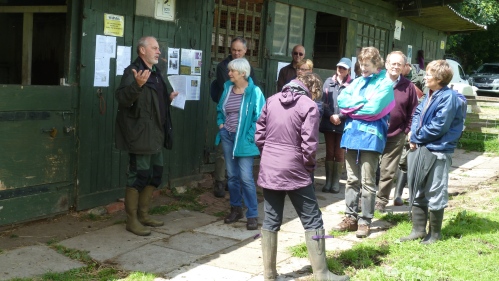
 Thank you to Alan and Diane Yarker who welcomed Friends of Adel Woods to their smallholding today – to mark National Meadows Day.
Alan gave us an interesting talk about aspects of running a smallholding, and management of a meadow in the traditional way to encourage bio-diversity. In the course of his talk, Alan told us about a very interesting website “Tracks in Time” at http://tithemaps.leeds.gov.uk/TwinMaps.aspx?township=WYL333_334 which enables us to compare historic maps with modern day maps – it is very interesting to see how Alwoodley and Adel have changed over the years.
Unlike last year, when the temperature was very cold, and rain almost horizontal, the heavens confounded the gloomy weather forecast with a beautiful afternoon.
After the talk we were free to wonder around the smallholding and Steve and Alan took us on a tour of the meadow to have a first look at the wildflowers. What appeared from a distance to be a field of grass contained a treasure trove of wildflowers. Your correspondent is no expert, but can confidently tell you that among other plants in this picture you can see white clover, red clover, cats-ear, birdsfoot trefoil, mouse-ear, common sorrell, yorkshire fog and crested dogstail. There may well be some smooth hawksbeard and plantain too.
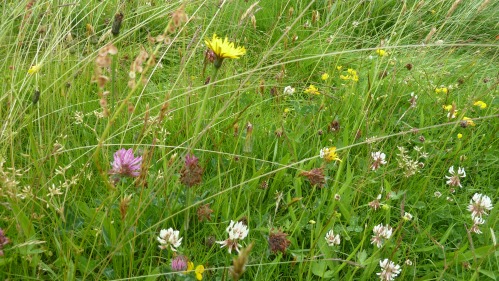
One of the “stars” of the meadow is the population of common spotted orchids which have been increasing in recent years.
After a cup of tea and biscuits provided by Steve Joul, Steve led a group of us in an initial survey of the meadow. The first step is to choose an area of the meadow at random and stake out a quadrat – an area two metres by two metres. The next step is to note the range of flora we can see within the quadrat, and finally to estimate what percentage of the quadrat is taken up by each species of plant.
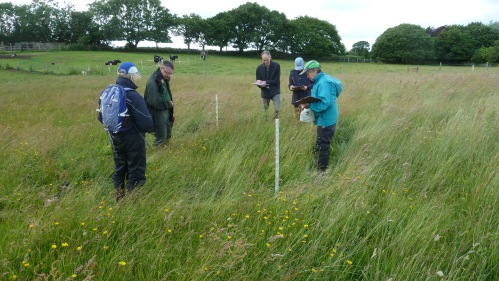
Ideally we would have surveyed ten quadrats, but we had time for only two. However, each of our quadrats contained about twenty species of plant.
Having completed our survey of the quadrats, we quickly counted the common spotted orchids and were able to delight Alan with the news that there were at least 123!
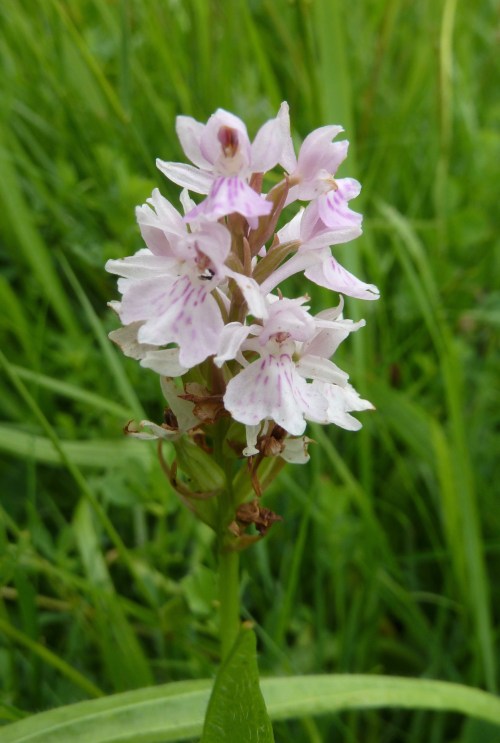
Common Spotted Orchid
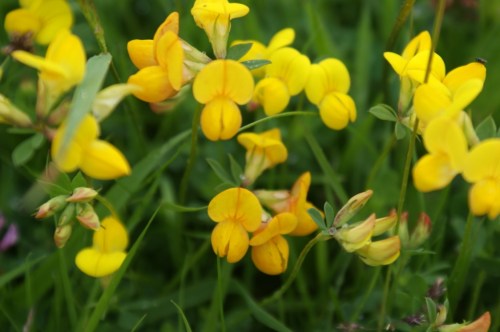
Birdsfoot Trefoil
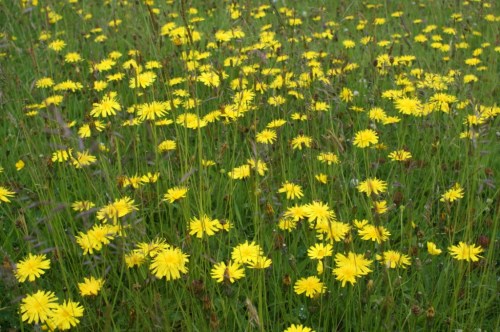
Cats Ear
 Friends of Adel Woods