
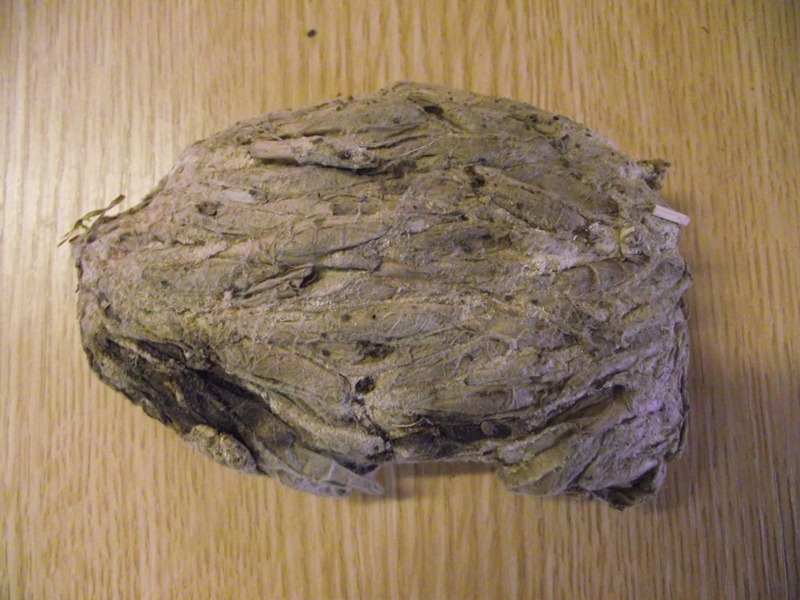
The fibrous mass found in a robin nest box
Our readers might be interested in the following exchange between your correspondent and Steve Joul in relation to the strange fibrous mass found in one of the robin nest boxes.
 Steve Joul: I thought you would be interested to see my photos of the wax moth cocoons and a larva that popped out on my desk
Response: Is the lump of brown stuff in the pictures the stuff that was in our nest box?
Steve Joul: Yes, I think it is an accumulation of the silken cocoons of the Bee Moth. It could possibly be the Wax Moth or the Lesser Wax Moth I’m not definitely sure but the Bee Moth is most likely to live with Bumble Bees.
It’s clearly meant to be communal (the cocoons are joined together into a mat) and very tough to penetrate (I could not tear it). This was on the underside of the lid of the nestbox.
It was also originally surrounded by a silken web which I believe was produced when the larvae were feeding on the nest to protect them from the bees which might otherwise remove them from the nest. I believe the caterpillars eat everything in the nest including the wax nest, food stores, dead bees etc.
Usually weak or failing colonies without a queen are most susceptible apparently. The adult moths detect the bees by scent then lay their eggs, about a hundred from what I’ve read.
A quick google reveals that the two Wax Moths are the scourge of bee keeper. I believe it is most commonly the Lesser Wax Moth which lives with Honey Bees but usually not Bumblebees.
There is confusion over the correct identification of the species which are very similar.
I read that the Wax Moth caterpillars can eat the caterpillars of the Lesser Wax Moth.
I’ve also read that the Wax Moth will eat diseased parts of the hive, removing it and stopping the disease from spreading and so has sometimes been useful in commercial beekeeping. This was apparently the case when it was introduced to New Zealand when the incidence of disease was reduced. So, there is sometimes disagreement about whether having Wax Moths living with the bees is a good or a bad thing.
 Friends of Adel Woods