
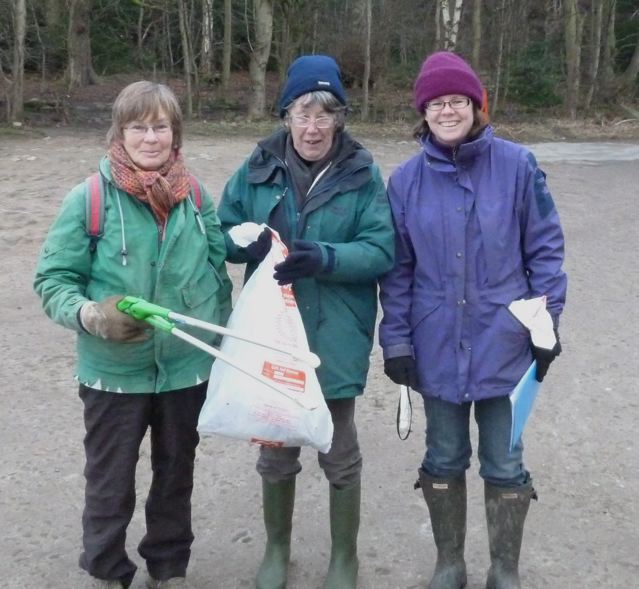
 Four of us met in Old Leo’s car park to join Steve Joul in surveying and cleaning the FOAW nest boxes.
Unfortunately, Steve’s new land rover had a flat battery which meant he could not bring the necessary ladders. Undeterred, we decided to clean the robin boxes which are all at low level – two or three feet from the ground –  and concealed in the middle of holly bushes.
Midway round we were joined by David.
Robin nest boxes are different from tit boxes in that robin boxes have an open front while tit boxes have a round hole for the entrance.
 We have put up five robin boxes and, for the first time ever, we were able to find all five of them! One particular nest has eluded us ever since we put it up and we found it entirely by chance this year when picking up a piece of litter: there, five feet away in the middle of a holly bush was the elusive box. The fault was that of your correspondent whose map making skills clearly need to be improved. However, the map has now been updated to show the correct position of the nest box.
The results were as follows (the boxes having numbers which follow no particular order):
Box 6: nest and two unhatched eggs —— Box 9: nest
Box 15: not used —— Box 19: strange contents – see below
Box 31: not used, but something had chewed the lip of the entrance.
The nests were tit nests rather than robin nests.
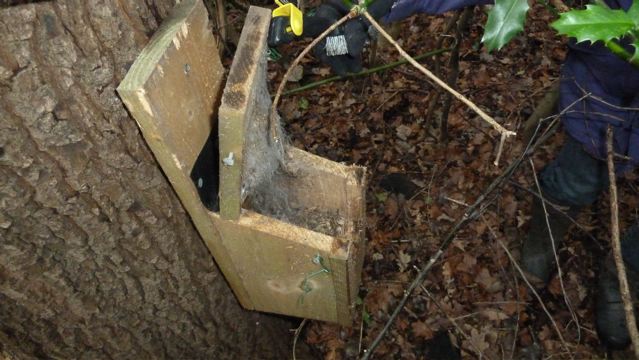 The contents of box 19 were very unusual: a kind of fibrous mass was attached to the inside of the lid and the inside of the box, covered in cobwebs, and lots of leaves and dead bees in the bottom of the box. It was so unusual that we decided not to clean that box but leave it for Steve to have a look at when we surveyed the rest of the boxes later in the month.
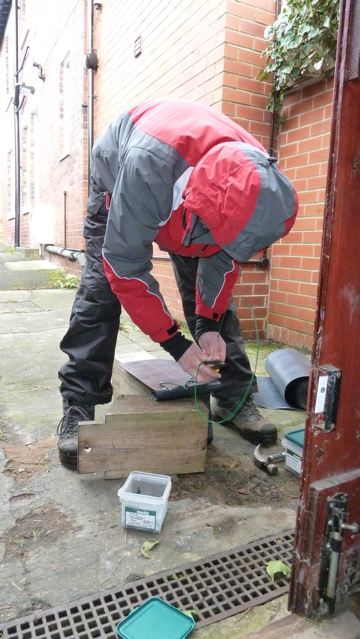 At the end of the morning, David joined your correspondent to help refurbish a couple more nest boxes.
 Friends of Adel Woods