
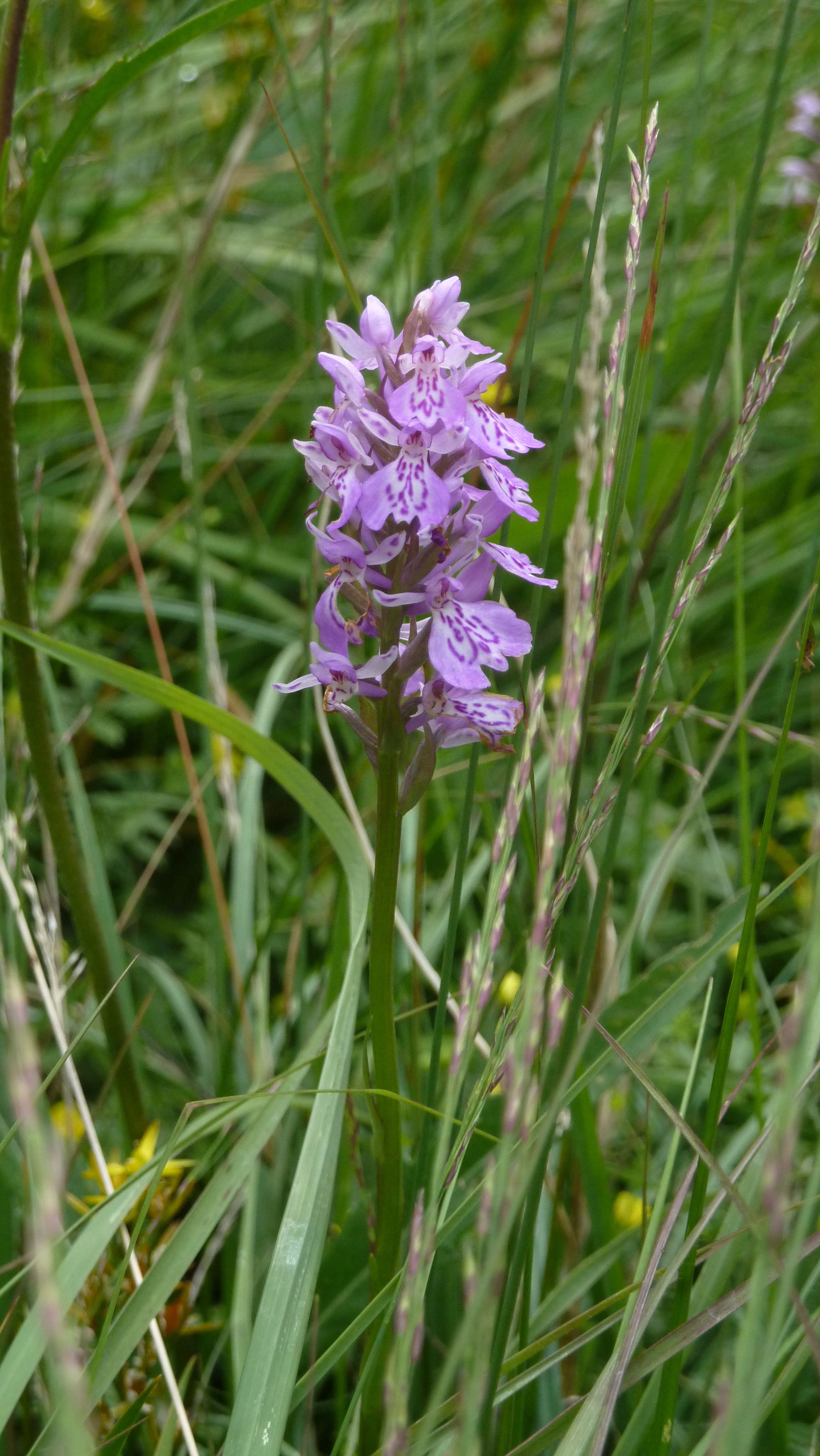
Heath Spotted Orchid,
Adel Bog, 29 July 2012
NB If you click on any of the thumbnail photographs in this report, you will see a larger version of the picture.
A crack team of seven met Steve Joul in Old Leo’s carpark to carry out a survey of the flora in Adel Bog. The bog is the only known site where the heath spotted orchid can be found in Leeds, though the population has declined over the years as the Bog has been taken over by purple moor grass (molinia cerulea) and trees.
Having explained how the survey is carried out, Steve led us down to the Bog, pausing to have a look at various plants and places of interest – including the pond where in the clear water we were able to see a number of newts swimming around. We also heard a toad calling from a patch of vegetation in the pond.

Adel Bog
28 April 2010
Steve last surveyed the Bog in August 2007 – before FOAW had even been imagined (we came into existence in July 2009). Since then a large amount of work has been done on the Bog. In August 2011 the British Trust for Conservation Volunteers did a lot of work funded by Alwoodley Parish Council in removing a large amount of the purple moor grass, whilst leaving areas where we knew that there were heath spotted orchids. Since then FOAW have built on BTCV’s work by removing invasive trees and brambles.

Q1: north east of bog
To your correspondent’s untutored eye the Bog is looking a lot better than in 2009. A large area of the Bog is clear of molinia and it is undoubtedly a lot wetter than before the work carried out by BTCV. There are lots of rushes which were not there before. But what would the survey show?

Q2: east end of Bog
We surveyed ten quadrats. A quadrat in this case is an area approximately 1 metre x 1 metre in area and marked out by canes. We chose areas from different parts of the Bog by throwing a cane towards the area we wanted to survey and putting the quadrat where it landed.
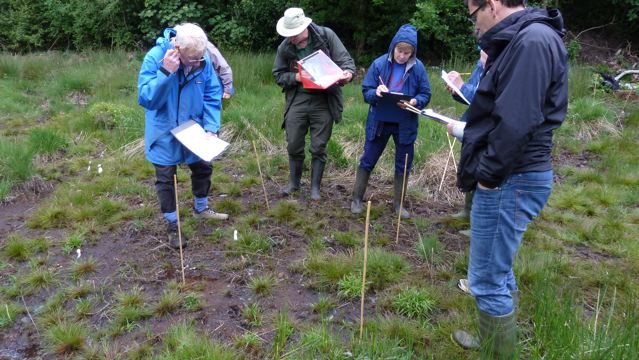
Q3 central area of Bog
We started at the north east end of the Bog (top right looking towards the top of the Bog), moved down the eastern side and then across the central area of the Bog to the western end, and then finished with the north west.
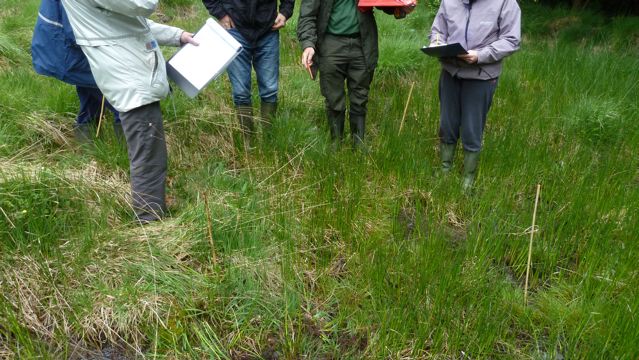
Q4: central area of Bog
As we carried out our survey, it was clear that there were many more rushes than pre 2011. There were also many potentilla erecta (tormentil) and young bog asphodels (narthecium ossifragum) both of which are good plants to find in a bog. We did not see any heath spotted orchids, but with the long cold winter everything is about a month behind this year (the hawthorn is only just reaching its peak at the moment).
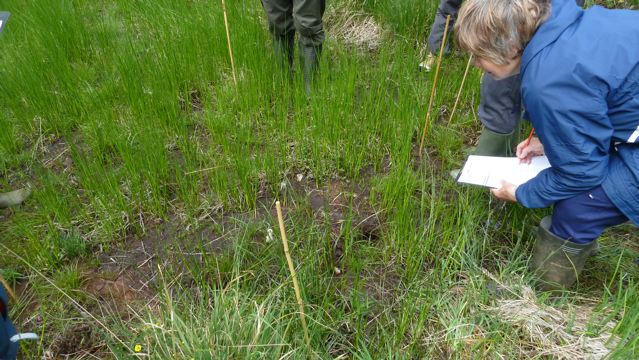
Q5: towards west of Bog
It was interesting that there were a couple of patches of cotton grass which we do not recall seeing in the bog before. There were also numerous hoof prints of roe deer – so perhaps one of our events will be to sit quietly in the woods one morning to see what turns up!

Q7 western end of Bog
Having completed our survey at about 1 pm we returned to Old Leo’s and sat at a picnic table, collated our data and compared it with the data from 2007.
The data was very interesting. The molinia covered about 80% of the area surveyed in 2007, but – not surprisingly – was a lot less significant this year.

Q8 west end of Bog
Further information will be published shortly, but the general indications were that the habitat is now a lot more varied than before 2011 and the true bog plants are beginning to return.

Q9 north west of Bog
FOAW have two mornings of work programmed in for July and August this year when we shall hopefully be able to survey the heath spotted orchids.

Q10 south east of Bog
We took the opportunity to assess the work to be done and there is plenty to do – bracken bashing, removal of tree seedlings, removal of brambles and removal of overhanging trees. However, your correspondent is optimistic that with hard work and dedication Adel Bog will eventually be restored to being a unique and valuable habitat in Adel Woods.
PS There is no picture of quadrant 6 because your correspondent became preoccupied with photographing a large and interesting spider.
 Friends of Adel Woods