
Birds are starting to sing at about 4.15 in the morning at this time of year, so we didn’t quite start with the lark, but fifteen enthusiastic Friends joined Steve at 7 am for our annual bird song walk. The weather was fine but chilly.
We had a very good start in Old Leo’s carpark with a good view of a female sparrowhawk flying overhead – long enough for us to get a good look through binoculars.
We set off along Crag Lane towards King Lane, and turned left into the Plantation just before the cottage. Having climbed the hill we turned to the left through the beech woodland to have a look at the hospice woodland, and then descended by Adel Crag to Crag Lane. [report continues after photo!]

Listening to birdsong in Alwoodley Plantation
At this point (8.30am), some of our party repaired home and the rest of us went down the Stairfoot Lane steps to Adel Beck. We then followed the path along the stream to the Slabbering Baby and then returned to the carpark via track alongside the cricket pitch.

Steve points out interesting plants along Adel Beck
In all we saw or heard nineteen species of birds – not bad for a short walk over about two and a half hours.
The species we heard – in no particular order – were: robin; nuthatch; wren; blackcap; chaffinch; chiffchaff; coaltit; great tit; blue tit; blackbird; woodpigeon; willow warbler; and great spotted woodpecker. We saw most of these species too but did not see the blackcap, coaltit, willow warbler or great spotted woodpecker.
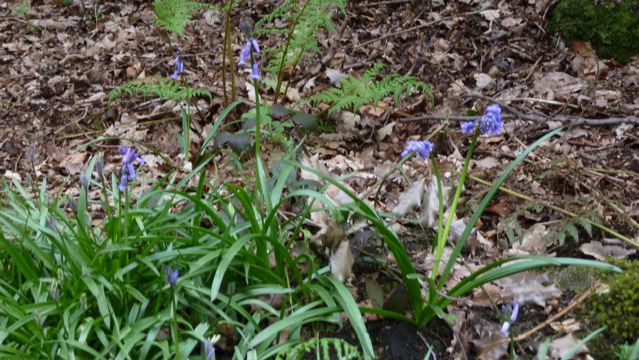
Early bluebells near Adel Beck
We saw, but did not (consciously) hear magpies; carrion crows; jays; dunnocks; a tree creeper and the female sparrow hawk. Hats off to Ade who was very good at spotting movements in the trees.
The main singers (in your correspondent’s opinion) were robin, wren, great tit, blue tit, chiffchaff, chaffinch and blackcap.
It was your correspondent’s suggestion that we go down to Adel Beck – in the hope that we would hear a different range of birds because it is probably the most secluded part of the woods, and free from traffic noise.
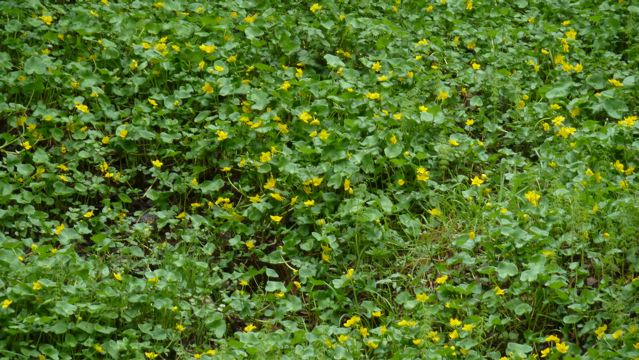
A mass of marsh marigolds by Adel Beck
However, whilst it is absolutely beautiful with the sound of the babbling brook and there is an interesting range of plant life, your correspondent was slightly disappointed that the birdsong was fairly predictable – robin, wren, tits and chaffinch. However, we did see a pair of dunnocks there.
Thanks are due to Steve Joul for once again leading a very enjoyable, interesting and educational walk.
If you can recognise birdsong, it undoubtedly adds greatly to awareness of what is going on around you and to the enjoyment of the woods. The starting point is probably to learn the songs of the half dozen most common birds in Adel Woods – the robin, blackbird, wren, chiffchaff, and great and blue tits. Once you have mastered these, it becomes a lot easier to pick out new songs.
If you want to learn more, Simon Barnes has created an excellent podcast called “Birdwatching with your Eyes Closed” which you can download free on iTunes. In this podcast he plays the song of sixty six birds and gives long and clear examples of each which makes it easier to hear and recognise the songs. Simon Barnes writes on nature for the Times and has written a book of which goes with the podcast and a number of readable and informative books like “How to be a Bad Birdwatcher: to the Greater Glory of Life”.
 Friends of Adel Woods